

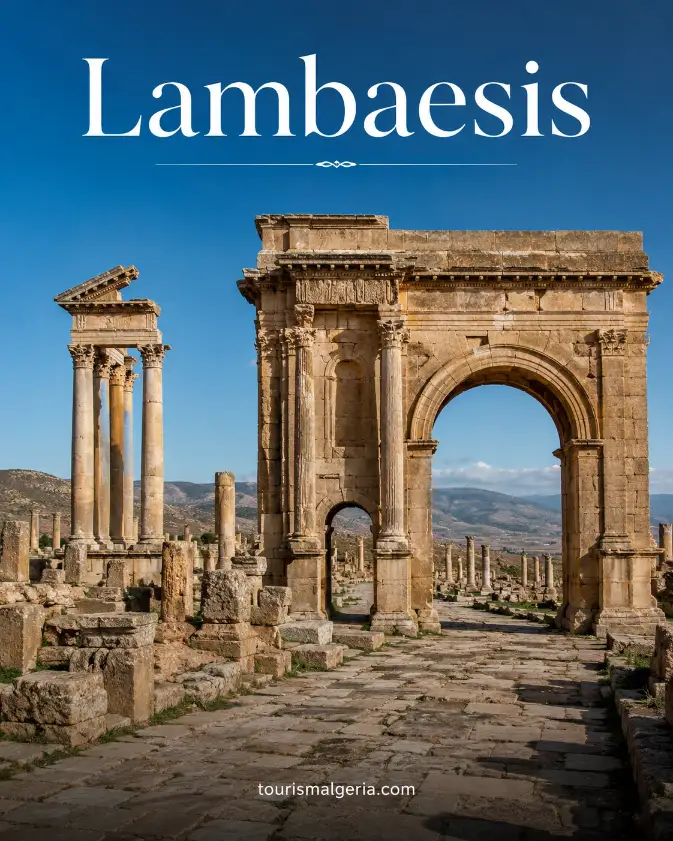
Lambaesis Roman Ruins in Tazoult, Algeria
Lambaesis, also known as Lambèse or Lambaesa, is a Roman archaeological site near modern Tazoult in Batna Province, famous for the remains of a major legionary camp and military city linked to the Legio III Augusta.
Why Visit Lambaesis
A visit to Lambaesis is useful for travellers who want to understand Roman Algeria from a military angle, because the site was not only a civilian settlement but also one of the most important Roman army bases in North Africa.
Where Lambaesis Is Located
The ruins are located near Tazoult, around 10 to 11 kilometres southeast of Batna and about 27 kilometres west of Timgad, making the site practical to combine with Batna, Timgad and the wider Aurès heritage route.
Lambaesis and the Legio III Augusta
Lambaesis is especially important because it was the headquarters of the Legio III Augusta, the Roman legion responsible for securing large parts of Roman North Africa and controlling routes between the highlands, Numidia and the Sahara-edge zones.
A Roman Military City Near Batna
Unlike Timgad, which is often admired for its urban grid, Lambaesis is mainly known for its military character, including camp structures, administrative remains, inscriptions, arches, public buildings and traces of the Roman army’s long presence in the region.
Tazoult and the Ancient Site
Modern Tazoult stands close to the ancient remains, so visitors should understand that Lambaesis is both an archaeological site and a place shaped by later settlement, reuse of stone, road access and changing local history around Batna.
What Visitors Can See at Lambaesis
Visitors can see the remains of a Roman praetorium, large arches, columns, foundations, temple areas, inscriptions, streets, military structures and scattered stone blocks that reveal the scale of the ancient camp and surrounding settlement.
The Roman Praetorium
The praetorium is one of the most recognisable monuments at Lambaesis, with its large arched structure still standing as a powerful reminder of Roman military administration and the architectural ambition of the legionary headquarters.
Inscriptions and Military Memory
Lambaesis is important for epigraphy because Roman military sites often preserved inscriptions connected to emperors, soldiers, dedications, construction works and official life, helping historians reconstruct the administrative and army history of Roman Numidia.
The Camp of the Legio III Augusta
The ancient legionary camp gives the site its strongest identity, because it shows how Rome organised military power in the interior of North Africa, far from the coast but close to strategic mountain and steppe routes.
Lambaesis as a Visit from Batna
Lambaesis is an excellent heritage excursion from Batna because it can be combined with Timgad, the Aurès landscapes, Tazoult, local museums and other Roman remains in a route focused on eastern Algeria’s archaeological depth.
Best Time to Visit Lambaesis
The best time to visit Lambaesis is usually spring or autumn, when temperatures are more comfortable for walking through open ruins, taking photographs and exploring exposed stone remains without the strongest summer heat.
How Long to Spend at the Site
A focused visit can take one to two hours, but travellers interested in Roman military history, architecture, inscriptions and photography should allow more time, especially if Lambaesis is combined with Timgad on the same day.
Practical Travel Tips
Visitors should wear comfortable shoes, bring water, avoid the hottest hours, use a local driver or guide if needed, and remember that the site can be harder to interpret than more complete Roman cities without historical context.
Main Highlights of Lambaesis Roman Ruins
- Legio III Augusta Headquarters
The strongest reason to visit Lambaesis is its connection with the Legio III Augusta, one of the key Roman military forces in North Africa. - Roman Praetorium
The standing arched structure is the most impressive visible monument and gives the site a powerful military and administrative identity. - Military Camp Remains
The camp remains help visitors understand how Roman soldiers lived, worked and controlled movement through the region. - Ancient Inscriptions
Inscriptions are important at Lambaesis because they preserve names, dedications and official traces of Roman military life. - Temple and Public Building Traces
The ruins include remains associated with public and religious life, showing that the site developed beyond a simple army camp. - Columns and Stone Blocks
Scattered columns, bases and blocks reveal the scale of the ancient settlement and the later fragmentation of the site. - Connection with Timgad
Lambaesis can be visited with Timgad, creating a strong itinerary that compares Roman military organisation with Roman urban planning. - Aurès Mountain Setting
The landscape near Batna and the Aurès gives the ruins a strong geographic context, connecting Roman history with eastern Algeria’s highland routes. - Quiet Archaeological Experience
The site is suitable for travellers looking for a less crowded Roman ruin and a more specialised heritage experience. - Roman Algeria Beyond the Coast
Lambaesis shows that Roman Algeria was not limited to coastal cities, but also included military, administrative and strategic centres deep inland.
How to Use This Page Before Visiting Lambaesis
Travellers should use this guide to plan transport from Batna, combine the visit with Timgad, prepare for open-air walking, prioritise the praetorium and camp remains, and understand the military importance of Lambaesis before arriving.