


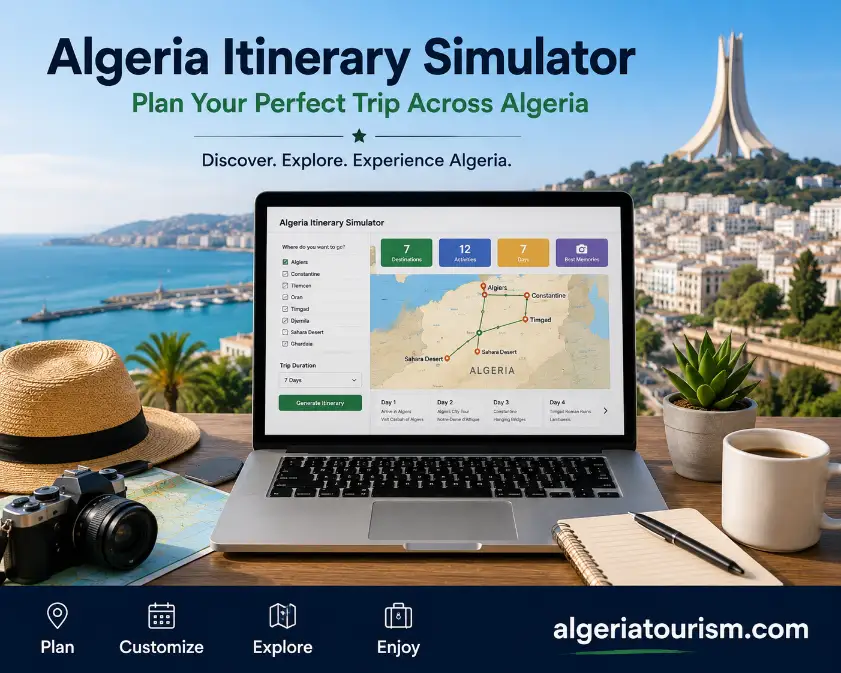
Algeria Itinerary Simulator for 3 days, 5 days or 7 days: plan Your Algeria Trip by City, Desert Route, Coast, Roman Ruins and Travel Duration
An Algeria itinerary trip planner for 3days, 5 days, 7 days simulator is a travel-planning tool that builds day-by-day routes across Algeria by using trip duration, arrival city, interests, transport, visa needs and season to organise realistic visits to cities, UNESCO sites, beaches and Sahara destinations.
What Is an Algeria Itinerary Simulator for 3, 5 or 7 days?
An Algeria itinerary simulator helps travellers design a realistic route before visiting Algeria. It converts travel preferences into a structured programme with cities, daily visits, transport logic, overnight stops and practical timing.
The simulator is especially useful because Algeria is very large. A good itinerary cannot simply place Algiers, Oran, Constantine, Djanet and Tamanrasset together without checking distances, flights, seasons and regional access.
ALGERIA’S ITINERARY ONLINE SIMULATOR
Who Should Use an Algeria Itinerary Simulator?
An Algeria itinerary simulator is useful for first-time tourists, travel agencies, bloggers, tour operators, families, business travellers adding leisure days, and visitors who want to compare cultural, coastal, historical or Sahara routes.
It also helps travellers decide whether their trip should focus on one region, combine two nearby areas, or include a long-distance extension by domestic flight.
How the Algeria Itinerary Simulator Works
A good Algeria itinerary simulator begins with essential travel inputs, then matches them with realistic destination clusters. It should not only list famous places, but also organise them in a logical travel order.
The simulator must consider geography, transport, visa requirements, season, local access and travel pace. This makes the final itinerary more useful than a simple list of Algerian attractions.
Main Inputs for the Simulator
The main inputs should include arrival date, departure date, arrival city, departure city, travel style, preferred theme, transport mode, pace, budget level and whether the traveller wants northern Algeria, the Sahara or a mixed route.
The number of days is the most important input. A three-day itinerary should stay in one region, while a ten-day itinerary can combine Algiers, Tipaza, Constantine and selected Roman ruins.
Arrival City and Departure City
The arrival city changes the entire itinerary. Starting in Algiers gives access to the Casbah, Tipaza and central Algeria, while starting in Oran makes western Algeria and Tlemcen more logical.
Starting in Constantine is better for eastern Algeria, Djemila, Timgad and Annaba. Starting in Djanet or Tamanrasset should usually create a Sahara-focused itinerary rather than a fast northern city route.
Travel Duration and Route Logic
A strong simulator should calculate the number of travel days and distribute destinations carefully. It should separate sightseeing days from transfer days when distances are long.
The simulator should also avoid repetition. If the traveller has more days than one city can justify, the tool should extend the itinerary toward the nearest logical region instead of repeating the same places.
Algeria Itinerary Simulator by Region
Regional logic is the heart of a good Algeria itinerary simulator. Algeria should be divided into coherent travel zones so that visitors do not waste time moving between distant points without reason.
The strongest route clusters are Algiers and Tipaza, Oran and Tlemcen, Constantine with Djemila and Timgad, Annaba and the eastern coast, Ghardaïa and the M’Zab Valley, Djanet and Tassili n’Ajjer, and Tamanrasset with Hoggar.
Algiers-Based Itinerary
An Algiers-based itinerary should begin with the Casbah, Martyrs’ Memorial, Notre Dame d’Afrique, the Bardo Museum, the National Museum of Antiquities and the seafront districts.
The most logical extension from Algiers is Tipaza with Cherchell. This creates a strong coastal heritage day combining Roman ruins, Mediterranean scenery and manageable distance from the capital.
Best Visits from Algiers
The best visits from Algiers include the Casbah, the Martyrs’ Memorial, Notre Dame d’Afrique, Tipaza, Cherchell, museums, seafront districts and selected historic neighbourhoods.
For short stays, the simulator should keep the traveller around Algiers and Tipaza instead of adding distant cities that require flights or long road transfers.
Oran-Based Itinerary
An Oran-based itinerary should focus on Fort Santa Cruz, the seafront, historic quarters, beaches, music culture and western Algeria’s Mediterranean identity.
The best extension from Oran is Tlemcen, which offers Islamic architecture, Sidi Boumediene, Mansourah ruins and El Mechouar Palace. This creates a coherent western Algeria cultural route.
Best Visits from Oran
The best visits from Oran include Fort Santa Cruz, the city centre, the seafront, nearby beaches, Tlemcen, Mansourah, Sidi Boumediene and El Mechouar Palace.
For a longer route, the simulator can add Mostaganem or a return toward Algiers, depending on whether the traveller wants coast, culture or a broader national route.
Constantine-Based Itinerary
A Constantine-based itinerary should start with the bridges, deep gorges, old city, Palace of Ahmed Bey, Cirta Museum and Emir Abdelkader Mosque.
The simulator should then add Djemila and Timgad as priority heritage excursions. These Roman sites fit naturally into an eastern Algeria route and should not be treated as random add-ons.
Best Visits from Constantine
The best visits from Constantine include Sidi M’Cid Bridge, the Rhumel gorges, Ahmed Bey Palace, Cirta Museum, Emir Abdelkader Mosque, Djemila, Timgad and nearby eastern cultural routes.
A longer itinerary can continue to Annaba for Hippo Regius, the Basilica of Saint Augustine and Mediterranean coastal scenery.
Sahara-Based Itinerary
A Sahara-based itinerary must be handled differently from northern Algeria itineraries. Desert travel requires guides, fixed routes, seasonal timing, domestic flights, suitable vehicles, water planning and stronger safety preparation.
The simulator should ask whether the traveller wants Djanet, Tamanrasset, Timimoun or Ghardaïa, because these are very different Sahara experiences.
Djanet and Tassili n’Ajjer
Djanet is ideal for Tassili n’Ajjer, Tadrart Rouge, prehistoric rock art, desert camps, guided walks, 4×4 routes, sandstone formations and Tuareg-guided travel.
A Djanet itinerary should usually be treated as a dedicated desert module rather than a quick addition to a northern city tour.
Tamanrasset and Hoggar
Tamanrasset is the gateway to the Hoggar Mountains and Assekrem. It suits travellers looking for high desert landscapes, volcanic formations, Tuareg culture and powerful sunset viewpoints.
The simulator should not merge Tamanrasset casually with Algiers, Oran and Constantine unless the trip has enough days and confirmed flights.
Ghardaïa and the M’Zab Valley
Ghardaïa and the M’Zab Valley offer a cultural Sahara experience focused on fortified towns, architecture, markets, palm groves and desert-adapted urban planning.
This route is useful for travellers who want southern Algeria without immediately choosing a remote expedition to Djanet or Tamanrasset.
Algeria Itinerary Simulator by Travel Duration
A good Algeria itinerary simulator must adapt to the number of travel days. The same destinations cannot be recommended for a three-day trip and a fourteen-day trip.
Short itineraries should focus on one region. Longer itineraries can combine cities, Roman ruins, coastal routes and selected Sahara extensions if flights and logistics make sense.
3-Day Algeria Itinerary
A realistic three-day itinerary should focus on Algiers and Tipaza. Day one can cover the Casbah, museums and seafront districts, while day two can focus on Tipaza and Cherchell.
Day three can remain in Algiers for Notre Dame d’Afrique, the Martyrs’ Memorial, markets, museums and departure preparation. This avoids unnecessary long-distance travel.
5-Day Algeria Itinerary
A five-day itinerary can combine Algiers, Tipaza and Constantine if domestic transport is planned correctly. It gives travellers a stronger mix of capital city culture, Roman ruins and dramatic urban landscapes.
Another five-day option is Oran and Tlemcen, which is more coherent for travellers arriving in western Algeria and interested in architecture, beaches and local culture.
7-Day Algeria Itinerary
A seven-day itinerary can include Algiers, Tipaza, Constantine, Djemila and Timgad. This is one of the strongest first-time heritage routes in Algeria.
The simulator should avoid adding Oran, Tlemcen and the Sahara into the same week unless the traveller accepts a very fast pace and has confirmed transport.
10-Day Algeria Itinerary
A ten-day itinerary can begin with Algiers and Tipaza, continue to Constantine, Djemila and Timgad, then add Annaba or Tlemcen depending on the traveller’s preferred direction.
If the traveller wants the Sahara, the simulator should build a different ten-day route around Algiers plus Djanet or Tamanrasset, instead of forcing every major northern city into the same trip.
14-Day Algeria Itinerary
A fourteen-day itinerary can combine Algiers, Tipaza, Constantine, Djemila, Timgad, Annaba, Oran or Tlemcen, and one Sahara extension if flights and logistics are confirmed.
The simulator should include rest days and transfer days. Algeria is too large for a fourteen-day route that treats every destination as a quick stop.
Algeria Itinerary Simulator by Travel Theme
A useful Algeria itinerary simulator should not create one generic route for every traveller. It should adapt the programme to the visitor’s interests.
The main themes are Roman ruins, UNESCO sites, Sahara tours, coastal travel, cultural discovery, nature, food, family travel and luxury routes.
Roman Ruins Itinerary
A Roman heritage itinerary should prioritise Tipaza, Djemila and Timgad. These three sites give Algeria one of the strongest Roman archaeology circuits in North Africa.
The simulator should place Tipaza near Algiers, Djemila near Constantine and Timgad near Batna. This creates logical geography and avoids rushed, unrealistic travel days.
UNESCO Algeria Itinerary
A UNESCO itinerary can include the Kasbah of Algiers, Tipaza, Djemila, Timgad, the M’Zab Valley, Tassili n’Ajjer and Al Qal’a of Beni Hammad.
The simulator should warn travellers that visiting all UNESCO sites requires time, multiple regions and careful logistics. A shorter trip should focus only on the most coherent sites by region.
Sahara Desert Itinerary
A Sahara itinerary should ask whether the traveller wants Djanet, Tamanrasset, Timimoun or Ghardaïa. These destinations are different and should not be merged automatically.
Djanet is best for Tassili n’Ajjer and Tadrart Rouge. Tamanrasset is best for Hoggar and Assekrem. Ghardaïa is best for architecture, markets and M’Zab Valley heritage.
Coastal Algeria Itinerary
A coastal itinerary should prioritise Algiers, Tipaza, Bejaïa, Jijel, Skikda, Annaba, Oran and Mostaganem, depending on the starting city and season.
The simulator should distinguish between urban coastal trips and scenic coastal routes. Oran and Algiers are stronger for city comfort, while Bejaïa and Jijel are stronger for natural coastline.
Cultural Algeria Itinerary
A cultural itinerary should include Algiers, Constantine, Tlemcen, Oran, Ghardaïa and Annaba. These cities reveal different layers of Algerian identity through architecture, religion, museums, markets and urban landscapes.
The simulator should group destinations by region. Western Algeria works well with Oran and Tlemcen, eastern Algeria with Constantine and Annaba, and central Algeria with Algiers and Tipaza.
Nature Algeria Itinerary
A nature-focused itinerary should include beaches, gorges, mountains, oases, Sahara plateaus and desert valleys. Strong choices include Bejaïa, Jijel, Constantine, Djanet, Tamanrasset, Timimoun and Ghardaïa.
The simulator should ask whether the traveller prefers sea, mountains or desert. This avoids mixing incompatible expectations and helps create a coherent route.
Practical Travel Planning With the Simulator
An Algeria itinerary simulator should not only recommend destinations. It should also help travellers prepare the practical side of the trip.
The best simulator should integrate transport logic, visa planning, safety checks, seasonal recommendations and realistic daily pacing.
Transport Logic
A reliable simulator must understand transport logic. Domestic flights are useful for long distances, while trains, buses and cars may work better for selected northern routes.
The tool should recommend flights for routes such as Algiers to Djanet or Tamanrasset, while suggesting road or rail options for some northern journeys where practical.
Avoiding Impossible Transfers
The simulator should avoid impossible same-day transfers between remote points. Algeria’s size requires realistic timing, not a map-based itinerary that ignores road conditions, flight schedules and actual travel fatigue.
Visa Planning
The simulator should include visa planning because many foreign travellers need a visa before entering Algeria. Tourist visa files often require accommodation proof or travel agency documentation.
If the traveller selects Sahara destinations, the simulator should mention organised travel procedures, agency support and any special southern Algeria visa arrangements that may apply.
Safety Checks
The simulator should include safety checks for border regions, remote desert areas and changing travel advice. It should encourage travellers to verify official advisories before departure.
For Sahara routes, it should recommend reputable local operators, approved itineraries, suitable vehicles, water planning and respect for local security instructions.
Seasonal Recommendations
Spring is ideal for Algiers, Tipaza, Constantine, Tlemcen, Djemila and Timgad because temperatures are more comfortable for walking, museums, ruins and cultural visits.
Autumn is also excellent for city tourism, coastal routes and desert planning. Summer is better for coastal itineraries than demanding Sahara travel, while winter can work for museums, northern cities and some desert routes.
Example Algeria Itineraries Generated by the Simulator
Examples help users understand how the simulator should work. Each itinerary should be realistic, regionally coherent and adapted to the number of travel days.
The following examples show how an Algeria itinerary simulator can organise routes without repeating destinations or creating impossible transfers.
Example 3-Day Algeria Itinerary
Day 1: Algiers, including the Casbah, Martyrs’ Memorial, museums and seafront districts.
Day 2: Tipaza and Cherchell, combining Roman ruins, coastal scenery and Mediterranean heritage.
Day 3: Algiers, with Notre Dame d’Afrique, markets, additional museum visits and departure preparation.
Example 5-Day Algeria Itinerary
Day 1: Algiers, including the Casbah, museums and city viewpoints.
Day 2: Tipaza and Cherchell as a coastal heritage excursion.
Day 3: Transfer to Constantine.
Day 4: Constantine, including bridges, gorges, Ahmed Bey Palace and Cirta Museum.
Day 5: Djemila or Timgad, depending on transport and departure plans.
Example 7-Day Algeria Itinerary
Day 1: Algiers and the Casbah.
Day 2: Tipaza and Cherchell.
Day 3: Algiers museums and transfer preparation.
Day 4: Constantine city tour.
Day 5: Djemila Roman ruins.
Day 6: Timgad and Batna region.
Day 7: Return or continuation toward Annaba.
Example 10-Day Algeria Itinerary
Day 1 to Day 3 can focus on Algiers, Tipaza and Cherchell. Day 4 and Day 5 can focus on Constantine and its main monuments.
Day 6 can include Djemila, Day 7 can include Timgad, and Day 8 to Day 10 can continue toward Annaba, Oran, Tlemcen or a flight-supported Sahara extension.
Example 14-Day Algeria Itinerary
A fourteen-day route can combine Algiers, Tipaza, Constantine, Djemila, Timgad, Annaba, Oran, Tlemcen and one Sahara extension if domestic flights and local logistics are confirmed.
The simulator should include rest time and transfer days so that the itinerary remains comfortable and realistic.
Key Features an Algeria Itinerary Simulator Should Include
A strong Algeria itinerary simulator should include arrival city, departure city, number of days, travel style, destination type, transport preference, season, visa reminders and safety notes.
It should also include automatic route logic, continuous day numbering, nearby extensions, destination deduplication, realistic distances, region grouping and different versions for heritage, beach, Sahara, nature and mixed trips.
Automatic Day-by-Day Planning
The simulator should generate a clear programme with Day 1, Day 2, Day 3 and so on. The numbering should remain continuous, even when the route extends from one region to another.
Nearby Extension Logic
If the traveller has more days than one destination needs, the simulator should add the nearest relevant region rather than repeating the same places.
For example, extra days after Algiers can extend to Tipaza, Cherchell, Constantine or Bejaïa depending on the chosen theme and transport mode.
Destination Deduplication
The simulator should avoid repeating the same destination unless the user intentionally wants a slow travel plan. Repetition makes the itinerary look weak and reduces SEO and user value.
Travel Style Filters
The simulator should allow different route styles, including heritage, Sahara, coast, family, luxury, backpacker, culture, food and nature.
Each travel style should change the recommended destinations, daily rhythm and practical advice.
Mistakes an Algeria Itinerary Simulator Should Avoid
The simulator should avoid repeating the same destination after three days, assigning impossible transfers, mixing distant regions without flights and creating routes that ignore seasonal desert conditions.
It should also avoid generic North Africa recommendations. Algeria requires specific logic because its geography, distances, visas, desert access and regional tourism structure are different from neighbouring countries.
Unrealistic Same-Day Routes
A major mistake is creating same-day routes between distant regions without transport logic. Algeria is too large for itineraries that ignore distance and travel time.
Mixing North and South Too Quickly
Another mistake is adding Djanet or Tamanrasset to short northern itineraries without allowing for flights, agency support and desert preparation.
Ignoring Visa and Safety Rules
A simulator that ignores visa requirements, travel advice and Sahara access rules can create a plan that looks attractive but is not practical for real travellers.
Official Sources for Algeria Itinerary Planning
Visit Algeria — Official Tourism Portal
Website: https://visitalgeria.dz/
Official tourism portal presenting Algerian destinations, beach tourism, mountain tourism, Saharan tourism, cultural tourism and destination inspiration for itinerary planning.
Algerian Ministry of Foreign Affairs — Tourism in Algeria
Website: https://www.mfa.gov.dz/discover-algeria/tourism
Official country presentation describing Algeria’s tourism assets, Mediterranean coastline, Sahara scale and general travel identity.
Algerian Ministry of Foreign Affairs — Entry Visa to Algeria
Website: https://www.mfa.gov.dz/services-for-foreigners/entry-visa-to-algeria
Official visa information useful for itinerary planning, especially because tourist visa applications may require accommodation proof or travel agency documentation.
UNESCO World Heritage Centre — Algeria
Website: https://whc.unesco.org/en/statesparties/dz
Official UNESCO list of Algeria’s World Heritage Sites, including the Kasbah of Algiers, Tipaza, Timgad, Djemila, M’Zab Valley and Tassili n’Ajjer.
Air Algérie
Website: https://www.airalgerie.dz/en/
Official airline website for checking international and domestic flights, especially routes connecting Algiers with major cities and Sahara gateways.
SNTF — Algerian National Railways
Website: https://www.sntf.dz/
National railway operator useful for travellers checking train options between selected Algerian cities and northern travel corridors.
Algérie Ferries
Website: https://algerieferries.dz/
Official ferry operator for travellers planning to reach Algeria by sea from Mediterranean ports or include vehicle-based itineraries.
ONAT — National Algerian Tour Operator
Website: https://www.onat.dz/
National tour operator offering organised trips, travel products and structured routes for visitors who prefer agency-managed logistics.
UK Foreign Travel Advice — Algeria
Website: https://www.gov.uk/foreign-travel-advice/algeria
Official travel advice covering safety, entry requirements, health, insurance and regional warnings for itinerary risk checks.
Government of Canada Travel Advice — Algeria
Website: https://travel.gc.ca/destinations/algeria
Government travel advisory with safety levels, entry guidance and regional precautions useful before validating an Algeria itinerary.