

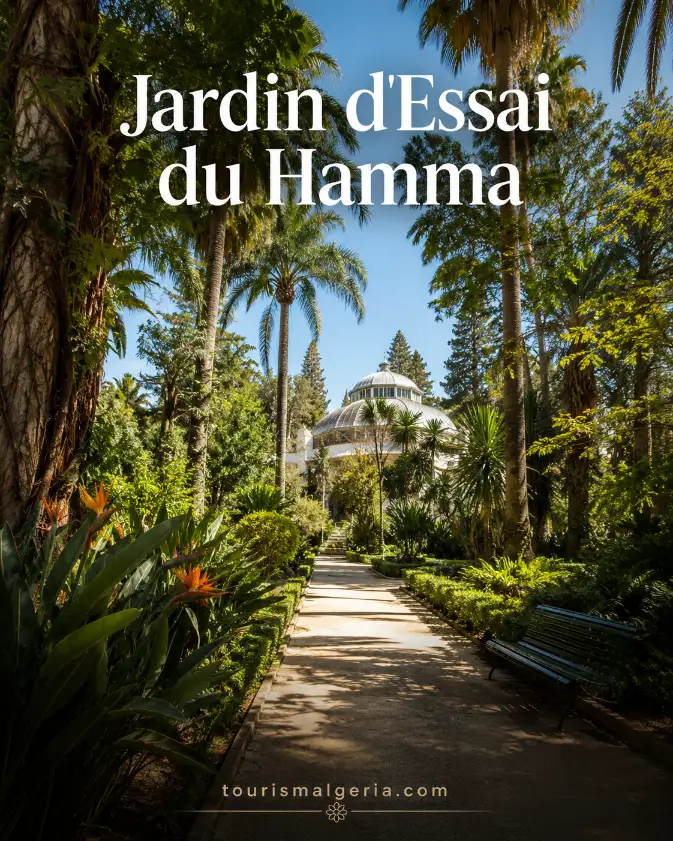
Jardin d’Essai du Hamma in Algiers
The Jardin d’Essai du Hamma is Algiers’ historic botanical garden in the Hamma district of Belouizdad. Founded in 1832, it combines scientific plant collections, landscaped gardens, monumental avenues, educational functions and a zoological section, making it one of the capital’s most distinctive green and cultural landmarks.
Official Jardin d’Essai du Hamma website
A Botanical Landmark in the Algerian Capital
The garden occupies a strategic position between central Algiers and the heights rising toward the National Museum of Fine Arts. Its amphitheatre-like setting, dense vegetation and long avenues create an immediate contrast with surrounding urban districts, offering visitors a remarkably green environment within Algeria’s largest metropolitan area.
Jardin d’Essai du Hamma in Algiers – Practical Visitor Information
Address, current opening hours, metro access, how to get there, admission, botanical attractions, zoo, accessibility and useful information for visiting Algiers’ historic botanical garden.
The Garden Was Founded in the Nineteenth Century
The institution dates to 1832, during the early French colonial period, when marshy land at Hamma was transformed into an experimental agricultural garden and model nursery. Its original purpose combined plant acclimatization, agricultural testing and the propagation of useful species suited to the climate of Algeria and the Mediterranean.
From Experimental Nursery to Botanical Institution
During the nineteenth century, the site expanded beyond its initial agricultural purpose and developed extensive collections of trees, ornamental plants and useful crops. Under successive directors, plant material arrived from different regions of the world, turning Hamma into an important centre for acclimatization, horticulture and botanical experimentation.
The Garden’s Scientific Mission Continues Today
The official Jardin d’Essai du Hamma presents biodiversity conservation, environmental awareness and scientific research as central parts of its modern mission. Its living collections include more than 900 plant species, ranging from palms and tropical trees to medicinal and ornamental plants maintained for conservation, education and study.
Official information about the garden
Living Plant Collections Across the Site
Visitors encounter botanical collections arranged through formal gardens, themed avenues and more naturalistic spaces. The official garden highlights palms, tropical trees, medicinal plants and ornamentals among its living heritage, while scientific collections also support documentation, conservation and educational activities connected with Algeria’s broader plant diversity.
A Herbarium and Seed Collections
Beyond the plants visible outdoors, the institution maintains non-living scientific collections. Its official information identifies a herbarium containing preserved plant specimens, together with seed collections used for documentation and conservation. These resources show that Hamma functions as a scientific institution as well as a public park.
Official botanical and zoological collections
The French Garden
One of Hamma’s most recognizable sections is the formal French Garden, designed around symmetry, perspective, clipped vegetation and ornamental pools. Long views frame fountains, lawns and carefully arranged planting, creating a disciplined landscape that contrasts strongly with the looser vegetation and winding atmosphere found elsewhere within the botanical garden.
The Avenue of Washingtonia Palms
The French Garden is especially associated with its grand avenue of Washingtonia palms. Their tall trunks create a powerful vertical rhythm above the formal axis, while terraces and fountains reinforce the sense of perspective. This avenue remains one of the most photographed views within the Jardin d’Essai du Hamma.
The English Garden
The English Garden offers a deliberately different experience, with denser vegetation, irregular paths and a more naturalistic composition. Mature trees, water features and layered foliage create shaded spaces that feel less formal than the French Garden, demonstrating how contrasting European landscape traditions were incorporated into the same historic botanical institution.
Water and Shade in the English Garden
A small lake and aquatic vegetation contribute to the quieter character of the English Garden. Trees and undergrowth provide shade, while reflections on the water soften the surrounding greenery. This section is particularly attractive for visitors seeking a slower walk away from the stronger geometry of the main formal avenues.
The Avenue of Plane Trees
The Avenue of Plane Trees is one of the principal organizing lines of the garden. Historic accounts place it among major nineteenth-century plantings that structured circulation across Hamma. Its long shaded perspective helps visitors understand how botanical collections were arranged through monumental avenues rather than isolated beds or greenhouse displays.
The Avenue of Dragon Trees
The Avenue of Dragon Trees is another celebrated feature, distinguished by the unusual forms of mature Dracaena specimens. Their thick branching structures and umbrella-like crowns create a sculptural appearance. The avenue demonstrates how plants from different climates were tested, established and eventually became integral elements of Hamma’s visual identity.
The Avenue of Giant Ficus Trees
Large ficus trees form some of the garden’s most atmospheric spaces. Their massive trunks, aerial roots and spreading canopies create deep shade and dramatic natural architecture. Visitors walking beneath these mature specimens experience a strong contrast between carefully planned avenues and vegetation that now appears almost tropical and untamed.
Bamboo and Palm Avenues
Bamboo and palm avenues add further variety to the garden’s historic circulation system. Tall bamboo creates enclosed green corridors, while palms emphasize openness and height. Together with the plane trees, dragon trees and ficus, these avenues transform a simple walk through Hamma into a sequence of changing botanical environments.
A Garden Shaped by Acclimatization
Hamma became internationally known as an acclimatization garden because plants from different parts of the world were tested under Algerian conditions. Historical research records experiments involving fruit trees, cereals, industrial crops, ornamentals and other useful plants, reflecting the economic and scientific ambitions attached to the institution during colonial rule.
A Complicated Colonial History
The garden’s history cannot be separated from French colonial rule in Algeria. Academic research emphasizes that botanical experimentation, agricultural development and landscape transformation formed part of a wider colonial system. Modern visitors can therefore appreciate Hamma’s beauty while also understanding the political and economic context in which the institution developed.
Agriculture and Botanical Experimentation
Historical records describe experiments with fruit varieties, cereals, textile plants, oil-producing crops, perfumes, dyes and other agricultural resources. The garden supplied plant material and tested species considered economically useful, making it both a landscaped attraction and an applied research centre connected with the transformation of Algerian agriculture.
The Hamma Zoological Garden
The Jardin d’Essai also contains a zoological section whose official history dates to 1900. The zoo forms part of the institution’s animal heritage and educational mission, complementing the botanical collections. Visitors should treat it as a separate component of the broader garden and verify current access conditions before visiting.
Animal Heritage and Environmental Education
The official garden presents its zoological collection as a tool for biodiversity awareness and conservation education. Its role has changed over time from earlier displays of exotic and North African animals toward a modern emphasis on public learning, responsible care and understanding the relationship between animal life and environmental protection.
The Garden and the Cinema
Hamma also entered popular cinema history through the 1932 adventure film Tarzan the Ape Man, starring Johnny Weissmuller. Film references identify exterior scenes shot in Algiers at the Jardin d’Essai, giving the garden an unusual connection with early Hollywood imagery of tropical landscapes and adventure storytelling.
The Famous Tarzan Ficus
A giant ficus within the garden is traditionally associated with the filming of Tarzan scenes and remains a popular point of curiosity. Whether visitors come for cinema history or botany, the tree illustrates how Hamma’s mature tropical-looking vegetation could convincingly represent a distant jungle environment for twentieth-century filmmakers.
Sculpture Among the Plants
Stone sculptures placed along the avenues add an artistic layer to the botanical landscape. Historic descriptions identify works by sculptor Émile Gaudissard among the garden’s decorative features. These pieces integrate human figures with fountains, formal planting and long perspectives, especially within areas shaped by early twentieth-century landscaping.
A Landscape for Art and Photography
The combination of monumental palms, fountains, dense ficus roots, bamboo corridors and formal terraces makes Hamma exceptionally photogenic. Visitors can move from symmetrical compositions to almost jungle-like scenes within a short walk. Early morning or late afternoon usually provides softer light for photographing foliage, water and architectural details.
The National Museum of Fine Arts Above the Garden
The National Museum of Fine Arts stands on the hillside directly above the Jardin d’Essai, creating one of Algiers’ strongest combinations of landscape and culture. Visitors can pair botanical exploration with an art museum visit, while the elevated surroundings provide broad views over the garden and parts of the capital.
A Cultural Route Through Hamma
A day in Hamma can combine the botanical garden, the National Museum of Fine Arts and nearby national landmarks. This concentration of attractions makes the district practical for visitors who want nature, art and modern Algerian history without travelling repeatedly across the city between widely separated destinations.
The Martyrs’ Memorial Nearby
The Martyrs’ Memorial rises on the heights above Hamma and is visible from several parts of the surrounding district. Dedicated to Algeria’s struggle for independence, it belongs to a very different historical period from the botanical garden, allowing visitors to place colonial-era landscape history beside the memory of national liberation.
Using the Algiers Metro
Public transport makes the garden relatively easy to reach. The Algiers Metro has a station named Jardin d’Essai on Line 1 in Belouizdad, close to the garden and museum area. Using the metro can be more convenient than negotiating central-city traffic, particularly during weekends and busy holiday periods.
Planning Enough Time for the Visit
Hamma deserves more than a rapid stop because its appeal comes from moving between contrasting sections. Visitors interested in botany, photography and history can easily spend several hours exploring the principal avenues, formal gardens, shaded areas and zoological section while allowing time to sit and observe the surroundings.
Choosing the Best Time of Day
Morning is often a pleasant period for visiting because temperatures can be milder and the garden may feel calmer before the busiest hours. Late afternoon can also provide attractive light. In warmer months, avoiding the strongest midday heat makes long walks through open avenues and formal areas more comfortable.
Seasonal Changes in the Garden
The garden changes throughout the year as flowering cycles, foliage and weather alter its appearance. Spring can bring particularly fresh growth, while evergreen collections preserve much of Hamma’s character in other seasons. Visitors interested in specific plants should consult the garden’s current information before planning a specialized botanical visit.
Check Current Opening Conditions
Opening hours, ticket prices and access to particular areas can change because of maintenance, special events, weather or institutional decisions. Travellers should therefore consult the official Jardin d’Essai du Hamma website shortly before visiting rather than relying entirely on older travel guides, blogs or archived tourism listings.
Check the Jardin d’Essai du Hamma official website
A Place for Families
The wide avenues, varied vegetation and educational character make Hamma popular with families. Children can experience large trees, fountains, birds and zoological displays within one site. Adults should nevertheless supervise younger visitors around water, animal areas and crowded paths, while respecting any barriers protecting plants and collections.
A Quiet Escape Inside Algiers
Despite its popularity, the garden still offers quieter corners where visitors can sit beneath mature trees and step away from traffic and dense urban activity. This contrast is one of Hamma’s greatest strengths: the surrounding capital remains close, yet many interior paths feel sheltered from the city’s pace.
Conservation Matters Inside the Garden
Hamma is not simply recreational green space; it contains living scientific collections that can be damaged by careless behaviour. Visitors should remain on permitted paths, avoid picking flowers or leaves, respect labelled specimens and follow staff instructions. Protecting mature trees and rare plants is essential to preserving the garden’s value.
Environmental Education and Research
The official institution describes environmental awareness and scientific research as continuing priorities. Educational activities can help visitors understand plant conservation, biodiversity and responsible interaction with nature. This mission gives Hamma relevance beyond tourism, linking a historic garden with contemporary concerns about ecological preservation and sustainable management.
Understanding Hamma Beyond Its Beauty
Appreciating Hamma fully means recognizing several histories at once: scientific experimentation, colonial agriculture, landscape design, Algerian institutional stewardship, conservation and popular recreation. The garden is therefore both beautiful and historically complex, offering visitors a place where botanical heritage and the changing story of Algiers intersect.
Why the Jardin d’Essai Is Worth Visiting
The Jardin d’Essai du Hamma is worth visiting because few places in Algiers combine monumental trees, formal landscaping, scientific collections, shaded walks and historical depth so effectively. Its contrasting French and English gardens, famous avenues and mature vegetation provide an experience distinct from the capital’s museums, monuments and seafront.
Combine the Garden with Central Algiers
Travellers can easily integrate Hamma into a broader Algiers itinerary that includes the Casbah, waterfront, museums and major monuments. Visiting the garden provides a green interval between denser urban attractions, while the nearby metro station makes it practical to continue toward central districts without needing a private vehicle.
Author and Update
This guide was written and updated on 29 August 2026 by Nabil Frik for TourismeAlgerie.com. Before visiting the Jardin d’Essai du Hamma, travellers should verify current opening hours, admission arrangements, zoological access and special events through the garden’s official website and relevant Algerian tourism authorities.
TourismeAlgerie.com Official Jardin d’Essai du Hamma