

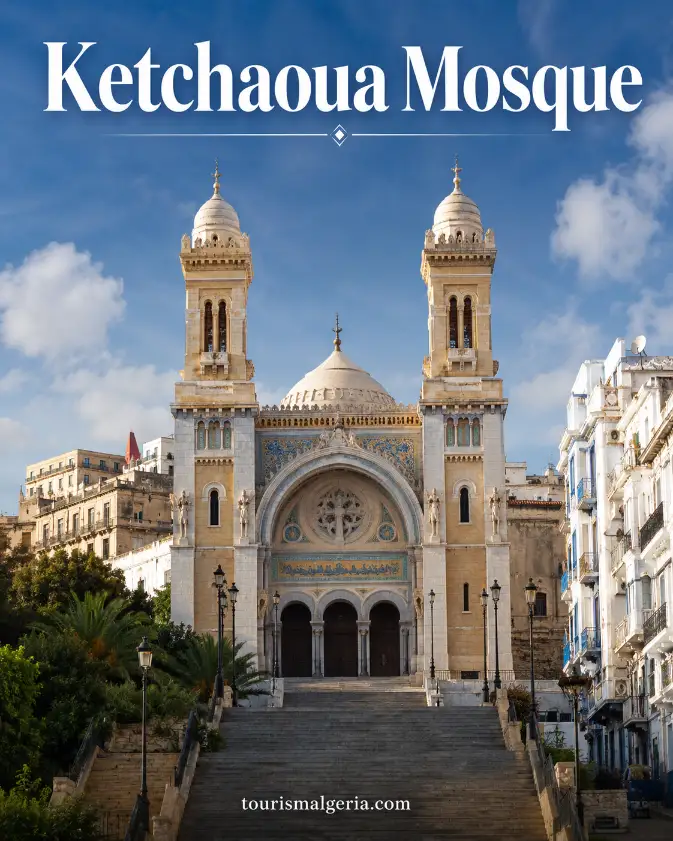
Ketchaoua Mosque in Algiers
Ketchaoua Mosque is a historic mosque at the foot of the Casbah of Algiers, combining Ottoman religious heritage, nineteenth-century architectural transformation, and modern restoration. Still used for Muslim worship, it is also one of the most recognizable monuments within the UNESCO-listed historic urban fabric of Algeria’s capital.
A Landmark at the Entrance to the Casbah
The mosque stands where the lower Casbah meets central Algiers, close to the waterfront and major historic streets. Its broad staircase, twin towers, arched entrance and elevated position make it a visual gateway between the dense old medina above and the more open lower city below.
Ketchaoua Mosque in Algiers – Practical Visitor Information
Address, opening and prayer times, how to get there by metro or on foot, visitor access, dress code, photography, architecture, history and practical information for visiting Ketchaoua Mosque in the Lower Casbah of Algiers.
The Meaning of the Name Ketchaoua
The name Ketchaoua is generally linked to an older local designation meaning the plateau of goats. Historical research shows that the place name existed before the present monumental building, reminding visitors that the mosque occupies a site whose urban and religious history predates its surviving architectural form.
A Mosque Existed Here Before the Ottoman Reconstruction
The exact foundation date of the earliest mosque remains uncertain, but documentary evidence confirms that a mosque existed on the site by 1612. Some historical studies suggest an even earlier medieval religious presence, although the better documented transformation occurred much later under Ottoman rule in Algiers.
Hassan Pasha Rebuilt the Mosque
In 1794, Hassan Pasha substantially rebuilt and enlarged Ketchaoua Mosque, transforming a smaller earlier sanctuary into a prestigious Ottoman religious monument. Historical descriptions present the new building as richly decorated, with marble columns, painted panels, inscriptions and a large central dome dominating its principal prayer space.
Ottoman Algiers and the Mosque
Ketchaoua belonged to the religious and political landscape of Ottoman Algiers, when mosques, palaces, fountains, markets and residences shaped the Casbah. Its reconstruction under Hassan Pasha reflected both devotional purpose and public prestige, placing the building among the capital’s significant late Ottoman architectural achievements.
A Central Dome Defined the Earlier Interior
Architectural studies of the eighteenth-century mosque describe a square central prayer space crowned by a large dome on an octagonal base. Galleries surrounded the main area, while smaller domes covered adjacent sections, creating a plan related to Ottoman mosque traditions adapted to the architectural culture of North Africa.
Marble Columns and Painted Decoration
Historical descriptions mention strong marble columns, painted decorative panels and monumental inscriptions inside the Ottoman mosque. These details suggest an interior intended to impress as well as serve worshippers. Surviving marble elements remain especially important because later conversions changed large portions of the original architectural composition.
French Conquest Changed the Building’s Function
After the French conquest of Algiers in 1830, Ketchaoua Mosque was converted to Catholic worship in 1832 and became Saint Philippe Cathedral. The change was not merely religious: later construction campaigns altered the architecture substantially to create a cathedral suited to colonial ceremonial and ecclesiastical requirements.
The Present Façade Reflects Several Periods
Visitors should therefore avoid describing the current façade as purely Ottoman. Its monumental staircase, twin octagonal towers and large central arched composition result from layers of nineteenth-century intervention combined with older materials and later restoration. Ketchaoua’s importance lies precisely in this visible accumulation of historical periods.
A Cathedral for Colonial Algiers
As Saint Philippe Cathedral, the building served the Catholic community of colonial Algiers for more than a century. Its ecclesiastical role linked it with a broader urban transformation in which streets, squares and public buildings around the lower Casbah were reconfigured under French administration while older structures survived nearby.
Return to Muslim Worship After Independence
Following Algerian independence in 1962, the former cathedral returned to Muslim worship and again became Ketchaoua Mosque. TİKA records that Algerians held Friday prayer there after independence, giving the building a renewed religious identity while preserving the architectural traces produced by its long and complicated history.
A Symbol of National Memory
The mosque’s return to Islamic worship carried meaning beyond ordinary religious use. For many Algerians, Ketchaoua became associated with independence, historical continuity and recovery of a major urban monument. Its story therefore combines architectural conservation with powerful memories of conquest, colonial rule, resistance and national sovereignty.
Ketchaoua Inside the UNESCO Casbah
Ketchaoua stands within the Casbah of Algiers, inscribed on UNESCO’s World Heritage List in 1992. UNESCO describes the Casbah as an outstanding historic Maghreb city containing old mosques, Ottoman palaces, traditional houses, hammams, souks and a dense urban structure adapted to a steep Mediterranean site.
UNESCO – Casbah of Algiers
The Mosque Is Not a Separate UNESCO Property
Ketchaoua is sometimes described as a UNESCO World Heritage mosque, but the distinction should be precise. The mosque forms part of the protected Casbah of Algiers property rather than holding a separate individual World Heritage inscription. This broader setting is essential to understanding its heritage significance.
Protected by Algeria as a Historic Monument
Algeria’s Ministry of Culture also lists Ketchaoua Mosque, identified as the former cathedral, among protected cultural properties in Algiers. Official records state that it was classified among historic sites and monuments in 1908, giving the building national heritage protection in addition to the Casbah’s international recognition.
Algerian Ministry of Culture – protected cultural properties
Architecture of the Present Mosque
Today’s Ketchaoua presents a distinctive blend of forms created through Ottoman foundations, colonial-period rebuilding and modern conservation. Pale stone, horseshoe-inspired arches, decorative tilework, a monumental central façade and twin towers combine elements associated with Moorish, Ottoman, Byzantine and nineteenth-century ecclesiastical architectural vocabularies.
The Monumental Staircase
A broad flight of stone steps leads visitors upward from the surrounding square toward the principal entrance. The staircase strengthens the ceremonial character of the façade and creates a dramatic transition from busy street level to the elevated portico, where the mosque appears more imposing against the dense Casbah background.
Three Arches Mark the Entrance
The principal façade is organized around three large arches supporting the entrance gallery. Decorative stonework, coloured ceramic details and carved patterns soften the monumentality of the elevation. These arches are among the most photographed features because they frame the doors while visually connecting the staircase with the upper façade.
Twin Octagonal Towers
Two octagonal towers rise on either side of the central façade and now function visually as minarets. Their proportions, balconies and decorative detailing reflect the building’s nineteenth-century transformation, while later restoration preserved their role as the most recognizable vertical elements in Ketchaoua’s silhouette above the lower Casbah.
The Interior Prayer Space
The interior now functions fully as a mosque, with prayer areas arranged according to Islamic worship. Visitors encounter arcades, marble columns, vaulted surfaces and restored decorative work. The atmosphere differs from the busy exterior square, especially outside major prayer times when the building can feel notably quiet and contemplative.
Layers of Religious Architecture
Ketchaoua’s interior should be read as a layered historical space rather than a perfectly preserved eighteenth-century mosque. The cathedral period introduced major changes, while the post-independence conversion restored Muslim use and later conservation addressed structural and decorative problems. Each phase contributed to the building visible today.
Damage and the Need for Restoration
By the early twenty-first century, Ketchaoua required significant conservation work. Structural concerns affected the towers and other parts of the building, and the mosque remained closed for an extended period. The need for intervention also reflected the wider preservation challenges facing historic structures throughout the Casbah of Algiers.
Turkish-Algerian Restoration Cooperation
During a 2013 agreement between Algeria and Turkey, cooperation was established for restoring selected Ottoman-period monuments. Ketchaoua became one of the most prominent projects. A protocol involving Algerian authorities and the Turkish Cooperation and Coordination Agency, known as TİKA, led to detailed conservation and strengthening work.
TİKA – Ketchaoua Mosque restoration
Restoration Work Began in the Following Years
After surveys, project preparation and approvals, restoration activities advanced from 2014. Specialists worked on structural reinforcement, façades, towers, interior ornament and calligraphy. TİKA states that Turkish academics advised on decorative and calligraphic elements, while the project was carried out through cooperation with Algerian institutions.
The Mosque Reopened in 2018
Following completion of the restoration, Ketchaoua Mosque was formally inaugurated in April 2018 and returned to regular worship. The reopening ended years of closure and allowed residents and visitors to experience the monument again, while highlighting the scale of conservation required for such a historically layered structure.
TİKA – reopening of Ketchaoua Mosque
Conservation Preserved a Complex Identity
The restoration faced an unusual challenge because Ketchaoua contains architecture from different historical phases. Successful conservation could not simply recreate one imagined original state. Instead, the building had to remain structurally safe while preserving significant evidence of its Ottoman, cathedral, post-independence and modern restoration histories.
Experiencing Ketchaoua as a Visitor
Ketchaoua is an active mosque rather than a conventional museum, so worship takes priority over sightseeing. Visitors should dress modestly, remain quiet, remove shoes where required and avoid disturbing prayer. Access for non-worshippers may vary according to services, religious occasions, security arrangements and local decisions.
Friday Prayer Changes the Atmosphere
Friday midday prayer is among the busiest weekly periods, when the mosque’s religious role becomes especially visible. Travellers primarily interested in architecture may find another time easier for observation. Those visiting during prayer should follow instructions carefully and avoid blocking entrances, stairways or spaces needed by worshippers.
Photography Requires Respect
The exterior staircase and façade are excellent photography subjects, particularly when the towers are framed against the surrounding Casbah. Inside, visitors should photograph only when permitted and should never treat worshippers as scenery. Flash, tripods or professional equipment may be restricted depending on current mosque rules.
Place Ibn Badis and the Lower Casbah
Ketchaoua stands around Place Ibn Badis at the lower edge of the Casbah, where several historic routes converge. This location makes the mosque a practical starting point for exploring the old city on foot, while also placing visitors close to central Algiers, the port and major public squares.
Walking Up Into the Casbah
From the mosque, visitors can continue upward into the narrow streets and stairways of the Casbah. The transition is immediate: formal monumental architecture gives way to dense residential lanes, small shops, historic houses and irregular passages that demonstrate the urban qualities recognized by UNESCO’s World Heritage inscription.
Visit Dar Hassan Pasha Nearby
Dar Hassan Pasha is another important monument close to Ketchaoua and belongs to the same Ottoman urban environment. Combining the two sites helps visitors understand how religious, administrative and residential architecture interacted within historic Algiers, rather than treating the mosque as an isolated object disconnected from its surroundings.
Continue Toward the Great Mosque of Algiers
The historic Djamaa el Kebir near the waterfront provides another useful comparison. Its much older fabric and different architectural character reveal how Islamic religious architecture in Algiers developed across centuries. Visiting several mosques allows travellers to distinguish medieval, Ottoman and later layers within the capital’s religious heritage.
Exploring the Wider Casbah
A complete visit should include more than individual monuments. UNESCO emphasizes the Casbah’s traditional houses, palaces, mosques, hammams, souks and steep urban pattern as a coherent historic environment. Walking carefully through its streets reveals how Ketchaoua belongs to a living district rather than a frozen heritage display.
The Casbah Remains a Living Neighbourhood
Thousands of residents still live within the Casbah, so visitors should respect privacy and ordinary neighbourhood life. Doorways, rooftops and residential courtyards are not automatically tourist spaces. Using an experienced local guide can improve orientation while encouraging a more informed and respectful understanding of the historic district.
Best Time to See the Mosque Exterior
Morning and late-afternoon light often reveal the façade’s stonework and ceramic decoration more effectively than harsh midday sun. Evening illumination can also emphasize the towers and central arches. Photographers should explore several angles from the surrounding square while remaining attentive to pedestrians, traffic and worshippers.
Check Current Access Before Visiting
Because Ketchaoua is a functioning mosque, public access cannot be assumed from old travel listings. Religious events, maintenance or security measures can change visiting conditions. Travellers should confirm arrangements locally through official tourism channels, a licensed guide or mosque staff shortly before planning an interior visit.
Why Ketchaoua Mosque Is Worth Visiting
Ketchaoua is worth visiting because few monuments in Algiers reveal so many historical layers within one building. Ottoman religious heritage, colonial conversion, independence, UNESCO protection and modern restoration all meet at the same site, while the surrounding Casbah gives those changes a powerful urban and cultural context.
Author and Update
This guide was written and updated on 29 August 2026 by Nabil Frik for TourismeAlgerie.com. Before visiting Ketchaoua Mosque, travellers should verify current access and prayer arrangements locally, while consulting UNESCO, Algeria’s Ministry of Culture and official heritage sources for the latest conservation and visitor information.