

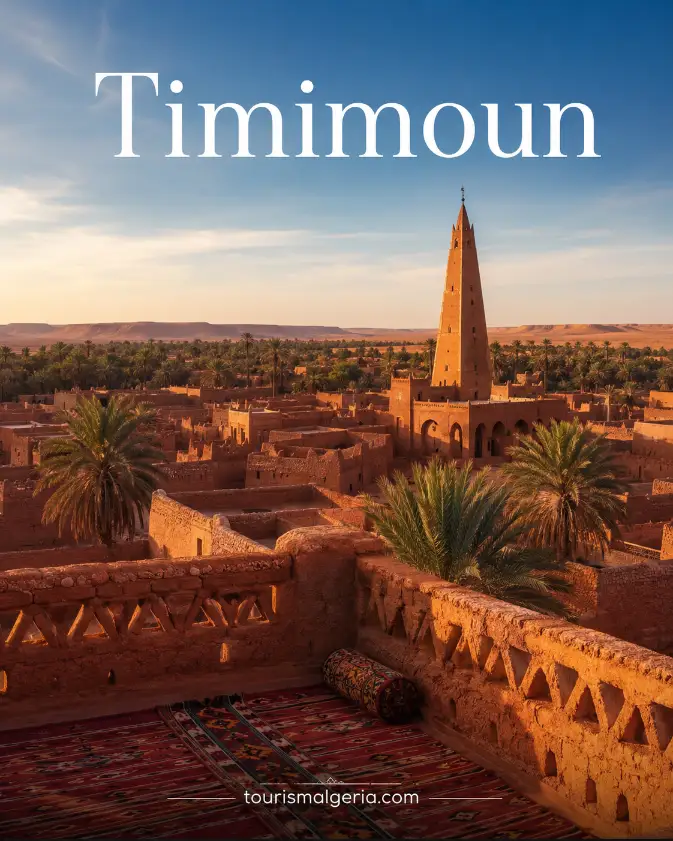
Timimoun in Algeria: What to See and Experience
Timimoun is a Saharan oasis city in southwestern Algeria, famous for red-ochre architecture, palm groves, dunes, historic ksour, and the cultural traditions of Gourara. It offers travellers a compact introduction to desert landscapes, oasis agriculture, vernacular architecture, music, and centuries-old settlement patterns.
Discover the Red Oasis
Timimoun is often called the Red Oasis because many buildings use earth-toned materials that create deep ochre and reddish façades. Against blue skies, green palms, and pale dunes, the town develops a distinctive colour palette that makes even ordinary streets visually memorable throughout the day.
Timimoun in Algeria – Practical Visitor Information
Location, how to get there by air and road, opening and visiting times, Timimoun’s red-ocher architecture, ksour, palm groves, foggaras, Sebkha, desert excursions, climate, local guides and official tourism contacts.
Walk Through the Old Town
The historic quarters reward slow exploration on foot. Narrow streets, shaded passages, traditional houses, and small public spaces reveal how local architecture responds to desert heat. Walking also makes it easier to notice carved doors, earthen walls, decorative details, and the rhythm of everyday neighbourhood life.
See the Traditional Ksour
Timimoun belongs to Gourara, a region shaped by numerous fortified settlements known as ksour. These compact communities were designed for protection, social cohesion, and climatic comfort. Their earthen construction and elevated positions also demonstrate how architecture developed around limited water, agricultural land, and caravan routes.
Visit Ighzer
Ighzer is one of the most attractive historic sites near Timimoun and lies roughly twenty kilometres from the city according to the local tourism authority. Its old ksar, oasis setting, and peaceful surroundings make it a rewarding excursion for visitors interested in architecture, photography, and rural desert life.
Explore the Gourara Oasis Landscape
Timimoun is the principal urban centre of Gourara, a vast oasis region bordered by the Grand Erg Occidental and rocky plateaus. The landscape is not simply empty desert: palms, villages, cultivated plots, dunes, salt depressions, and ancient water systems create a complex environment shaped by long human adaptation.
Understand the Palm Groves
Palm groves are central to the visual and economic identity of Timimoun. Date palms provide shade and help create cooler microclimates where additional crops can grow beneath them. Walking near these gardens shows how oasis agriculture transforms small areas of the Sahara into productive green environments.
Observe Traditional Foggara Irrigation
The Gourara region historically used foggara irrigation, an underground system that captures and channels groundwater toward cultivated land. These systems required detailed communal knowledge, maintenance, and careful water distribution. Seeing their traces helps visitors understand why water management is one of the defining achievements of Saharan oasis societies.
See the Sebkha of Timimoun
The Sebkha of Timimoun is a broad salt depression that adds a completely different landscape to the oasis. Depending on light and season, its pale surface contrasts dramatically with surrounding dunes, palms, and settlements. Viewpoints around the basin are especially attractive near sunrise and sunset.
Watch Sunset Over the Sebkha
Late afternoon is one of the best times to experience the Timimoun landscape. Warm light deepens the colours of earthen architecture and dunes while the sebkha becomes softer and more reflective. Elevated viewpoints allow photographers to combine several elements of Gourara within a single panoramic scene.
Experience the Grand Erg Occidental
Timimoun lies along the immense Grand Erg Occidental, one of Algeria’s major dune systems. The surrounding sands create classic Saharan scenery, yet their proximity to villages and oasis agriculture makes the experience more varied than a purely remote desert expedition. Guided outings can reach quieter dune sectors.
Walk on the Dunes
Walking on the dunes near Timimoun offers wide horizons, changing textures, and silence that contrasts sharply with town life. Sand can become extremely hot during strong sunshine, so early morning or late afternoon is preferable. Visitors should carry water and avoid wandering far without local guidance.
Try a Desert Excursion
A local excursion can combine dunes, ksour, palm groves, and remote settlements in one day. Travelling with an experienced guide adds historical and cultural context while reducing navigation risks. It also helps visitors reach viewpoints and villages that are difficult to understand from maps alone.
See Ksar Draa
Ksar Draa is one of the most striking structures associated with the wider Timimoun desert. Its isolated earthen walls rise dramatically from surrounding sands, creating an almost cinematic scene. Because the site is remote and heritage information can be limited, it is best visited with knowledgeable local guidance.
Photograph Earthen Architecture
The architecture around Timimoun is exceptionally photogenic because walls, towers, and ruins often share the same tones as the surrounding desert. Strong midday sun produces hard shadows, while early and late light reveals texture more gently. Wide compositions work especially well when palms or dunes appear behind buildings.
Discover Gourara Music and Poetry
Timimoun is also a cultural destination, not only a landscape attraction. Gourara is home to Ahellil, a poetic and musical tradition combining chant, music, and collective movement. UNESCO recognizes Ahellil as intangible cultural heritage, reflecting its importance for community identity and historical transmission.
Understand the Ahellil Tradition
Ahellil is traditionally performed during religious celebrations, pilgrimages, weddings, and community gatherings. Performers form a circle around singers and instrumentalists, gradually building a collective musical atmosphere. For visitors, encountering Ahellil respectfully can provide a deeper understanding of Gourara than sightseeing alone.
Learn About Zenete Heritage
UNESCO describes Ahellil as emblematic of the Zenete population of Gourara. The tradition transmits local values, history, poetry, and language across generations. Understanding this cultural background helps explain why Timimoun should be approached as a living Saharan society rather than simply an attractive desert backdrop.
Experience Sbuâ if Your Visit Coincides
Another major Gourara tradition is Sbuâ, an annual pilgrimage linked with the celebration following the Prophet’s birthday. UNESCO inscribed the practice on its Representative List in 2015. The event involves communities from surrounding ksour and illustrates strong connections between religion, social organization, and regional identity.
Respect Religious Celebrations
Visitors present during major religious events should remember that ceremonies are community traditions rather than staged entertainment. Modest clothing, discreet photography, and respect for processions and worship are appropriate. Asking local hosts or guides about expected behaviour is better than assuming unrestricted access to every part of an event.
Visit Ouled Saïd
Ouled Saïd is among the oasis settlements that can be included in excursions around Timimoun. The journey introduces travellers to cultivated gardens, traditional architecture, and a quieter rural rhythm. Visiting neighbouring communities also helps show that Gourara is a network of interconnected oases rather than one isolated town.
Explore Smaller Villages
Smaller settlements around Timimoun often provide some of the most memorable moments of a trip. Earthen houses, palm gardens, local mosques, and quiet lanes reveal daily life beyond the better-known attractions. Visitors should remain respectful because these villages are residential communities, not open-air tourist displays.
Visit the Market and Town Centre
Timimoun’s town centre gives travellers a practical introduction to local life through shops, cafés, markets, and public spaces. It is a good place to observe regional products, purchase everyday supplies, and experience the social pace of the oasis before heading toward more remote landscapes or villages.
Look for Local Handicrafts
Handicrafts can include textiles, jewellery, leatherwork, decorative objects, and products inspired by Saharan traditions. Quality and origin vary, so buying directly from local artisans or established shops is preferable. Purchases made locally can support skills that remain connected with community identity and regional tourism.
See the Architecture of Modern Timimoun
Modern Timimoun retains a strong visual identity because many public and private buildings use forms, colours, and decorative details inspired by traditional Gourara architecture. The result is unusual among growing towns: newer streets often continue the red-ochre palette instead of completely abandoning the appearance of older settlements.
Notice Sudanese and Saharan Influences
Architectural descriptions of Timimoun often emphasize Saharan and Sudanese-inspired forms, especially in façades, towers, and geometric decoration. These influences contribute to the city’s recognizable appearance. Rather than searching for one pure style, visitors should notice how local builders combine regional traditions with newer construction techniques.
Enjoy the Desert Gardens
Gardens around the oasis provide a welcome contrast to open sand and rocky terrain. Beneath palm canopies, irrigation supports fruit trees, vegetables, and other crops. These cultivated spaces demonstrate that Saharan life depends on detailed ecological knowledge rather than simply enduring extreme conditions without modifying the environment.
Learn Why Water Is Precious
Every green area around Timimoun depends on careful access to water. Traditional irrigation and community management made settlement possible, yet changing lifestyles and agricultural practices have placed pressure on older systems. Cultural-park research specifically notes the decline of some foggaras and the need to preserve associated knowledge.
Explore the Touat-Gourara-Tidikelt Cultural Park
Timimoun belongs to the broader Touat-Gourara-Tidikelt cultural landscape, where Algeria seeks to protect architecture, oasis ecosystems, archaeological heritage, and living knowledge together. This perspective is useful for travellers because it explains why villages, irrigation, agriculture, oral traditions, and desert scenery should be viewed as interconnected heritage.
Understand the Caravan Heritage
The Grand Erg Occidental may appear difficult to cross, yet official Algerian tourism information notes that caravan routes historically connected the scattered oases around its edges. Timimoun’s location therefore reflects movement and exchange as much as isolation, linking Gourara with other Saharan regions and trading communities.
Choose the Best Light for Photography
Timimoun is especially rewarding for photographers because colours change rapidly with the sun. Early light works well for palms and quiet streets, while late afternoon intensifies ochre walls and dune ridges. Blue-hour scenes can also be attractive as warm buildings contrast with a deepening desert sky.
Photograph People Respectfully
Portrait photography requires sensitivity. Ask permission before photographing residents closely, especially in smaller villages or during ceremonies. Children should never be treated as automatic subjects simply because they are outdoors. Respectful interaction usually produces better memories than taking images quickly without establishing whether people are comfortable.
Travel in the Cooler Months
The cooler part of the year is generally the most comfortable time for exploring Timimoun, particularly for walking through ksour and spending time on dunes. Desert temperatures can still vary sharply between day and night, so travellers should bring sun protection together with warmer layers for evenings.
Prepare for Desert Conditions
Even short excursions require sensible preparation. Carry drinking water, sun protection, comfortable closed shoes, and clothing suitable for strong light and wind. A charged phone and basic personal medication are useful, but travellers should not depend entirely on mobile coverage when venturing into more remote desert sectors.
Use Timimoun as Your Base
Timimoun works well as a base because travellers can combine town exploration with half-day and full-day excursions. Staying several nights creates time for different light conditions, nearby ksour, the sebkha, dunes, palm groves, and cultural experiences without trying to compress everything into one exhausting itinerary.
Allow Time for a Slow Visit
Two travellers can visit the same places yet have very different experiences depending on pace. Timimoun benefits from unstructured time for tea, market visits, conversations, sunsets, and walks through quiet streets. Leaving gaps between excursions often reveals more about oasis life than continuously moving between landmarks.
Consider Local Guides for Rural Sites
Local guides are particularly valuable when exploring ksour, archaeological ruins, traditional irrigation, or remote viewpoints. They can explain place names, community history, and access customs that are invisible on ordinary maps. Using local expertise also directs tourism income toward people who know and maintain the surrounding landscape.
Respect Fragile Earthen Heritage
Traditional mud-brick and earthen structures can deteriorate quickly when climbed, scratched, or entered without permission. Visitors should stay on obvious paths, avoid removing fragments, and respect closed areas. Ruined buildings may also be structurally unstable, even when walls appear solid enough for photographs or exploration.
Why Timimoun Is Worth Visiting
Timimoun is worth visiting because its attractions work together rather than existing as isolated monuments. Red architecture, palm groves, foggaras, salt landscapes, dunes, ksour, music, and village traditions form one coherent Gourara experience, giving travellers an unusually rich introduction to Algeria’s northwestern Sahara.
Author and Update
This guide was written and updated on 29 August 2026 by Nabil Frik for TourismAlgeria.com. Visitors planning Timimoun should verify current transport, accommodation, excursion access, weather, and local event schedules before departure, while approaching Gourara’s villages, religious traditions, irrigation heritage, and fragile architecture respectfully.
Algeria trip planer 3 days, 5 days, 7 days
Hotels Comparator in Algeria
Algiers-Kasbah english speaking guide
Algeria Ferries
Algerie Car Rental
Sahara Desert Hotels in Algeria
Algeria Visa Application
Casbah of Algiers
Algiers Church of Notre-Dame d’Afrique
Makam El Chahid
Algeria Flights
Algeria Tour Operators
Algeria Airports Timetable
Algeria Tourism Video
Algeria Tourism Board
Algeria Train Services