

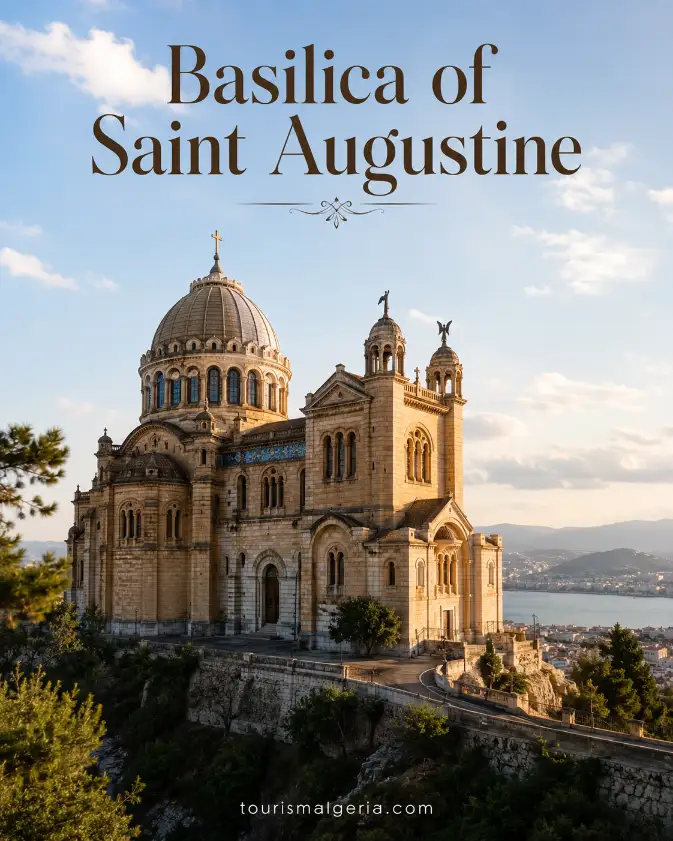
The Basilica of Saint Augustine in Algeria
The Basilica of Saint Augustine in Algeria is a Roman Catholic basilica in Annaba, overlooking the archaeological remains of ancient Hippo Regius. Dedicated to Saint Augustine of Hippo, it combines religious worship, Algerian heritage, Mediterranean history, and architectural interest in one of eastern Algeria’s most distinctive monuments.
The Basilica Above Ancient Hippo
The basilica stands on a hill above Annaba, near the ancient city where Augustine served as bishop. Its elevated position gives the building a strong visual presence and connects the modern sanctuary directly with the landscape of Hippo, the North African city that shaped Augustine’s mature life.
How to Visit the Basilica of Saint Augustine in Annaba, Algeria
Practical information for reaching the Basilica of Saint Augustine, including its address, visiting hours, transport from central Annaba and Rabah Bitat Airport, religious-service information, visitor advice and local travel-agency contacts.
Basilica of Saint Augustine
Visitor Hours
| Day | Visitor hours commonly published |
|---|---|
| Sunday | 11:00-11:30 and 14:30-16:30 |
| Monday | 09:00-11:30 and 14:30-16:30 |
| Tuesday | 09:00-11:30 and 14:30-16:30 |
| Wednesday | 09:00-11:30 and 14:30-16:30 |
| Thursday | 09:00-11:30 and 14:30-16:30 |
| Friday | Tourist visits should be planned for the afternoon. Official church information says no tourist visits Friday morning because Mass is celebrated at 09:30. |
| Saturday | Closed to tourist visits |
Cost and Visit Duration
What to See
Taxi Is the Simplest Option
Why Saint Augustine Matters
Saint Augustine was one of the most influential Christian thinkers of late antiquity. His theological, philosophical, and autobiographical writings shaped Western Christianity for centuries, while his career in North Africa makes Annaba an essential place for understanding the historical Augustine beyond the later European traditions built around his work.
Augustine’s North African Origins
Augustine was born in 354 at Thagaste, the Roman Numidian town generally identified with modern Souk Ahras in eastern Algeria. His North African origins are central to his biography, linking the basilica in Annaba with a wider regional itinerary that includes places associated with his childhood, education, ministry, and family.
Bishop of Hippo
After a long intellectual and spiritual journey through Carthage, Rome, and Milan, Augustine returned to North Africa. He eventually became a priest at Hippo and then bishop, serving the Christian community there from the late fourth century until his death during the Vandal siege in 430.
The Writings That Shaped Christianity
Augustine’s best-known works include the Confessions and The City of God, texts that continue to influence theology, philosophy, literature, and political thought. Visiting Annaba places those writings back within their North African environment, where Augustine preached, debated theological controversies, organized religious communities, and addressed everyday pastoral concerns.
The Ancient Basilica of Peace
Below the modern basilica lie the archaeological remains of ancient Hippo Regius, including the area associated with the early Christian Basilica of Peace. The modern sanctuary should therefore not be confused with Augustine’s original church; it commemorates him while overlooking the ruins connected with his historical episcopal ministry.
Building a Monument to Augustine
The idea of creating a major monument to Saint Augustine at Hippo emerged during the nineteenth century. Catholic authorities sought a sanctuary that would reconnect the saint’s memory with the city where he had been bishop, eventually leading to the construction of the basilica that dominates the Annaba skyline today.
Construction on the Hill
Construction began in 1881 and continued until 1900. The lengthy project produced a large church designed for both worship and commemoration, rising above the archaeological zone of Hippo. The completed basilica became one of the most recognizable religious buildings in Algeria and an important landmark for visitors to Annaba.
Joseph Pougnet’s Design
The architect commonly associated with the basilica is Abbé Joseph Pougnet, a French church architect who developed an eclectic design suited to the site. His approach combined several architectural traditions rather than copying a single European model, giving the building a distinctive appearance within Algeria’s nineteenth-century religious architecture.
A Mediterranean Architectural Blend
The basilica blends neo-Byzantine, Romanesque, and Moorish or Arab-inspired elements. This mixture appears in the domes, arches, decorative bands, towers, mosaics, and interior forms. The result reflects the Mediterranean setting of Annaba and visually acknowledges the many cultural traditions that have shaped Algeria across successive historical periods.
Twin Towers Over Annaba
The main façade is framed by two tall bell towers that resemble monumental vertical gateways above the entrance. Pale stone, coloured decorative bands, arches, and circular windows soften their mass. Seen from below, the towers create the basilica’s most recognizable silhouette and emphasize its position high above the surrounding landscape.
The Central Dome
A central dome rises above the crossing and gives the basilica a strong Byzantine character. Inside, the plan directs attention toward the sanctuary while side spaces, arcades, galleries, and decorative surfaces create visual depth. The combination of vertical towers and a rounded dome produces an unusually balanced exterior composition.
Materials Connected with Algeria
Sources describing the original construction emphasize the use of materials associated with Algeria, reinforcing the intended connection between the church and the country where Augustine lived. Stone, marble, and decorative materials contribute to an interior that feels monumental without losing the warmer colours and textures of its Mediterranean setting.
Stained Glass and Marble
Inside the basilica, visitors encounter marble, stained glass, painted decoration, large arches, and carefully restored liturgical furnishings. The stained-glass windows are especially important because several illustrate episodes connected with Augustine’s life, transforming the interior into both a place of worship and a visual narrative of his spiritual journey.
A Relic of Saint Augustine
The basilica also preserves a relic associated with Saint Augustine, traditionally described as a bone from his arm or elbow returned to Hippo in the nineteenth century. The relic gives the sanctuary particular importance for Catholic pilgrims, while the wider monument remains accessible as a historical and cultural destination.
Lalla Bouna
Local people also know the basilica as Lalla Bouna, a name linked with Our Lady of Hippo. This local designation is significant because it shows how the building has entered Annaba’s own cultural vocabulary rather than remaining only a foreign ecclesiastical monument separated from the city and its inhabitants.
Catholic Church in Algeria – Saint Augustine Basilica
An Algerian Heritage Monument
Algeria’s Ministry of Culture lists the Church of Saint Augustine in Annaba on the supplementary inventory of cultural property. The protective measure dates from 2011, confirming that the basilica is recognized not only for religious use but also as part of Algeria’s architectural and historical heritage requiring preservation.
Algerian Ministry of Culture heritage list
Restoration of the Basilica
A major restoration campaign took place from 2010 to 2013 after deterioration threatened the building. The work addressed façades, roofs, towers, interiors, stained glass, decorative finishes, and structural concerns. Algerian institutions, church bodies, international partners, companies, and private donors contributed to the large conservation effort.
Reopening After Conservation
The restored basilica was formally reopened in October 2013 after more than two and a half years of work. The reopening returned an important Annaba landmark to worshippers and visitors while demonstrating how conservation can preserve a religious building whose significance extends well beyond the community that uses it liturgically.
A Shared Restoration Effort
The restoration became notable for the cooperation surrounding it. Algerian public authorities, foreign partners, religious institutions, businesses, and individual donors supported the project. This broad participation reinforced the basilica’s modern reputation as a place where heritage conservation, Christian memory, Algerian identity, and Mediterranean cultural dialogue can meet.
A Living Place of Worship
The Basilica of Saint Augustine remains an active Catholic place of worship rather than functioning only as a museum. Visitors therefore enter a religious space where Mass, prayer, pilgrimage, and community life continue alongside tourism. Respect for services and quiet areas is an important part of visiting the monument responsibly.
The Augustinian Community
The sanctuary is entrusted to the Order of Saint Augustine, whose community maintains a direct spiritual link with the saint commemorated there. The Augustinians welcome worshippers, pilgrims, researchers, and tourists while also supporting cultural activities and dialogue, making the basilica both a religious house and a meeting place.
Order of Saint Augustine – Annaba
Pope Leo XIV in Annaba
The basilica gained exceptional international attention in April 2026 when Pope Leo XIV celebrated Mass there during his apostolic journey to Algeria. The event linked the modern Catholic community in Annaba with Augustine’s ancient episcopal city and gave the sanctuary renewed visibility within the worldwide Augustinian and Christian tradition.
Vatican – Pope Leo XIV’s Mass in Annaba
A Historic Papal Visit
Pope Leo XIV’s visit was historically significant because Vatican reporting described him as the first pope to visit Algeria. Before celebrating Mass at the basilica, he also visited the archaeological site of Hippo, visually and symbolically connecting Augustine’s ancient city, the modern sanctuary, and Algeria’s contemporary Christian community.
An Augustinian Pope at Hippo
The visit carried an additional meaning because Pope Leo XIV belongs to the Augustinian tradition. In Annaba, he spoke of Augustine as bishop of ancient Hippo and reflected on Christian life in Algeria. For pilgrims, this created a contemporary chapter in a site already deeply connected with Augustinian memory.
Christian-Muslim Dialogue
The basilica is frequently presented as a symbol of dialogue between Christians and Muslims in Algeria. Its preservation with substantial Algerian participation, its popularity among local visitors, and the cultural activities organized there allow the building to function as a shared heritage site even though it remains explicitly Catholic.
Visitors from Algeria and Abroad
Vatican News reported in 2026 that the Augustinian community receives around one hundred to one hundred fifty visitors on ordinary days, rising substantially in summer. Most visitors are Algerian, illustrating how the basilica attracts people for architecture, history, local identity, curiosity, spirituality, and intercultural interest.
Vatican News report from Annaba
The Library and Augustinian Days
The Augustinian community also maintains a library and organizes cultural initiatives known as the Augustinian Days. These activities explore Augustine’s philosophy, theology, spirituality, and relevance to dialogue, giving visitors reasons to understand the basilica not simply as a photogenic monument but as an intellectual and cultural centre.
Visiting Hippo Regius and the Basilica
A visit to the basilica should ideally be combined with the archaeological site of Hippo Regius below the hill. Seeing both places clarifies the chronology: the ruins belong to the ancient city Augustine knew, while the monumental church above was built many centuries later to commemorate his life and legacy.
The Protected Ruins of Hippo
The ruins of Hippo are themselves protected cultural heritage in Algeria. The Ministry of Culture lists the ancient site among Annaba’s classified monuments, reinforcing the importance of treating the basilica and archaeological landscape together. Their proximity creates one of Algeria’s most compelling combinations of ancient and modern religious history.
Views Across Annaba and Ancient Hippo
From the basilica’s elevated surroundings, visitors can appreciate why the site was chosen for a memorial church. The view opens toward Annaba, the Mediterranean environment, and the archaeological zone, creating a physical relationship between present-day city life and the ancient landscape associated with Augustine’s episcopal ministry.
Planning a Visit
The Catholic Church in Algeria currently states that visits are possible every day except Friday morning and Saturday, with liturgical activity affecting access. Because schedules can change for religious celebrations, maintenance, security, or special events, travellers should verify current visiting conditions directly before making a dedicated journey.
Current basilica visiting information
Annaba Is the Correct Destination
Annaba is the correct destination for travellers planning to see the basilica; it is not located in Algiers. The city lies in northeastern Algeria near the Mediterranean coast. Visitors arriving from other parts of the country should build the basilica into an Annaba itinerary rather than an Algiers sightseeing programme.
Photography Inside and Outside
Photography can be rewarding because the basilica offers dramatic exterior views, colourful decorative details, stained glass, marble, and broad architectural perspectives. Inside, visitors should follow any instructions given by the Augustinian community, especially during services, and avoid flash or intrusive photography where worshippers are praying.
Choosing the Best Time of Day
Morning or late-afternoon light can make the pale façade, towers, domes, and coloured decorative bands particularly attractive to photographers. Summer can be hot in Annaba, so combining the basilica with the archaeological site is generally more comfortable when outdoor temperatures are lower and strong midday sun is avoided.
Discovering More of Annaba
Beyond the basilica, Annaba offers a broader historical setting that includes Hippo Regius, the old city, mosques, Mediterranean waterfront areas, and museums. Exploring several layers of the city helps visitors understand that Augustine belongs to one chapter of a much longer Algerian history shaped by successive civilizations and religions.
A Destination for Pilgrims and Travellers
For Christian pilgrims, the basilica offers a rare opportunity to connect Augustine’s writings with the land where he served as bishop. For nonreligious visitors, its architecture, restoration history, archaeological setting, and cultural symbolism provide equally strong reasons to visit, making the monument accessible from several different perspectives.
Why the Basilica Is Worth Visiting
The Basilica of Saint Augustine deserves a place among Algeria’s major heritage attractions because it unites ancient Hippo, modern Annaba, Christian history, Algerian conservation, and Mediterranean architecture. Its importance lies not only in the building itself, but in the historical landscape and continuing dialogue surrounding it.
Author and Update
This guide was written and updated on 28 August 2026 by Nabil Frik for TourismeAlgerie.com. Opening schedules, religious services, restoration work, and visitor arrangements can change, so travellers should verify current information with the Catholic Church in Algeria and official Algerian cultural authorities before visiting Annaba.