


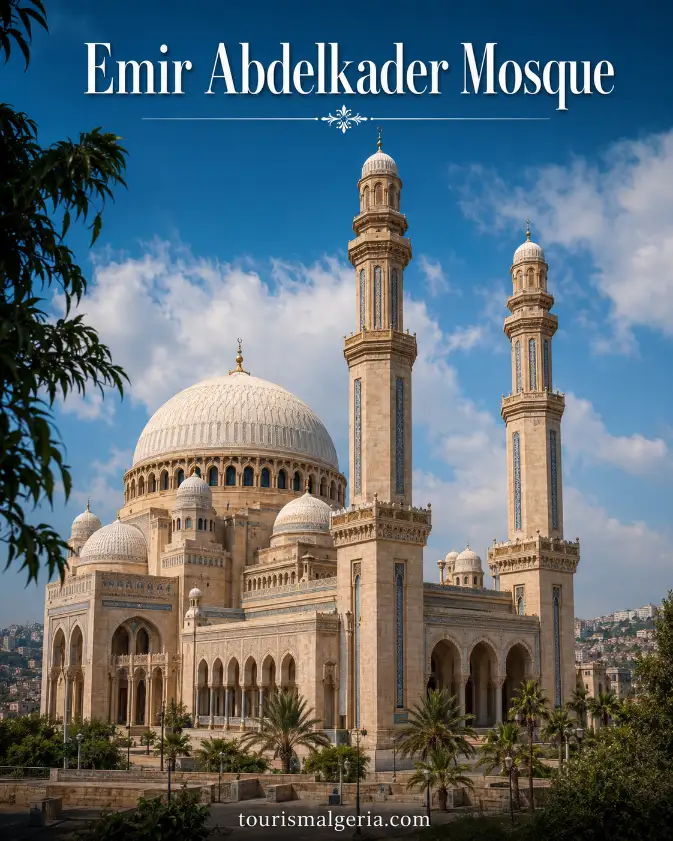
Emir Abdelkader Mosque in Algeria
The Emir Abdelkader Mosque in Algeria is a major modern mosque in Constantine, eastern Algeria. Built as part of a religious and academic complex, it is distinguished by monumental twin minarets, a central dome, extensive marble decoration, and its close relationship with Emir Abdelkader University of Islamic Sciences.
A Monumental Landmark in Constantine
The mosque occupies a prominent place in Constantine’s urban landscape, a city already famous for dramatic ravines, bridges, Ottoman heritage, and religious architecture. Its scale, pale stone surfaces, elevated position, and slender minarets make it one of the easiest modern landmarks to recognize when approaching the city.
Emir Abdelkader Mosque in Constantine: How to Get There and Visitor Information
Practical information for visiting the Emir Abdelkader Mosque in Constantine, Algeria, including its address, visitor access, prayer times, transport from Ahmed Bey Palace and central Constantine, admission, dress code and architectural highlights.
Where Is Emir Abdelkader Mosque?
When Can You Visit?
| Period | Visitor information |
|---|---|
| Monday-Thursday | Open as an active mosque. Daytime sightseeing is generally possible outside prayer periods. |
| Friday | Open for worship. Avoid tourist visits around the major Friday congregational prayer, especially around midday. |
| Saturday-Sunday | Active mosque; daytime visits are normally possible when no prayer or religious event is taking place. |
| Five daily prayers | Prayer times change every day according to sunrise and sunset. Sightseeing visitors should wait until worship has finished before entering the prayer hall. |
Entrance and Visitor Rules
What Makes the Mosque Important?
How to Get to Emir Abdelkader Mosque
Palace to Mosque
Tram Is the Easiest Public Transport
Mohamed Boudiaf International Airport
Constantine Tram
Practical Visiting Advice
Combine With Other Constantine Sights
Why the Mosque Bears Emir Abdelkader’s Name
The building is named after Emir Abdelkader, the nineteenth-century Algerian statesman, scholar, Sufi, and resistance leader. He became a central figure in Algeria’s struggle against French expansion and is widely associated with the formation of a modern Algerian political state during the resistance of the nineteenth century.
Emir Abdelkader and the Algerian State
Emir Abdelkader was proclaimed leader in 1832 and organized resistance to French occupation across large areas of western Algeria. Algerian official heritage sources describe his command structures, administration, and military organization, while modern institutions continue to present him as a major symbol of state-building, knowledge, dignity, and national memory.
A Humanitarian Legacy Beyond Algeria
His later life also contributed to his international reputation. After imprisonment in France and eventual exile in the Middle East, Emir Abdelkader settled in Damascus. In 1860, he became known for protecting Christians during violence in the city, strengthening his image as a figure of humanitarian responsibility and intercultural respect.
Origins of the Mosque Project
The decision to create a large mosque in Constantine emerged during the early post-independence period. University documentation states that the idea appeared in 1968, initially as a mosque for around ten thousand worshippers, before the project expanded into a much larger religious and educational complex incorporating an Islamic university.
From Local Mosque to National Complex
The project developed beyond a neighbourhood mosque because Constantine’s residents and national authorities envisioned a major institution combining worship and higher Islamic learning. Technical studies, architectural expertise, engineering work, and state involvement gradually transformed the original proposal into one of the most ambitious religious complexes built in independent Algeria.
A Construction Spanning Several Decades
Construction progressed over many years. University records explain that engineering teams worked on the foundations around 1970 and 1971, while the associated university was formally created by presidential decree in 1984. The mosque itself was later completed and opened for worship in the 1990s, after a long construction process.
Mustafa Moussa and the Architectural Vision
The mosque is closely associated with Egyptian architect Mustafa Moussa, whose design was selected for the expanded project. Accounts describe a building conceived on a monumental scale while drawing from Islamic traditions, creating a composition that feels modern in size but strongly connected with North African and Muslim visual language.
The Twin Minarets
Two extraordinarily tall minarets define the mosque’s silhouette. Reliable architectural references generally give their height as approximately 107 metres. Their verticality makes them visible from many parts of Constantine and gives the mosque a distinctive profile that contrasts with the city’s older, more compact religious buildings and dense hillside neighbourhoods.
The Central Dome
Between the minarets rises the mosque’s principal dome, creating a balanced central composition above the prayer spaces. The dome, arches, geometric ornament, stone surfaces, and repeating vertical elements produce a strongly symmetrical exterior, particularly when the building is viewed directly from the large forecourt before the principal entrance.
The Ceremonial Forecourt
The main approach is deliberately ceremonial. Broad steps rise from an expansive paved forecourt toward a façade articulated by tall arches and decorated openings. From this viewpoint, the minarets frame the dome while pale surfaces reflect strong Algerian sunlight, making the building especially striking during clear mornings and late afternoons.
Marble, Granite and Interior Craftsmanship
Marble and granite are among the materials frequently associated with the mosque and university complex. Inside, polished surfaces, columns, decorative arches, calligraphic elements, patterned details, and carefully controlled lighting create an atmosphere that is both monumental and devotional, emphasizing craftsmanship rather than leaving the enormous interior visually empty.
A Vast Prayer Hall
The interior prayer hall was designed to accommodate very large congregations. Published sources differ slightly on exact capacity, commonly giving figures between roughly fifteen thousand and nineteen thousand worshippers. The important point for visitors is the extraordinary scale, especially during Friday prayers, Ramadan evenings, and major Islamic religious occasions.
A Blend of Islamic Architectural Traditions
The mosque’s architecture combines influences rather than reproducing one historical monument. Maghrebi forms, broader Islamic decorative traditions, monumental modern planning, and features associated with eastern Islamic architecture appear together. This synthesis helps explain why the complex is often presented as an important achievement of post-independence Algerian Islamic architecture.
The Monumental Entrance
The five principal entrance openings create a particularly imposing façade. Their arches lead toward an interior where scale becomes more apparent through columns, decorative surfaces, chandeliers, windows, and the central worship area. Architecture enthusiasts should look carefully at transitions between the vast exterior spaces and the more ornamented interior.
The Minbar and Maghrebi Connections
The minbar, from which the Friday sermon is delivered, is another notable feature of the mosque. Published accounts from Islamic institutions state that a minbar was presented by Morocco’s King Hassan II, adding a cross-Maghreb dimension to the interior and reflecting the ceremonial importance attributed to the Constantine complex.
The Mosque and Emir Abdelkader University
The mosque is not an isolated place of worship. It forms part of a larger intellectual environment associated with Emir Abdelkader University of Islamic Sciences, an Algerian public university supervised by the Ministry of Higher Education and Scientific Research. The university’s creation was directly connected with the mosque complex.
Emir Abdelkader University of Islamic Sciences
The Creation of the Islamic Sciences University
Emir Abdelkader University was established by presidential decree in August 1984. Its mission developed around Islamic sciences, education, research, Arabic and related fields. The institution gives the site a distinctive character because students, scholars, worshippers, and visitors share a broader environment dedicated to both religious practice and structured academic study.
Worship and Knowledge in One Complex
The relationship between mosque and university expresses a traditional Islamic connection between worship and knowledge in a modern institutional form. Rather than functioning only as a monumental prayer hall, the complex places religious architecture beside higher education, research, Qur’anic learning, conferences, and scholarly exchange within the same symbolic setting.
An International Academic Centre
The university has hosted national and international academic meetings involving scholars from Algeria and many foreign universities. Recent events have covered Qur’anic readings, Islamic scholarship, and related disciplines, demonstrating that the complex continues to operate as an active intellectual centre rather than surviving merely as a prestigious architectural landmark.
Qur’anic Education and Religious Life
Qur’anic education also forms part of the mosque’s religious life. Reports concerning the complex describe Qur’anic teaching and competitions, while Algeria’s Ministry of Religious Affairs has used the mosque for national religious events. These activities reinforce its role as a major spiritual institution serving Constantine and visitors from elsewhere.
Algerian Ministry of Religious Affairs and Endowments
Ramadan at Emir Abdelkader Mosque
The mosque becomes especially animated during Ramadan. Large congregations attend evening prayers, Qur’anic recitations, and devotional gatherings, making the vast spaces function very differently from ordinary daytime conditions. Travellers interested in religious culture may find Ramadan particularly memorable, while respecting that worship takes priority over sightseeing during busy prayer periods.
Friday Prayer and Busy Visiting Periods
Friday prayer is another moment when the mosque’s scale and religious role are most visible. Visitors who are not attending worship should avoid disrupting entrances, ablution areas, and prayer rows at busy times. Arriving outside major prayer periods generally makes architectural observation easier and gives staff more flexibility.
Visiting as a Non-Muslim
Non-Muslim visitors should approach the mosque respectfully and understand that access policies can vary according to prayer schedules, religious events, security arrangements, and local decisions. Modest clothing is appropriate, shoes are removed before entering prayer areas, and visitors should follow any instructions provided by mosque staff or local guides.
Clothing and Respectful Conduct
Women visiting should carry clothing suitable for a functioning mosque, including coverage appropriate to local expectations. Some visitor accounts mention garments being available near the entrance, but travellers should not depend on this. Bringing a scarf and dressing conservatively makes access simpler while demonstrating respect for the building’s religious character.
Photography at the Mosque
Photography is particularly rewarding from the main forecourt because the symmetrical façade, dome, minarets, paving patterns, and reflecting surfaces can be framed together. Interior photography should be discreet and subject to current rules. Worshippers should never be photographed closely without permission, particularly during prayer, Qur’anic study, or private devotion.
The Mosque Is in Constantine
The mosque is located in Constantine rather than Algiers, an important distinction when organizing an Algerian itinerary. Constantine lies in the northeast of the country and has its own airport, rail connections, roads, hotels, and tourism infrastructure. Travellers based in Algiers therefore need a separate journey to visit the mosque.
Combine the Mosque with Ahmed Bey Palace
A visit can easily be combined with Ahmed Bey Palace, another of Constantine’s major landmarks. The palace represents the city’s Ottoman-era political history, whereas Emir Abdelkader Mosque expresses the monumental religious architecture of independent Algeria. Seeing both provides a useful contrast between nineteenth-century palace culture and twentieth-century national construction.
Discover Constantine’s Famous Bridges
Constantine’s famous bridges should also form part of the same itinerary. The city’s deep gorge and dramatic crossings create views unlike those of almost any other Algerian destination. Visiting the mosque together with Sidi M’Cid Bridge, Sidi Rached Bridge, El Kantara, and central viewpoints gives travellers a fuller understanding.
Add the National Cirta Museum
The National Cirta Museum provides another useful historical layer. Its archaeological collections help explain Constantine’s ancient Numidian and Roman past, while the mosque belongs to a much later period. Combining museum, Ottoman palace, bridges, old city, and modern mosque reveals how many different historical identities coexist within one urban landscape.
Understanding the Historical Connection
Travellers interested in Emir Abdelkader himself should remember that Constantine was not the principal centre of his nineteenth-century state. His strongest historical associations lie with western Algeria, including Mascara and surrounding areas. The Constantine mosque is therefore a commemorative national monument bearing his name rather than his residence or headquarters.
Following Emir Abdelkader to Mascara
Mascara preserves important sites connected directly with Emir Abdelkader’s political and military history. Algeria’s cultural heritage map identifies his former command house there as a protected national monument. Travellers following an Emir Abdelkader itinerary can therefore combine Constantine’s commemorative mosque with authentic historical locations in western Algeria.
Algerian Cultural Heritage Map – Emir Abdelkader Command House
Emir Abdelkader’s International Legacy
The Emir’s legacy continues to receive international academic attention. In June 2026, Algeria’s Ministry of Higher Education announced the inauguration of an Emir Abdelkader Chair at the Oxford Centre for Islamic Studies, highlighting his contributions to state-building, knowledge, humanitarian values, and dialogue between cultures far beyond Algeria itself.
Algerian Ministry of Higher Education – Emir Abdelkader Chair at Oxford
Experiencing the Architecture
For architecture enthusiasts, the best way to experience the mosque is slowly. Begin with distant views that reveal the overall proportions, cross the forecourt to study the façade, examine arches and decorative details, then enter respectfully if access is permitted. Changing distance reveals how monumental scale and ornament interact.
Seeing the Mosque in Different Light
Light can transform the building dramatically. Strong daytime sun emphasizes pale stone and geometric relief, while evening illumination makes the dome and twin minarets stand out against the sky. Photographers may consider visiting the surrounding area at different times, while confirming access remains compatible with prayer and security arrangements.
Check Access Before Visiting
Because this is an active religious complex, opening conditions should be checked locally rather than relying entirely on old tourism listings. Special ceremonies, Friday worship, Ramadan, maintenance, university events, and official visits can change access. A hotel reception, licensed local guide, tourism office, or mosque administration can confirm practical arrangements.
Avoid Confusing Similar Mosque Names
Visitors should also avoid confusing this landmark with other mosques named after Emir Abdelkader elsewhere in Algeria. His national importance means that several religious buildings, streets, institutions, and public places carry his name. Search specifically for the Emir Abdelkader Mosque associated with the Islamic Sciences University in Constantine.
Why the Mosque Is Worth Visiting
The mosque is worth visiting even for travellers whose main interests are cultural rather than religious. Its importance lies in the combination of architecture, post-independence history, national memory, education, worship, and Constantine’s urban identity. Few Algerian landmarks show so clearly how a modern religious monument can also function academically.
Author and Update
This guide was written and updated on 28 August 2026 by Nabil Frik for TourismeAlgerie.com. Before visiting, travellers should verify current access with local authorities or the mosque and university administration, because prayer schedules, academic events, maintenance, security measures, and religious celebrations can temporarily affect normal visitor arrangements.
TourismeAlgerie.com