


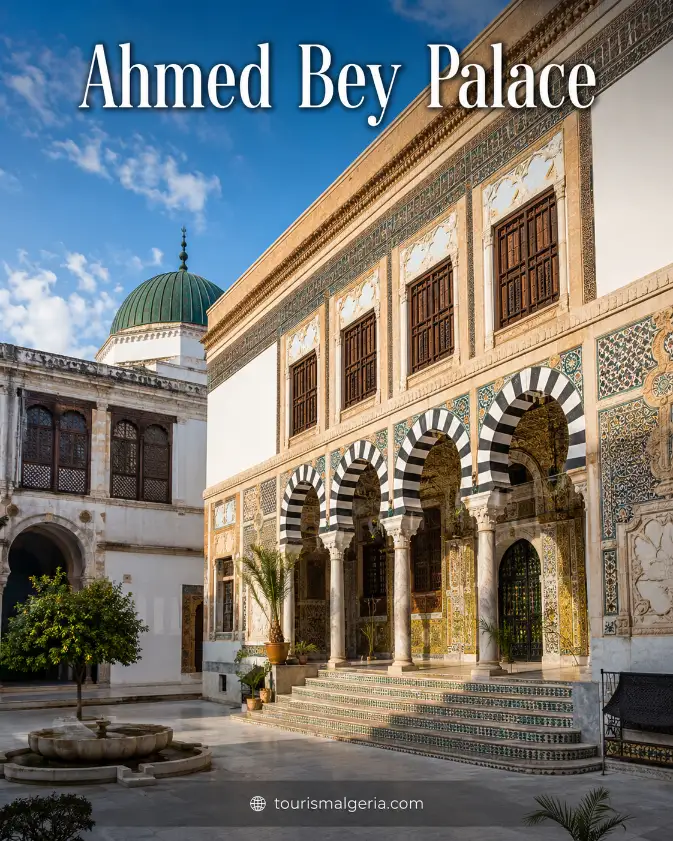
Ahmed Bey Palace in Constantine, Algeria
Ahmed Bey Palace is a historic Ottoman-era residence in Constantine, Algeria, not in Algiers. Built for Ahmed Bey, the last Bey of Constantine, it is one of the city’s major heritage monuments and today houses the National Public Museum of Traditional Arts and Cultural Expressions. Constantine Tourism Directorate
Why the Palace Is Not in Algiers
The confusion with Algiers is understandable because Constantine formed part of the Regency of Algiers during the Ottoman period. Ahmed Bey governed the eastern beylik from Constantine, however, and his palace stands in the old city there, hundreds of kilometres east of the national capital.
How to Get to Ahmed Bey Palace in Constantine, Algeria
Practical visitor information for Ahmed Bey Palace, including the address, current visitor hours, admission, access from central Constantine and Mohamed Boudiaf Airport, public transport, historical features and useful contact details.
Ahmed Bey Palace
When to Visit
| Day | Current commonly listed hours |
|---|---|
| Monday | 09:00 – 17:00 |
| Tuesday | 09:00 – 17:00 |
| Wednesday | 09:00 – 17:00 |
| Thursday | 09:00 – 17:00 |
| Friday | Closed according to the most recent 2026 visitor listings |
| Saturday | 09:00 – 17:00 |
| Sunday | 09:00 – 17:00 according to recent listings; confirm before travelling because some older guides list Sunday as the weekly closure |
Entrance and Visit Duration
Special Features of Ahmed Bey Palace
How to Get There
Walking Is Easy
Mohamed Boudiaf Airport
From Constantine Railway Station
Public Transport
Before You Go
Nearby Attractions
Useful Internet Links
Constantine and the Eastern Beylik
Constantine occupied an important political position in eastern Algeria before the French conquest. The city was the capital of the Beylik of Constantine, one of the major territorial divisions of Ottoman Algeria, and its difficult rocky setting helped it remain a powerful regional centre for centuries.
Ahmed Bey and His Legacy
Ahmed Bey ben Mohamed Chérif became the best-known final ruler of the Beylik of Constantine. Remembered for resisting French expansion after the fall of Algiers, he also left an architectural legacy whose most visible expression is the palace created as both residence and centre of government.
Building Ahmed Bey Palace
Construction of Ahmed Bey Palace began in 1825 and continued for about a decade, reaching completion in 1835. The official Constantine tourism authority describes an ambitious project involving skilled builders and a design combining Moorish influences with local architectural traditions rooted in the Maghreb and North Africa.
A Very Brief Royal Residence
Ahmed Bey moved into the completed palace in the autumn of 1835, but his residence there was brief. Constantine fell to French forces in 1837 after determined resistance, meaning the ruler enjoyed the palace for only about two years before losing control of the city.
The Palace After the French Conquest
After the French capture of Constantine, the palace passed into colonial use and underwent alterations associated with its new functions. Despite those changes, significant parts of the original structure, courtyards, decorative schemes, woodwork and painted surfaces survived, allowing the building to preserve a remarkable connection with the Beylik period.
Ahmed Bey Palace as a Museum Today
The palace now serves as the National Public Museum of Traditional Arts and Cultural Expressions of Constantine. Algeria’s Ministry of Culture formally established this national museum in 2010, giving the historic residence a new institutional role focused on safeguarding and presenting Algeria’s material and intangible cultural heritage. Algerian Ministry of Culture museum information
A Protected Algerian Monument
Ahmed Bey Palace is also a protected historic monument. Algeria’s Ministry of Culture lists the former Palais de la Division, today identified as Palais Ahmed Bey, among Constantine’s classified cultural properties, reinforcing its importance not merely as a tourist attraction but as a legally protected element of national heritage. Official Algerian cultural heritage list
Architecture Behind the Palace Walls
The palace covers roughly 5,600 square metres according to Constantine’s tourism authority. Rather than presenting a monumental European-style exterior, much of its architectural richness unfolds inward, through interconnected rooms, shaded galleries, courtyards, gardens, fountains and administrative or private spaces organised around an essentially introverted residential plan.
An Architecture Designed Inward
This inward-looking arrangement creates a strong contrast between the surrounding urban fabric and the atmosphere inside. Visitors move from enclosed passages into luminous courtyards where marble, painted timber, ceramics, vegetation and water interact, producing the cool, sheltered environment characteristic of prestigious North African domestic architecture.
Different Areas for Different Functions
Official tourism information describes four principal functional areas within the complex, including spaces for the Bey’s family, servants, seasonal residence and administration. These divisions reveal that the palace was designed not simply as a luxurious home but as a working seat of political authority with carefully separated activities.
The Administrative Wing
The administrative wing was especially important because government business and judicial matters were handled there. Constantine’s tourism authority notes that the palace included areas associated with civil and military justice, illustrating how Ahmed Bey combined residence, administration and political oversight within a single fortified urban complex.
A Winter Section Adapted to Climate
The winter section was positioned to benefit from sunlight and from warmth associated with the hammam below. During warmer periods, the same area could serve a different social function, showing how the palace’s architecture responded intelligently to Constantine’s seasonal climate without relying on modern mechanical heating or cooling.
Family and Private Spaces
Other sections were reserved for Ahmed Bey’s household, including his wives, daughter, mother, attendants and servants. The separation of family, service and official spaces helped regulate privacy and hierarchy, while galleries and courtyards connected the different areas without exposing every part of palace life to visitors or officials.
Courtyards at the Heart of the Palace
Courtyards are central to the experience of Ahmed Bey Palace. They bring daylight deep into the building, organise circulation and create visual pauses between rooms. Marble paving, arcades, columns and planted areas transform these internal courts into spaces that are simultaneously practical, ceremonial and highly decorative.
Orange Trees and Palm Gardens
The palace’s gardens are among its most memorable features. Constantine’s tourism authority identifies an orange garden and a palm garden among the open spaces, while the planted courtyards soften the surrounding stone and plaster architecture. Their vegetation also reinforces the sense of an enclosed urban oasis.
Fountains and the Sound of Water
Water was another essential design element. Fountains appear within the palace’s open spaces and contributed to cooling, sound and atmosphere. The official tourism description even records a tradition that the Bey used running water during private conversations, allowing the fountain’s noise to make discreet discussion more difficult to overhear.
Marble and Mediterranean Craftsmanship
Marble columns create much of the palace’s visual rhythm. Official tourism information describes around 250 columns originating from different Mediterranean areas, while architectural studies note the variety of capitals and materials. Their repeated presence along galleries gives the residence an elegant, almost continuous sequence of shaded arcades.
Carved and Painted Cedar Wood
Woodwork provides another distinctive layer of decoration. Constantine’s tourism authority describes hundreds of doors and windows made from carved cedar and painted in strong reds, greens and yellows. These elements link craftsmanship with architecture, turning ordinary openings, ceilings and partitions into an important part of the palace’s artistic identity.
Decorative Tiles from Across the Mediterranean
Ceramic decoration also contributes strongly to the interior. The palace contains zellij and other decorative tiles whose origins reflect Mediterranean exchange. Official local tourism information cites materials connected with Italy, Spain, the Netherlands and Tunisia, showing how a Constantine residence could absorb artistic products and influences from multiple regions.
The Famous Painted Walls
The palace’s painted walls are among its most extraordinary features. Large polychrome compositions depict landscapes, cities, buildings, ships and episodes connected with Ahmed Bey’s travels. Rather than functioning only as ornament, these images form a visual record through which architecture, memory, geography and personal biography intersect.
A Painted Journey Across the Mediterranean
Several murals evoke the ruler’s journeys through the Mediterranean and toward the eastern Arab world. Sources describing the palace identify places such as Tunis, Tripoli, Alexandria and Cairo, giving visitors the impression of following a painted itinerary across ports, cities and landscapes encountered during Ahmed Bey’s travels.
Mecca and Medina in the Palace Narrative
The pilgrimage to Islam’s holy places has an especially important place in the palace’s visual narrative. Depictions associated with Mecca and Medina appear within the decorative program, turning the walls into more than a luxury backdrop and linking Ahmed Bey’s personal religious journey with the memory embedded in his residence.
Ships and Mediterranean Ports
Maritime scenes are particularly striking because they show sailing vessels, ports and coastal settings within a palace far inland. These images recall the Mediterranean networks connecting Ottoman Algeria with Tunisia, Egypt and the wider region, while also giving modern visitors an unusually vivid nineteenth-century visual geography.
Colour Throughout the Interior
Colour is essential to the palace’s atmosphere. Painted beams, doors, walls and decorative surfaces combine greens, reds, yellows, blues and earth tones with white plaster and marble. The resulting contrasts make each gallery visually distinctive and help explain why interior photography of Ahmed Bey Palace is so immediately recognisable.
Conservation of a Historic Residence
Conservation has been crucial because colonial alterations, ageing materials and environmental exposure affected parts of the monument. Restoration campaigns have sought to preserve surviving decoration and recover historical character, while researchers continue to study the paintings, architecture and craft techniques as evidence of nineteenth-century Algerian cultural life.
A Museum That Keeps Traditions Alive
The museum role gives the palace a living cultural function rather than reducing it to an empty monument. Exhibitions and heritage events use its rooms and galleries to present traditional clothing, craftsmanship and cultural practices, connecting Ahmed Bey’s residence with Algerian heritage that continued long after his era.
Cultural Events Inside the Palace
Recent cultural programming confirms that the palace remains active. Algeria Press Service reported strong public interest during Constantine’s Night of Museums, when the National Public Museum of Traditional Arts and Cultural Expressions at Ahmed Bey Palace hosted artistic and cultural activities devoted to heritage and museum discovery. APS report on the Night of Museums
What Visitors Discover Inside
A visit is therefore both architectural and museological. Travellers can examine the building itself while also encountering exhibitions devoted to traditional arts and cultural expression. The combination is especially valuable because the historical setting gives objects, clothing and craft traditions a stronger sense of place than a neutral modern gallery.
Official Address of Ahmed Bey Palace
The official Algerian cultural heritage map gives the museum’s address as Ksar Ahmed Bey, 02 Rue Place Si El Houas, Constantine. It also publishes institutional contact details and identifies the palace as the home of the National Public Museum of Traditional Arts and Cultural Expressions. Official Algerian cultural heritage map entry
Checking Opening Times Before Visiting
Opening hours, ticket prices and temporary closures should be checked shortly before visiting because museum schedules can change for holidays, restoration, official events or seasonal reasons. Travellers should use the museum or Constantine tourism authorities for current practical information rather than relying exclusively on old travel blogs or archived listings.
Photography and Heritage Protection
Visitors interested in photography should remember that heritage museums can apply specific rules to flash, tripods, professional equipment or temporary exhibitions. Asking staff before photographing sensitive interiors is sensible, particularly because the palace contains historic painted surfaces, traditional objects and architectural details whose conservation takes priority over unrestricted photography.
What to See Near Ahmed Bey Palace
Ahmed Bey Palace fits naturally into a broader exploration of central Constantine. The official tourism authority includes it within cultural routes connecting the old city, theatre, museums and famous bridges, making the palace an excellent anchor for a walking itinerary focused on architecture, history and urban scenery. Official Constantine cultural itineraries
The National Cirta Museum
The National Cirta Museum is another important stop for understanding Constantine beyond the Ottoman period. Algeria’s Ministry of Culture recognises it as a national museum, and its archaeological collections help visitors place the city’s much longer Numidian, Roman and later history alongside the nineteenth-century world represented by Ahmed Bey Palace.
Constantine and Its Famous Bridges
Constantine’s bridges provide the dramatic landscape counterpart to the palace. Official tourism itineraries connect heritage sites with structures such as Sidi Rached, Sidi M’Cid and El Kantara, allowing visitors to experience both the enclosed beauty of the palace and the spectacular ravines that define the city’s famous topography.
Walking Through the Old City
The old city should also be explored on foot where conditions allow. Constantine’s tourism directorate includes Ahmed Bey Palace in routes through the historic centre, combining traditional streets, monuments and viewpoints. This context helps visitors understand the palace as part of a living urban fabric rather than an isolated attraction.
Travelling from Algiers to the Palace
Travellers starting in Algiers must therefore plan a journey to Constantine rather than searching for Ahmed Bey Palace in the capital. Constantine is in eastern Algeria and has its own airport and intercity transport links. The location correction is essential when booking hotels, guides, transfers or a heritage itinerary. Constantine Airport official flight information
Why Ahmed Bey Palace Is Worth the Journey
Ahmed Bey Palace is worth the journey because few Algerian monuments combine political history, domestic architecture, gardens, craft decoration and narrative wall painting so completely. Its surviving spaces offer an unusually intimate way to understand the final decades of Ottoman-era rule in eastern Algeria immediately before the French conquest.
Author and Update
This guide was written and updated on 28 August 2026 by Nabil Frik for TourismeAlgerie.com. Before visiting Ahmed Bey Palace, travellers should verify current access with the museum or Constantine tourism authorities, especially when restoration work, public holidays or cultural events may temporarily modify normal opening conditions.