

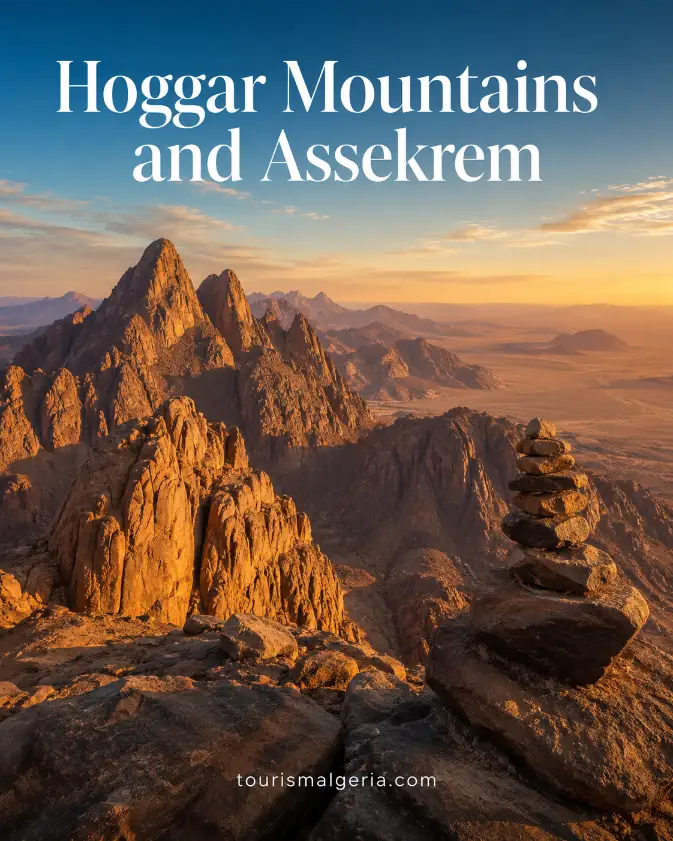
Hoggar Mountains and Assekrem in Algeria
The Hoggar Mountains and Assekrem form one of Algeria’s most extraordinary Saharan landscapes, combining volcanic peaks, high plateaus, ancient rock formations, Tuareg cultural heritage, archaeological sites and the celebrated Assekrem viewpoint. The region surrounds Tamanrasset in Algeria’s far south and offers a very different Sahara from vast sand dunes.
The Hoggar in Southern Algeria
The Hoggar, also written Ahaggar, lies deep in southern Algeria around Tamanrasset. This immense mountain region rises abruptly from the central Sahara, creating plateaus, volcanic spires, dry valleys and isolated summits. Algeria’s tourism authorities present the massif as one of the defining landscapes of the country’s Great South.
Hoggar Mountains & Assekrem – Practical Visitor Information
How to reach Assekrem from Tamanrasset, location, access conditions, visiting times, the Charles de Foucauld Hermitage, guides, climate, altitude and useful official contacts.
Hoggar and Ahaggar Mean the Same Region
Both names, Hoggar and Ahaggar, refer to the same broad mountain region. French and English travel writing often uses Hoggar, while Algerian heritage institutions commonly use Ahaggar. Knowing both spellings is useful when searching maps, official tourism information, cultural-heritage records, archaeological references and local tour itineraries.
An Ancient Volcanic Mountain Landscape
Much of the Hoggar’s dramatic appearance comes from ancient volcanic activity and long erosion. Dark lava fields, exposed volcanic necks, basaltic formations and weathered massifs create an almost sculptural landscape. The result is not a single mountain chain but a complex collection of plateaus, peaks, valleys and rocky desert surfaces.
Atakor at the Heart of the Hoggar
Atakor forms the high volcanic heart of the Hoggar and contains many of its most spectacular silhouettes. From elevated viewpoints, travellers see isolated towers and eroded volcanic forms emerging above broad plateaus. The changing light gives these formations colours ranging from brown and ochre to purple, charcoal and deep red.
Assekrem Above the Sahara
Assekrem is one of the best-known high points within this wider landscape. The Tamanrasset Tourism Directorate places it about eighty kilometres from Tamanrasset and at roughly 2,800 metres above sea level. Its elevated position provides panoramic views across the Atakor and surrounding volcanic formations. Official Tamanrasset Tourism information on Assekrem
A Panorama of Volcanic Peaks
The attraction of Assekrem comes less from one isolated summit than from the panorama surrounding it. Jagged peaks appear at different distances, creating overlapping silhouettes across the horizon. Wind, altitude, sparse vegetation and enormous open space give the plateau an atmosphere that feels dramatically different from lower Saharan plains.
Mount Tahat and the Highest Hoggar Summits
Mount Tahat is the highest summit of the Hoggar and reaches about 2,908 metres according to UNESCO documentation concerning the Ahaggar. It belongs to the region’s elevated volcanic landscape and demonstrates that southern Algeria contains substantial mountain terrain, challenging the assumption that the Sahara is almost entirely flat.
Sunrise at Assekrem
Sunrise is the moment most strongly associated with Assekrem. Before dawn, the landscape remains almost monochrome, then successive ridges catch orange and golden light. The Tamanrasset tourism authority promotes the exceptional sunrise panorama, making an overnight excursion attractive for travellers who want to experience the plateau at its most atmospheric.
Sunset Across the Atakor
Sunset offers an equally memorable but visually different experience. As the sun lowers, individual volcanic towers glow briefly before falling into deep shadow, while distant ridges become softer. Visitors who remain until dusk can watch the landscape transform rapidly, but should prepare for falling temperatures and limited light.
Climate in the High Sahara
The Hoggar has a Saharan climate, yet altitude moderates conditions compared with lower desert areas. Days can be intensely sunny, while nights become surprisingly cool. Official tourism information warns that winter nights may freeze, so travellers should not assume clothing suitable for hot desert afternoons remains adequate after sunset.
Visiting the Hoggar in Winter and Summer
Winter can be an excellent season for exploring the Hoggar because daytime walking temperatures may be comfortable, but cold nights require preparation. Summer brings stronger heat and sun exposure, particularly during lower-altitude travel. Weather can change quickly at elevation, making layered clothing more useful than relying on seasonal stereotypes.
The Sahara Is More Than Sand Dunes
The Hoggar shows why the Sahara should not be imagined only as endless dunes. Visitors encounter volcanic massifs, stone plains, dry wadis, gueltas, rocky plateaus and mountain passes. Algeria’s Ministry of Tourism contrasts the volcanic Hoggar with other Saharan environments, highlighting the geographical variety found across the country’s south.
Springs and Gueltas in the Mountains
Water is scarce but important throughout the Hoggar. Springs, seasonal streams and gueltas create local habitats contrasting sharply with surrounding rock. The Tamanrasset Tourism Directorate identifies sites such as Afilal and several waterfalls and water points, reminding visitors that hyper-arid mountain landscapes still contain pockets of ecological significance.
Wildlife and Desert Vegetation
The Ahaggar supports plants and animals adapted to extreme dryness, altitude and large temperature variations. Official local tourism material mentions acacias, oleanders, gazelles, mouflons, fennec foxes, reptiles and numerous birds. Wildlife encounters are never guaranteed, and visitors should observe animals from a distance without disturbing scarce water sources.
The Protected Ahaggar Cultural Landscape
Algeria protects this vast region through the Ahaggar cultural-park system. The Ministry of Culture lists the Ahaggar site as protected cultural heritage and maintains an office in Tamanrasset responsible for the park. Protection covers scenery, archaeological remains, traditional landscapes and cultural values spread across an enormous Saharan territory.
Algerian Ministry of Culture – Ahaggar Park Office
Understanding the UNESCO Status
Travellers should distinguish the Ahaggar Cultural Park from UNESCO World Heritage status. UNESCO’s current list of Algerian World Heritage properties includes Tassili n’Ajjer but not the Hoggar as an inscribed property. This matters because older tourism texts sometimes describe the Hoggar inaccurately as already belonging to the World Heritage List.
UNESCO World Heritage properties in Algeria
The Tefedest Massif on the Tentative List
Part of the wider Ahaggar landscape has nevertheless entered UNESCO’s nomination process. In 2025, Algeria added the Tefedest Massif within the Ahaggar Cultural Park to its World Heritage Tentative List. The proposal highlights exceptional geology, biodiversity, archaeological shelters, rock art and traditional knowledge preserved within this remote Saharan mountain environment.
UNESCO – Tefedest Massif in the Ahaggar Cultural Park
Prehistoric Archaeology in the Hoggar
Archaeology is an important part of the Hoggar experience. Official cultural sources identify prehistoric and protohistoric remains throughout the park, including stone tools, funerary monuments and settlement evidence. These traces show that the apparently empty landscape has supported human movement and occupation across extremely long periods of North African prehistory.
Rock Art Across the Ahaggar
Rock art provides another window into earlier environments and societies. UNESCO’s Tefedest documentation records hundreds of painted or engraved shelters within that part of the Ahaggar. Such sites demonstrate changing fauna, human activities and cultural expression, while also requiring careful protection from touching, graffiti and uncontrolled access.
Tuareg Culture in the Hoggar
The Hoggar is a living cultural landscape closely associated with Tuareg communities. Their knowledge of routes, water, livestock, weather and terrain developed through generations of Saharan life. Travellers gain more when local guides explain place names, environmental knowledge and cultural practices instead of treating the region as empty wilderness.
Tamasheq and Tifinagh
Tamasheq language and Tifinagh writing are important elements of Tuareg cultural identity across the central Sahara. Place names in the Hoggar often reflect this linguistic heritage. Visitors may encounter different spellings when names are transcribed into Arabic, French or English, so variations on maps do not necessarily indicate different locations.
The Imzad Musical Tradition
The imzad, a traditional single-string instrument played by Tuareg women, represents one of the region’s most recognized cultural traditions. UNESCO placed practices and knowledge associated with the imzad of Algeria, Mali and Niger on its Representative List of Intangible Cultural Heritage, with documentation specifically recording practitioners from the Ahaggar.
UNESCO – Imzad tradition of the Tuareg communities
Tin Hinan and Tuareg Memory
Tin Hinan occupies a major place in Tuareg historical tradition. Her monumental tomb at Abalessa, west of Tamanrasset, is protected by Algeria’s Ministry of Culture. Official tourism information dates the associated funerary material broadly to late antiquity, making Abalessa a valuable cultural extension to a Hoggar and Assekrem itinerary.
Visiting Abalessa from Tamanrasset
Abalessa lies roughly eighty kilometres from Tamanrasset according to the local tourism authority and can be explored separately from Assekrem. Its association with Tin Hinan adds archaeology and Tuareg historical memory to a journey otherwise dominated by geology. Travellers planning several days can combine mountain landscapes with protected cultural sites.
Charles de Foucauld and the Hoggar
Charles de Foucauld is strongly associated with the Hoggar. The French priest and hermit lived among Tuareg communities in southern Algeria and devoted substantial effort to language study and religious contemplation. His connection with Tamanrasset and Assekrem later made the region important for Christian pilgrims and cultural travellers.
His Retreat at Assekrem
In 1911, Charles de Foucauld spent about five months at Assekrem, where he had a small retreat built high in the mountains. Algerian Catholic sources describe this period as part of his search for solitude and prayer, while the location also enabled continued engagement with the Tuareg language and people.
Catholic Church in Algeria – Charles de Foucauld and Assekrem
The Stone Hermitage and Chapel
The Assekrem hermitage is modest rather than monumental. Rough stone walls and simple rooms sit within an immense mountain panorama, emphasizing isolation instead of architectural grandeur. Visitors should approach it as a living spiritual site, respecting prayer, community life and any instructions concerning access or photography inside the small chapel.
A Place of Silence and Contemplation
For many visitors, Assekrem’s spiritual atmosphere exists independently of religious belief. The combination of silence, altitude, wind, extraordinary light and expansive horizons encourages contemplation. Catholic pilgrims connect the site with Charles de Foucauld, while other travellers experience the landscape through geology, photography, solitude or appreciation of Saharan culture.
Tamanrasset as the Gateway to Assekrem
Tamanrasset is the practical gateway to the Hoggar and Assekrem. Accommodation, guides, transport and supplies are generally arranged there before travelling into the mountains. The city also has its own links with Charles de Foucauld and Tuareg culture, making it more than simply a departure point for remote excursions.
The Mountain Road to Assekrem
Travel to Assekrem normally involves a rugged mountain route rather than an ordinary urban transfer. The official tourism authority places the site about eighty kilometres from Tamanrasset across difficult terrain, so experienced local transport is sensible. Journey times depend on route conditions, stops, weather and the operator’s chosen itinerary.
Official Atakor Tourist Circuits
The Tamanrasset Tourism Directorate publishes official Atakor circuits that include Assekrem. One loop continues through Ilaman, Terhinant and other sites before returning to Tamanrasset, while another connects Assekrem with Hirafouk, Idles and Tazrouk. These routes show how Assekrem fits into a much broader exploration of the Hoggar.
Official Tamanrasset Tourism – Hoggar and Atakor circuits
Walking at High Altitude
Walking is part of the Assekrem experience because the highest viewpoints and hermitage area require movement over uneven mountain ground. Visitors should wear supportive shoes, carry water and pace themselves at altitude. Anyone with reduced mobility should discuss walking requirements with a local operator before committing to a particular itinerary.
Spending the Night Near Assekrem
An overnight excursion is popular because it allows travellers to experience both sunset and sunrise without making the mountain journey twice. Accommodation near Assekrem is usually much simpler than a city hotel, so visitors should confirm sleeping arrangements, meals, sanitation, heating and electricity beforehand, especially during cold periods.
Stargazing in the Hoggar
Night in the Hoggar can be almost as impressive as daylight. Remote mountain locations have limited artificial lighting, allowing clear skies to reveal an exceptionally dense field of stars when weather cooperates. Visitors interested in stargazing should prioritize safe footing, warm clothing and respect for people sleeping or praying nearby.
What to Pack for Assekrem
Packing for Assekrem requires preparation for both Sahara and mountain conditions. Useful items include layered clothing, a wind-resistant jacket, sturdy footwear, sun protection, drinking water and a small light. Travellers staying overnight should ask their operator what bedding and meals are provided rather than assuming standard hotel facilities.
Photographing the Hoggar Mountains
Photography is one of the great pleasures of the Hoggar because light changes the mountains continuously. Wide lenses capture layered volcanic panoramas, while longer focal lengths isolate distant peaks. Sunrise and sunset are especially rewarding, but photographers should avoid unstable edges and should request permission before photographing local people closely.
Travelling Responsibly in the Ahaggar
Responsible travel is particularly important in the Ahaggar because archaeological remains, fragile water points and desert vegetation recover slowly from damage. Visitors should leave rock art untouched, remove waste, avoid collecting archaeological objects and follow local guides. Supporting legitimate local tourism also connects conservation with economic benefits for nearby communities.
Why the Hoggar and Assekrem Are Worth Visiting
The Hoggar Mountains and Assekrem are worth visiting because they overturn simple ideas about the Sahara. Instead of endless sand, travellers encounter high volcanic mountains, ancient human heritage, Tuareg culture, spiritual history and extraordinary light. Few Algerian destinations combine geology, archaeology, living tradition and panoramic scenery so completely.
Author and Update
This guide was written and updated on 29 August 2026 by Nabil Frik for TourismeAlgerie.com. Before travelling to the Hoggar or Assekrem, visitors should verify current access, route conditions, accommodation and local requirements with the Tamanrasset Tourism Directorate, licensed local operators and relevant Algerian cultural authorities.
Algeria trip planer 3 days, 5 days, 7 days
Hotels Comparator in Algeria
Algiers-Kasbah english speaking guide
Algeria Ferries
Algerie Car Rental
Sahara Desert Hotels in Algeria
Algeria Visa Application
Casbah of Algiers
Algiers Church of Notre-Dame d’Afrique
Makam El Chahid
Algeria Flights
Algeria Tour Operators
Algeria Airports Timetable
Algeria Tourism Video
Algeria Tourism Board
Algeria Train Services