


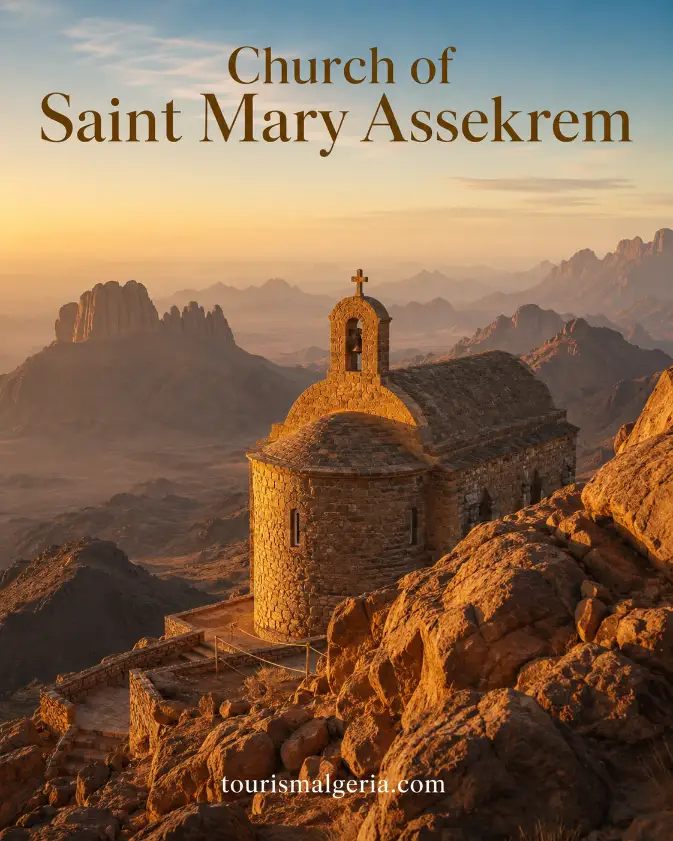
Church of Saint Mary at Assekrem in Algeria
The place described as the Church of Saint Mary at Assekrem is better known in official Algerian tourism and Catholic sources as the Assekrem hermitage and chapel associated with Saint Charles de Foucauld. It stands high in the Hoggar Mountains near Tamanrasset, combining prayer, history and extraordinary Saharan scenery.
The Assekrem Plateau
Assekrem lies in the Atakor massif of the Hoggar, around eighty kilometres from Tamanrasset. Algeria’s official tourism authority places the site at roughly 2,800 metres above sea level, where volcanic peaks, exposed rock and immense desert horizons create an environment of unusual isolation and visual power. Official Tamanrasset Tourism Directorate – Assekrem
Church of Saint Mary at Assekrem: How to Get There and Practical Visitor Information
Practical guide to visiting the remote Christian chapel and hermitage at Assekrem in the Hoggar Mountains of southern Algeria, including location, access from Tamanrasset, visiting conditions, Mass, altitude, accommodation and essential preparation.
Address and Geographic Location
When Is the Chapel Open?
| Part of site | Visiting conditions |
|---|---|
| Assekrem plateau | There is no museum-style opening timetable. Visits are organized according to guide, road, weather and security conditions. |
| Hermitage | Visitors can normally be received when members of the resident religious community are present. |
| Chapel | No fixed official tourist opening hours are published. Entry depends on the presence of the brothers and religious activities. |
| Mass | Visitor sources report a morning Mass, traditionally around dawn. The precise time should be confirmed locally because it can change. |
You Need a Guide and a 4×4
Walking to the Hermitage
How to Get There
4×4 Journey to Assekrem
Fly First to Tamanrasset
Assekrem Refuge
Entrance and Costs
• local guide
• permits / logistical arrangements where applicable
• meals
• overnight refuge or bivouac
• agency services
October to April
Essential Equipment
Mass and Behaviour
Saint Charles de Foucauld
Reliable Sources and Trip Planning
A Chapel Rather Than a Conventional Church
Travellers should not expect a large parish church, cathedral or basilica. The religious building at Assekrem is a very small stone chapel within the hermitage associated with Charles de Foucauld. Its importance comes from simplicity, location, prayer and history rather than monumental architecture or elaborate decoration.
Saint Charles de Foucauld
Charles de Foucauld was born in Strasbourg in 1858 and followed an extraordinary path from military officer and explorer to Catholic priest and desert hermit. He spent the final years of his life in the Algerian Sahara, where his spirituality became deeply connected with prayer, hospitality and human fraternity.
From Military Life to Spiritual Conversion
Foucauld’s early adult life included military service and geographical exploration in North Africa. After recovering his Christian faith in France, he pursued religious life, lived for a period in the Holy Land, became a priest in 1901 and then returned to the Sahara seeking a radically simple vocation.
Béni Abbès Before Tamanrasset
Before settling among the Tuareg around Tamanrasset, Foucauld lived at Béni Abbès in western Algeria. There he created a small fraternity centred on prayer, hospitality and service. His later move south brought him into closer contact with the people, languages and immense landscapes of the Hoggar region.
The Retreat at Assekrem
Foucauld established his high-altitude retreat at Assekrem around 1911 and stayed there for only limited periods because conditions were severe. Church sources describe approximately five months of residence, yet the isolated hermitage became one of the places most strongly associated with his spiritual memory in Algeria.
Why He Chose Such Isolation
The plateau offered the solitude Foucauld sought for prayer, contemplation and study, while remaining connected with the Tuareg communities he wished to know better. The extreme silence, wind, cold nights and vast horizon made Assekrem a demanding environment, but precisely those conditions gave the retreat its spiritual character.
Friendship with the Tuareg
Foucauld’s relationship with the Tuareg became central to his life in southern Algeria. Rather than building a large missionary institution, he pursued personal presence, friendship and hospitality. Later Catholic reflections often describe this approach as a spirituality of universal fraternity rooted in living respectfully among people of another faith.
Study of the Tuareg Language
His years in the Hoggar were also devoted to linguistic and cultural research. Foucauld worked intensively on the Tuareg language and oral traditions, producing important lexicographical material. This scholarly activity remains part of his Algerian legacy and shows that his desert years combined contemplation with disciplined intellectual work.
Architecture of Radical Simplicity
The Assekrem hermitage is striking because it is so modest. Rough stone walls, small openings and simple interior spaces respond directly to the mountain environment. There is little separation between architecture and landscape, making the chapel feel less like an isolated object than a shelter embedded within the rocky plateau.
The Small Stone Chapel
The chapel itself is intimate and austere, designed for prayer rather than spectacle. Visitors encounter stone, sparse furnishings and a scale that contrasts sharply with the enormous landscape outside. Its visual simplicity reflects the spirituality later associated with Foucauld: poverty, silence, Eucharistic prayer and closeness to ordinary human life.
Altitude and Mountain Climate
At roughly 2,800 metres, Assekrem can be much colder than Tamanrasset, especially at night and during winter. Strong winds are common, and temperature differences between sun and shade can be dramatic. Visitors should therefore prepare for mountain conditions even though the wider journey takes place within the Sahara.
The Atakor Landscape
The wider Atakor landscape consists of dark volcanic formations, eroded peaks, valleys and plateaus rather than classic sand dunes. This geological drama gives Assekrem its unmistakable appearance. From the heights, visitors look across a succession of jagged silhouettes extending toward the horizon, especially striking in low-angle light.
Sunrise at Assekrem
Sunrise is one of the principal reasons travellers stay near Assekrem overnight. Before dawn, visitors climb toward the high viewpoint and watch changing light reveal the surrounding peaks. The official Tamanrasset tourism authority specifically promotes Assekrem for its exceptional sunrise and sunset panoramas across the Atakor massif.
Sunset Over the Hoggar
Sunset offers a different atmosphere as the volcanic ridges gradually shift from warm tones into deep shadow. Photographers value the layered silhouettes, while pilgrims often experience the same moment more contemplatively. The combination of altitude, silence and unobstructed horizon makes evening at Assekrem particularly memorable.
A Place of Christian Pilgrimage
Assekrem is an important pilgrimage site for Christians following the life of Charles de Foucauld. The Diocese of Laghouat-Ghardaïa specifically identifies Béni Abbès, Tamanrasset and Assekrem as places attracting tourists and spiritual pilgrims, linking the remote plateau with a wider route through Algeria’s Saharan Christian heritage. Catholic Diocese of Laghouat-Ghardaïa
Canonization of Charles de Foucauld
Charles de Foucauld was canonized by Pope Francis in Rome on 15 May 2022. His sainthood renewed international interest in the Algerian places associated with his life. Vatican sources emphasize that Algeria, where he lived from 1901 until his death in 1916, was decisive in shaping his mature spirituality.
A Living Spiritual Presence
The Assekrem site is not merely an abandoned historic monument. Members of the spiritual family inspired by Foucauld have maintained a presence there, welcoming visitors and preserving a life of prayer. Recent church reporting continues to describe the plateau as a place of retreat, hospitality, contemplation and encounter.
The Little Brothers of Jesus
The Little Brothers of Jesus have been especially associated with maintaining the Assekrem presence. Algerian Catholic sources describe brothers restoring the original hermitage and gradually establishing additional simple retreats nearby. Their vocation combines prayer, practical work and hospitality within the overwhelmingly Muslim social environment of southern Algeria.
Morning Mass at the Hermitage
Visitors staying at Assekrem may encounter a rhythm shaped by silence and Christian prayer. Church accounts describe morning Mass celebrated in Foucauld’s hermitage, although attendance and schedules should never be assumed. Anyone hoping to join worship should contact the local Catholic community or guides before travelling.
Respect Between Religious Traditions
The meaning of Assekrem extends beyond Catholic pilgrimage. Foucauld lived among Muslim Tuareg communities and became remembered for friendship rather than confrontation. Contemporary Catholic commentary presents his Algerian legacy as one of fraternity and respectful encounter, making the hermitage relevant to conversations about Christian-Muslim relations today.
The Name Saint Mary at Assekrem
The expression “Church of Saint Mary Assekrem” is used by some travellers, but official Algerian tourism and Catholic sources more commonly identify the site as the hermitage or chapel of Charles de Foucauld. Visitors searching maps or booking excursions should therefore use “Assekrem” and “Charles de Foucauld” as primary references.
Tamanrasset as the Gateway
Tamanrasset is the practical gateway for visiting Assekrem. The city serves as the main tourism centre of the Hoggar region and the usual starting point for organised four-wheel-drive excursions. Travellers normally arrange transport, guides, food, overnight logistics and mountain access there rather than attempting an independent desert journey.
Distance from Tamanrasset
The official Tamanrasset tourism authority places Assekrem approximately eighty kilometres from the provincial capital. The distance can be misleading because mountain tracks make travel slower than an ordinary paved-road journey. Visitors should allow substantial time and treat the excursion as a full desert and mountain experience, not a short transfer.
Why Four-Wheel Drive Is Important
Official Algerian tour programmes use four-wheel-drive vehicles for the Tamanrasset-to-Assekrem route. Terrain can include rough tracks, stone, steep sections and remote stretches where ordinary urban cars are unsuitable. Using an experienced local driver also helps visitors navigate route conditions, weather changes and the practical realities of Saharan travel. ONAT – Charles de Foucauld itinerary
The Final Walk to the Hermitage
Reaching the highest part of Assekrem generally involves walking after the vehicle approach. Official Algerian tourism programmes describe an ascent on foot to the hermitage and viewpoint. The walk is not extremely long, but altitude, wind, uneven stone and darkness before sunrise can make it more demanding than expected.
Clothing for the High Sahara
Visitors should bring layered clothing rather than assuming Sahara means constant heat. A warm jacket, wind protection, sturdy shoes, sun protection and sufficient water are sensible. Winter mornings can feel particularly cold at altitude, while daytime sunshine remains intense, creating rapid temperature changes over only a few hours.
Water and Physical Preparation
Assekrem’s altitude and dryness can affect travellers who are accustomed to sea level. Hydration, gradual walking and sensible pacing are important, especially during the dawn ascent. Anyone with significant mobility, respiratory or cardiovascular concerns should obtain appropriate advice before undertaking a remote high-altitude excursion in difficult terrain.
Sleeping Near Assekrem
Many excursions are arranged with an overnight element because sunrise is a central part of the experience. Accommodation can be basic compared with city hotels, so travellers should confirm bedding, meals, sanitation, electricity and heating beforehand. The reward is experiencing darkness, stars and silence far from urban light.
Stargazing in the Hoggar
The remote location and limited artificial lighting make the Hoggar exceptionally impressive after dark. Clear nights reveal dense stars above the volcanic landscape, while the plateau’s silence reinforces the sense of isolation. For many visitors, the night sky becomes almost as memorable as the sunrise that follows several hours later.
The Tamanrasset Circuit
Algeria’s official Tamanrasset tourism directorate includes Assekrem in several recognised Atakor circuits. Routes can combine the plateau with Ilaman, Idles, Tazrouk and other Hoggar destinations. This allows travellers to treat the hermitage as one highlight within a broader exploration of Tuareg culture, mountains, valleys and desert settlements. Official Tamanrasset tourist circuits
Combine Assekrem with Tamanrasset
A complete visit should also include Tamanrasset itself, where Foucauld lived and died in 1916. The city provides another perspective on his relationship with the Tuareg and his final years. It also offers the practical services, accommodation, transport connections and guide networks needed for a wider Hoggar itinerary.
Continue to El Meniaa
Travellers following Foucauld’s Algerian story can continue far beyond Assekrem. His tomb has been located since 1929 at El Meniaa, formerly El Goléa, near Saint Joseph Church. The Diocese of Laghouat-Ghardaïa identifies this grave as another important point within Algeria’s extensive Saharan Christian geography.
Béni Abbès on the Foucauld Route
Béni Abbès is another major stop because Foucauld lived there before moving to the Hoggar. His surviving association with the oasis allows travellers to compare two very different Saharan environments: the lower Saoura oasis landscape and the austere volcanic heights of Assekrem in the far south.
A Site for Non-Religious Travellers
Visitors do not need to be Christian to appreciate Assekrem. The site offers exceptional geology, landscape photography, cultural history and insight into a remarkable twentieth-century encounter between a European hermit and Tuareg society. Respectful travellers can value the place as heritage without participating in its religious practices.
Photography at the Chapel
Photography is most rewarding outside, where the tiny stone hermitage can be framed against the immense mountain panorama. Inside the chapel, visitors should remain discreet and ask before photographing worshippers or religious activity. The building’s small dimensions mean intrusive equipment can easily disturb people using the space for prayer.
Protecting a Fragile Mountain Environment
Assekrem’s appeal depends on its remoteness and fragile high-desert environment. Visitors should avoid leaving waste, disturbing wildlife, removing stones or damaging paths. Following local guides and established routes helps protect both the natural landscape and the quiet character that makes the hermitage meaningful to pilgrims and travellers.
Why Assekrem Is Worth the Journey
Assekrem is worth the difficult journey because landscape and spiritual history are inseparable there. The tiny hermitage would be modest anywhere else, but on this isolated volcanic plateau it becomes a powerful symbol of solitude, encounter and contemplation, surrounded by one of the most extraordinary panoramas in Algeria.
Author and Update
This guide was written and updated on 28 August 2026 by Nabil Frik for TourismeAlgerie.com. Access conditions, community presence, road quality and visitor arrangements can change, so travellers should confirm current information with the Tamanrasset Tourism Directorate, local guides and the Catholic Diocese of Laghouat-Ghardaïa before departure.