


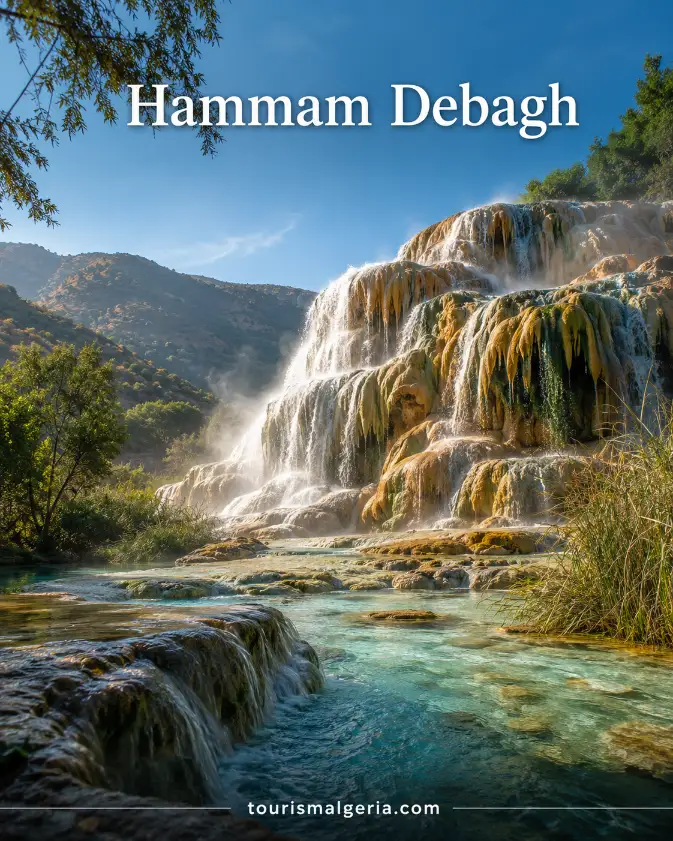
Hammam Meskhoutine at Hammam Debagh in Guelma, Algeria
Hammam Meskhoutine, today generally associated with Hammam Debagh in Guelma Province, is one of Algeria’s most spectacular thermal sites. Extremely hot mineral water emerges through a faulted geological basin, depositing travertine over time and creating colourful cascades, cones, terraces, steam and an unusual natural spa landscape.
Understanding the Different Names
The destination is known by several related names. Hammam Meskhoutine is the historic name of the hot-spring area, Hammam Debagh is the modern commune containing it, and Hammam Chellala refers to the major thermal complex developed beside the springs. Travellers should recognize all three when researching directions or accommodation.
Hammam Meskhoutine in Hammam Debagh, Guelma: How to Get There and Practical Visitor Information
Practical guide to visiting Hammam Meskhoutine, also known as Hammam Debagh or the Hammam Debagh thermal waterfall, in Guelma Province, Algeria, including its location, access, opening conditions, hot springs, thermal complex, safety precautions and nearby attractions.
Where Is Hammam Meskhoutine?
When to Visit
| Area | Access |
|---|---|
| Natural thermal waterfall | No official fixed daily tourist timetable currently published. Visit during daylight. |
| Outdoor limestone formations | Normally accessible as part of the open tourist area. |
| Hammam Chellala thermal complex | Operates as a hotel, bathing and thermal-treatment facility. Service hours depend on the hotel, hammam and treatment department. |
| Late evening / night | Not recommended for first-time sightseeing because visibility around hot-water outlets and mineral formations is reduced. |
Why Hammam Meskhoutine Is Special
Entrance and Visit Duration
How to Get to Hammam Meskhoutine / Hammam Debagh
Guelma to Hammam Debagh
Constantine to Hammam Debagh
Annaba to Hammam Debagh
Bus, Taxi and Car
Extremely Hot Water
Hammam El-Challala
• 112 bungalows
• Total accommodation capacity of approximately 542 beds
• Two hammams
• 102 shower rooms
• Two treatment pools
• Restaurants and cafeteria
• Thermal-treatment and rehabilitation facilities
When Should You Go?
What to Bring
What Else to See Around Guelma
Reliable Visitor Information
Where Hammam Debagh Is Located
Hammam Debagh lies in northeastern Algeria, west of the city of Guelma. The official Guelma tourism platform places the famous thermal waterfall within Hammam Debagh municipality, while the nearby underground lake Bir Ben Osman is described as roughly twenty-two kilometres from Guelma and two kilometres from the main tourist site.
A Major Thermal Destination in Guelma
Guelma Province is one of Algeria’s principal thermal-tourism regions. Provincial authorities report thirteen thermal sources across the wilaya, with Hammam Debagh among its most important attractions. The hot springs contribute to a broader network of spas, traditional baths, hotels and wellness facilities that attract visitors throughout the year.
One of Algeria’s Hottest Thermal Areas
Scientific research on the Hammam Debagh hydrothermal system has measured spring outlet temperatures from about 88.5°C to 97.8°C. The official Guelma tourism platform commonly presents the water at around 95°C. These temperatures make direct contact with newly emerging water dangerous and require controlled bathing arrangements.
The Water Comes from Great Depth
The thermal water rises from a geologically active basin affected by faults. Studies of Hammam Debagh describe unusually high geothermal gradients and estimate much hotter conditions at depth. As groundwater circulates through underground formations, it heats, dissolves minerals and eventually returns toward the surface through fractures in the rocks.
Why Steam Is Often Visible
When very hot groundwater reaches the open air, cooling and evaporation create visible steam, particularly when surrounding temperatures are low. This effect can make Hammam Meskhoutine especially dramatic during cool mornings or winter visits, when clouds of vapour contrast with the ochre, cream and rust-coloured mineral formations around the springs.
The Famous Petrified Waterfall
The thermal waterfall is the visual symbol of Hammam Debagh. Guelma’s provincial tourism authority describes it as a natural limestone cascade roughly eight metres high and forty metres across, shaped like a folded stone curtain. Its striking colours result from repeated mineral deposition as hot water flows over the surface.
Official Guelma tourism information on Hammam Debagh
How Travertine Is Created
Travertine forms when mineral-rich thermal water reaches the surface and loses dissolved carbon dioxide, encouraging calcium carbonate to precipitate. Layer after layer gradually hardens into terraces, ridges and curtains. At Hammam Debagh, this continuing process has produced a landscape that appears sculpted, although water and chemistry are the real artists.
Colours Across the Mineral Cascade
The cascade is not simply white limestone. Visitors can see cream, yellow, orange, brown and reddish tones across the deposits. These variations reflect mineral chemistry, water pathways, weathering and biological activity. Changing light also transforms the colours, making early morning and late afternoon particularly attractive for landscape photography.
A Landscape That Continues to Change
Hammam Meskhoutine is not a fossilized formation from a single ancient event. Thermal water continues interacting with the surface, adding mineral deposits and modifying channels over time. Some outlets become less active while others appear elsewhere, meaning the appearance of individual flows and wet surfaces can change between visits.
The Conical Formations of Larayes
Near the main cascade, the Larayes area contains more than one hundred cone-shaped mineral formations according to Guelma’s provincial authorities. Some rise several metres high. They formed around former outlets where hot water once emerged, leaving calcium-rich deposits after flow patterns shifted and older spring vents became inactive.
Why the Cones Look Mysterious
The cones create one of the strangest parts of the landscape because they resemble towers, figures or petrified people. Their unusual shapes inspired local storytelling, while geology explains them as mineral accumulations around former thermal outlets. Natural formations and traditional interpretation together are central to experiencing Hammam Meskhoutine.
The Legend of the Damned Baths
The traditional name Meskhoutine is commonly translated as the “baths of the damned” or “cursed baths.” A local legend connects the stone formations with a forbidden wedding whose participants were transformed into rock. The tale has many retellings and belongs to local folklore rather than documented historical fact.
The Wedding Legend
In the best-known version, a man wished to marry his sister despite warnings from his community. During the wedding celebration, divine punishment supposedly struck the couple and their companions, turning them into stone. The strange conical shapes around the thermal site were then interpreted as the petrified wedding party.
Folklore and Geology Side by Side
Visitors do not need to choose between enjoying the legend and understanding the science. The story gives the site cultural personality, while geology explains its travertine cones, hot-water vents and terraces. Together they show how communities often create memorable narratives around natural phenomena that appear extraordinary or difficult to explain.
Thermal Use Since Roman Times
Hammam Debagh has a long history of thermal use. Geological research notes that its springs have served bathers since Roman times. Archaeological scholarship identifies the ancient station as Ad Aquae Thibilitanae, connecting modern thermal tourism with a much older North African tradition of bathing around naturally heated mineral water.
Aquae Thibilitanae
The ancient name Aquae Thibilitanae reflects the importance of water to the Roman-era settlement. Archaeological records associate the site with Roman Numidia and preserve evidence of religious dedications around the thermal station. The modern hammam therefore occupies a landscape where water, settlement and ritual have been linked for centuries.
Roman Interest in Thermal Water
Romans across North Africa developed sophisticated bathing traditions, and naturally heated springs were particularly valuable because they reduced the need to heat large volumes of water artificially. At Hammam Debagh, the combination of abundant discharge, high temperatures and mineral content made the location especially suitable for thermal bathing and settlement.
The Chemistry of the Springs
Scientific studies describe Hammam Debagh water as strongly mineralized, with compounds containing magnesium, sodium, calcium, chloride and sulphate among the recorded constituents. The exact composition varies by spring and sampling method. Visitors should distinguish between geological mineral content and medical claims, which require professional assessment rather than tourism advertising.
Why the Water Smells Different
Some visitors notice a distinctive mineral or sulphurous smell near thermal outlets. Hydrothermal studies have identified gases and dissolved components associated with the system, including hydrogen sulphide. Such aromas are common at many geothermal sites and can become stronger near active vents, enclosed channels or areas with limited air movement.
Do Not Touch the Source Directly
Water approaching ninety-five degrees Celsius can cause severe burns within seconds. Visitors should never test active source outlets with a hand or foot because nearby bathing pools feel comfortable. Thermal establishments cool or control water before use, while natural channels beside the cascade should be treated as potentially hazardous.
Thermal Bathing and Wellness
Hammam Debagh is more than a sightseeing stop because thermal bathing remains part of local tourism. Algeria’s Ministry of Tourism identifies thermal resources as an important wellness sector nationally, while Guelma authorities promote the province as a leading thermal destination combining natural springs, accommodation, bathing facilities and rehabilitation-oriented services.
Algerian Ministry of Tourism thermal resources
Hammam Chellala Thermal Complex
The official Guelma tourism platform describes Hammam El-Chellala as a substantial thermal complex in Hammam Debagh. It includes hotel rooms, bungalows, treatment pools, hammams, restaurants and a health pavilion. Its role is different from the outdoor waterfall: visitors use managed facilities rather than bathing directly in uncontrolled spring outlets.
Official Hammam El-Chellala complex information
Accommodation at the Thermal Complex
According to the provincial tourism platform, Hammam El-Chellala includes a hotel and more than one hundred bungalows, creating a sizeable accommodation capacity beside the thermal zone. Travellers planning an overnight stay should confirm current room availability, refurbishment status, prices and which wellness facilities are operating before making a special journey.
Health Claims Need Care
Local thermal centres traditionally promote mineral-water treatments for various conditions, but a tourism article should not present such claims as guaranteed medical outcomes. People with cardiovascular disease, pregnancy, mobility limitations or other health concerns should seek medical advice before prolonged hot-water exposure, especially during intensive treatment routines.
Bir Ben Osman Underground Lake
About two kilometres from the principal Hammam Debagh tourist site lies Bir Ben Osman, an underground lake highlighted by the Guelma Tourism Directorate. The authority states that it formed after geological movement associated with an 1878 earthquake, adding another unusual natural attraction to the area’s thermal and geological landscape.
Official Guelma Tourism – Bir Ben Osman
Dimensions of the Underground Lake
The official tourism description gives Bir Ben Osman approximate dimensions of one hundred metres long, forty metres wide and fifteen metres deep. Access conditions can change because underground sites need careful management, so travellers should confirm whether entry or boating is currently permitted rather than relying on older reports.
Travelling from Guelma
Guelma is the most convenient urban base for visiting Hammam Debagh. Provincial information places the thermal area roughly twenty kilometres west of the city, while official tourism descriptions of nearby attractions use distances around twenty-two kilometres. A private vehicle, taxi or locally arranged excursion is generally the simplest approach.
What to See in Guelma
A thermal excursion can be combined with Guelma’s archaeological and cultural attractions. The province contains remains of ancient Calama, including the Roman theatre, as well as other archaeological sites and mountain landscapes. This makes Hammam Debagh suitable for a broader itinerary rather than only a stand-alone spa visit.
Hammam Ouled Ali Nearby
Guelma Province contains other important thermal destinations, including Hammam Ouled Ali near Héliopolis. The official tourism directorate describes several springs there with temperatures around 57°C and established thermal complexes. Comparing Ouled Ali with Hammam Debagh reveals how varied the province’s geothermal resources and spa infrastructure can be.
Official Guelma Tourism – Hammam Ouled Ali
A Region Built Around Thermal Tourism
Provincial authorities report that Guelma’s thermal stations receive hundreds of thousands of visitors annually. Winter and spring are particularly associated with thermal tourism because cooler weather makes hot-water bathing attractive. These seasons also enhance the visual effect of steam around Hammam Debagh’s outdoor cascade and mineral formations.
Best Time to Visit
Hammam Meskhoutine can be visited throughout much of the year, but cooler months offer comfortable sightseeing and stronger visible steam. Spring also brings greener surrounding landscapes. Summer can be very hot, so outdoor exploration is better scheduled for morning or late afternoon while avoiding the hottest thermal outlets.
Photography at Hammam Debagh
Photographers should include both wide views and close geological details. The petrified cascade works well from frontal viewpoints, while conical deposits, steam, flowing channels and coloured mineral layers reward closer observation. Early and late light provides texture, although visitors must remain behind safe boundaries near unstable or extremely hot surfaces.
Respect the Travertine Formations
Travertine develops slowly and can be fragile despite its stone-like appearance. Visitors should use established paths, avoid climbing on wet mineral surfaces and never break pieces away as souvenirs. Respecting barriers protects both travellers and the formations, while also allowing continuing mineral growth to remain visible for future visitors.
Practical Safety at the Springs
The principal danger at Hammam Debagh is straightforward: the source water is exceptionally hot. Slippery mineral surfaces, steam, uneven ground and crowded viewpoints can add further risks. Children require close supervision, and visitors should follow local signs and staff instructions rather than approaching outlets simply to obtain unusual photographs.
What to Bring
Comfortable walking shoes, drinking water, sun protection and layered clothing are useful for a visit. Anyone planning to use a thermal facility should also bring appropriate bathing items and confirm local requirements. A camera is worthwhile, but valuable electronics should be protected from steam and splashing near active water channels.
Check Services Before Travelling
Opening arrangements for thermal complexes, pools, restaurants and accommodation can change because of maintenance, renovation, holidays or operational decisions. The natural outdoor site may also have changing access controls. Before travelling, visitors should consult the Guelma Tourism Directorate or official provincial tourism platform for the latest practical information.
Guelma Province official tourism portal
Why Hammam Meskhoutine Is Worth Visiting
Hammam Meskhoutine stands out because geology, history, folklore and living thermal culture occupy the same small landscape. Visitors can see extraordinarily hot springs, mineral cascades and ancient bathing traditions while hearing a famous local legend. Few Algerian attractions combine natural processes and cultural memory so immediately and visibly.
Author and Update
This guide was written and updated on 28 August 2026 by Nabil Frik for TourismeAlgerie.com. Thermal-site access, accommodation, treatment services and local infrastructure can change, so travellers should verify current conditions with the Guelma Tourism Directorate and Algerian tourism authorities before visiting Hammam Debagh or booking thermal services. TourismeAlgerie.com