


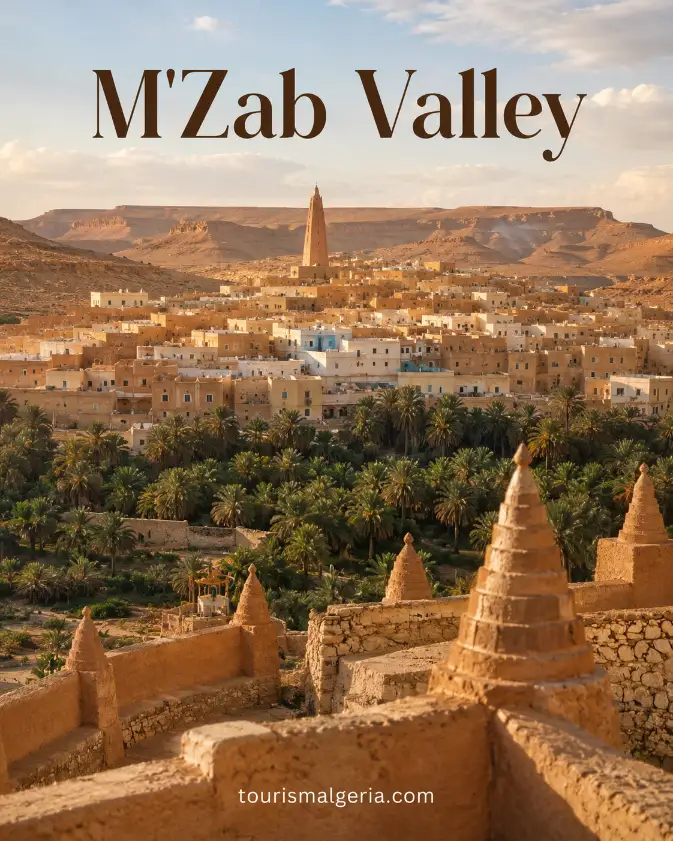
M’Zab Valley in Algeria
The M’Zab Valley in Algeria is a UNESCO-listed cultural landscape in the northern Sahara, centred on five historic fortified settlements and their palm groves. Created by Ibadi communities, its compact architecture, water systems and urban organisation demonstrate an exceptional adaptation to a harsh desert environment.
A World Heritage Landscape
UNESCO inscribed the M’Zab Valley on the World Heritage List in 1982 under cultural criteria relating to architectural influence, cultural testimony and traditional settlement. The protected property includes a serial ensemble of ksour, palm groves and associated structures that still form a coherent inhabited landscape.
Where the M’Zab Valley Is Located
The valley lies around 600 kilometres south of Algiers in Ghardaïa Province. It occupies a rocky Saharan plateau cut by wadis and dry valleys, with historic settlements positioned on elevated spurs above flood-prone ground. Ghardaïa is the principal urban gateway for most visitors exploring the region.
The Five Historic Ksour
UNESCO identifies five principal fortified settlements within the World Heritage property: El Atteuf, Bounoura, Melika, Ghardaïa and Beni Isguen. Founded between the eleventh and fourteenth centuries, they share similar planning principles while responding individually to the contours, slopes and water conditions of their sites.
Understanding the Meaning of Ksar
In the M’Zab, a ksar is more than a fortified village. It is a carefully ordered urban community built around a mosque, defensive enclosure, narrow streets and tightly grouped houses. The settlement’s compact form responds simultaneously to security, climate, religious organisation and limited building land.
Architecture Built Around the Mosque
Each historic M’Zab settlement rises toward a mosque placed at or near its highest point. UNESCO notes that the minaret also served a defensive role as a watchtower. Streets and houses descend concentrically from this religious centre, creating the distinctive pyramidal silhouettes visible across the valley.
The Simplicity of Mozabite Architecture
Traditional Mozabite architecture is deliberately simple, functional and restrained. Decoration is limited, while proportion, shade, ventilation and efficient use of space receive greater importance. UNESCO considers this vernacular architecture exceptionally well adapted to the desert and influential for architects and urban planners studying sustainable settlement design.
M’Zab Valley – Practical Visitor Information
How to reach the M’Zab Valley and Ghardaïa, location, visiting times, the five UNESCO-listed ksour, local guides, Beni Isguen visiting rules, transport, climate, photography, clothing and official contacts.
Local Materials and Building Techniques
Builders traditionally relied on materials available within the region, including stone, earth, lime and palm wood. Thick walls moderate temperature changes, while compact construction reduces surfaces exposed to intense sun. The M’Zab Valley protection authority documents these techniques for restoration, conservation and heritage education.
Ghardaïa at the Heart of the Valley
Ghardaïa, also known as Taghardait, is the best-known of the five historic settlements and the main commercial centre of the valley. The Office for the Protection and Promotion of the M’Zab Valley dates its foundation to 1048 and describes its urban form as organised around a central hill.
The Great Mosque of Ghardaïa
The Great Mosque occupies the dominant point of Ghardaïa’s ksar and was the first major building established with the settlement. Its austere character reflects M’Zab religious architecture, where unnecessary ornament is avoided. The complex historically combined prayer, learning and functions connected with community surveillance and defence.
The Market of Ghardaïa
Ghardaïa’s traditional market area provides a different perspective on life in the ksar. Shops, traders and everyday movement show that the World Heritage property is not an archaeological ruin but a living urban environment. Visitors should therefore respect residents, commercial activity and local customs while exploring its streets.
El Atteuf as the Oldest Ksar
El Atteuf is regarded by the local heritage authority as the oldest of the five M’Zab ksour. Founded in 1012, it marked the beginning of the valley’s historic urban development. Its layout, cemetery areas, mosque traditions and palm grove make it fundamental to understanding later settlements.
The Sidi Brahim Mosque
El Atteuf is particularly associated with the Sidi Brahim Mosque, whose simple geometric forms became internationally admired by architects studying North African vernacular design. The building demonstrates how modest materials, controlled light and functional spaces can create architecture of remarkable visual strength without elaborate decoration.
Bounoura Above the Wadi
Bounoura was founded during the eleventh century on elevated ground near the meeting of the M’Zab wadi and one of its tributaries. Its historic development reflects the defensive logic of the valley, where settlements occupied rocky positions while cultivated palm groves remained closer to water below.
Melika Between Historic Settlements
Melika lies between Ghardaïa and Beni Isguen on the eastern side of the M’Zab wadi. The local preservation office presents it as a settlement associated with coexistence and neighbourly relations. Its compact hillside form, cemetery and mosque contribute another distinctive silhouette to the valley.
Beni Isguen and Its Preserved Walls
Beni Isguen is particularly notable for the survival of its defensive enclosure. Algeria’s Ministry of Culture lists its ramparts among protected monuments, while the local heritage office describes a continuous inner alley and watchtowers. This preservation makes the settlement especially valuable for reading traditional defensive planning.
The Gates of Beni Isguen
Historic Beni Isguen has controlled gateways connecting the enclosed settlement with surrounding areas. The local preservation authority identifies principal eastern and western gates alongside entrances serving cemetery areas. These openings were part of a wider defensive system linking walls, houses, watchtowers and the mosque minaret.
The Auction Market of Beni Isguen
Beni Isguen is also known for its traditional market square and late-afternoon auction practices. The heritage office records an ancestral auction held on most days except Friday. Visitors interested in attending should follow current local guidance, because access arrangements and appropriate behaviour may differ from ordinary sightseeing.
Palm Groves as Part of the Heritage
The palm groves are not secondary scenery but essential components of the World Heritage landscape. UNESCO includes major oasis areas within the protected property. They supplied dates, shade, water-managed agriculture and seasonal living spaces, creating an environmental system that complemented the dense fortified settlements above.
A Layered Oasis Agriculture System
Traditional oasis agriculture uses vertical layers to make efficient use of scarce water and shade. Date palms create the upper canopy, while fruit trees and smaller crops can grow beneath. This arrangement moderates heat, reduces evaporation and turns limited irrigated land into a productive cultivated environment.
Traditional Water Management
Water management is one of the M’Zab Valley’s most sophisticated cultural achievements. Community systems controlled wells, channels and floodwater distribution, allowing agriculture to survive in an arid environment. UNESCO highlights this knowledge as an important example of environmental adaptation and community organisation developed across many generations.
Floodwater and Urban Planning
Traditional planning kept permanent housing away from areas known to flood, while water infrastructure channelled occasional flows toward useful agricultural zones. UNESCO notes that abandoning some of these practices increased vulnerability during later floods. The historical system therefore offers lessons about climate adaptation as well as architectural heritage.
The Oued M’Zab
The Oued M’Zab crosses the rocky landscape from northwest to southeast and structures the entire valley. Although often dry, it can carry powerful floodwaters after exceptional rainfall. Settlements, palm groves and hydraulic works were organised around this irregular water regime rather than assuming a permanently flowing river.
The Chebka Rocky Plateau
The wider landscape is known as the Chebka, meaning a network or net, because erosion cut the rocky plateau into an intricate system of valleys. The local heritage authority describes this terrain as a vast stony environment where exposed brown and dark rock creates the characteristic setting around Ghardaïa.
The Ibadi Heritage of the Valley
The historic communities of the M’Zab follow the Ibadi tradition of Islam, which shaped social organisation, religious institutions and aspects of urban life. UNESCO links the valley’s architecture to this cultural context. Visitors should approach religious practices respectfully and avoid treating living traditions as merely picturesque tourist attractions.
Community Life and Urban Form
The physical form of each ksar reflects a strong relationship between individual households and collective institutions. Homes preserve family privacy while streets, mosques, markets and defensive structures serve communal needs. UNESCO praises this balance between community organisation and respect for family structure within the traditional urban fabric.
Why the Houses Are So Compact
Closely grouped houses reduce exposure to solar heat and create shaded passages between buildings. Their stepped arrangement follows the slope rather than imposing a flat street grid. This compactness also conserved valuable land and strengthened defence, demonstrating how several practical needs produced a remarkably coherent urban form.
Influence on Modern Architecture
The M’Zab Valley has long attracted architects interested in functional planning and climate-responsive design. UNESCO states that its vernacular architecture influenced modern architecture and urban planning. The appeal lies less in copying individual forms than in understanding compactness, environmental adaptation, social organisation and material economy.
The Protected Cultural Sector
Algeria protects the M’Zab Valley nationally as a safeguarded cultural sector in addition to its UNESCO designation. Ministry of Culture records identify protected areas covering historic settlements and their surroundings, reinforcing legal measures intended to conserve architecture, landscapes, traditional building techniques and the inherited urban structure.
The M’Zab Valley Protection Office
The Office for the Protection and Promotion of the M’Zab Valley is based in Ghardaïa and works under Algeria’s cultural authorities. Its role includes conservation, technical guidance, heritage education and community involvement. The office publishes information on restoration, construction techniques, traditional regulations and historic monuments.
Conservation Challenges
Protecting a living World Heritage valley is more complicated than preserving an empty monument. Population growth, new construction, traffic, infrastructure, flooding and changing lifestyles can affect historic character. Conservation therefore requires balancing residents’ contemporary needs with protection of traditional building techniques, urban patterns and oasis environments.
Visiting Ghardaïa Respectfully
Visitors should remember that the historic ksour are residential communities with active religious and social traditions. Modest clothing, discreet photography and respect for private doorways are appropriate. Some places may require local guidance or have restrictions, so instructions from residents, heritage staff and authorised guides should always be followed.
Photography in the Historic Settlements
Wide viewpoints are ideal for photographing the distinctive pyramidal settlements, while narrow streets reveal textures, doors, plaster and changing light. Photographing people closely should require permission. Religious spaces and private homes deserve particular sensitivity, and visitors should never enter restricted areas simply to obtain a more dramatic photograph.
The Best Light for the Valley
Early morning and late afternoon are especially attractive for viewing the M’Zab Valley because low sunlight emphasizes the ochre, cream and pink tones of buildings and surrounding rock. Midday light can be harsh, while evening shadows reveal the stepped geometry of the settlements particularly clearly.
Climate and the Best Seasons
Ghardaïa has a Saharan climate with very hot summers and milder winters. Spring and autumn are often comfortable for walking, although temperatures can vary considerably between day and night. Whatever the season, visitors should carry water, sun protection and clothing appropriate to current local weather conditions.
Getting to Ghardaïa
Ghardaïa is the usual base for exploring the M’Zab Valley and can be reached from northern Algeria by road and domestic air connections when operating. Once there, taxis and locally organised tours can connect the historic settlements. Travellers should verify current transport schedules shortly before departure.
Using a Local Guide
A knowledgeable guide can explain architectural features, water systems, religious customs and settlement history that are not obvious from visual observation alone. Guidance can be particularly useful where visitor movement is regulated. Choosing authorised local professionals also directs tourism income toward communities responsible for protecting the heritage.
Allow More Than One Day
The five historic ksour should not be treated as a single quick stop. Spending several days allows visitors to distinguish their layouts, observe palm groves, visit viewpoints and understand daily life at different times. A slower itinerary also reduces the temptation to rush through residential areas without cultural context.
Why the M’Zab Valley Is Exceptional
The M’Zab Valley is exceptional because architecture, religion, water management, agriculture and social organisation remain visibly interconnected. Its World Heritage value does not depend on one palace or monument, but on an entire cultural landscape whose settlements demonstrate how communities built durable urban life within an unforgiving desert environment.
Author and Update
This guide was written and updated on 29 August 2026 by Nabil Frik. Before visiting the M’Zab Valley, travellers should verify current access rules, transport, guided-tour requirements and conservation measures through UNESCO, Algeria’s Ministry of Culture and the M’Zab Valley protection authorities.