


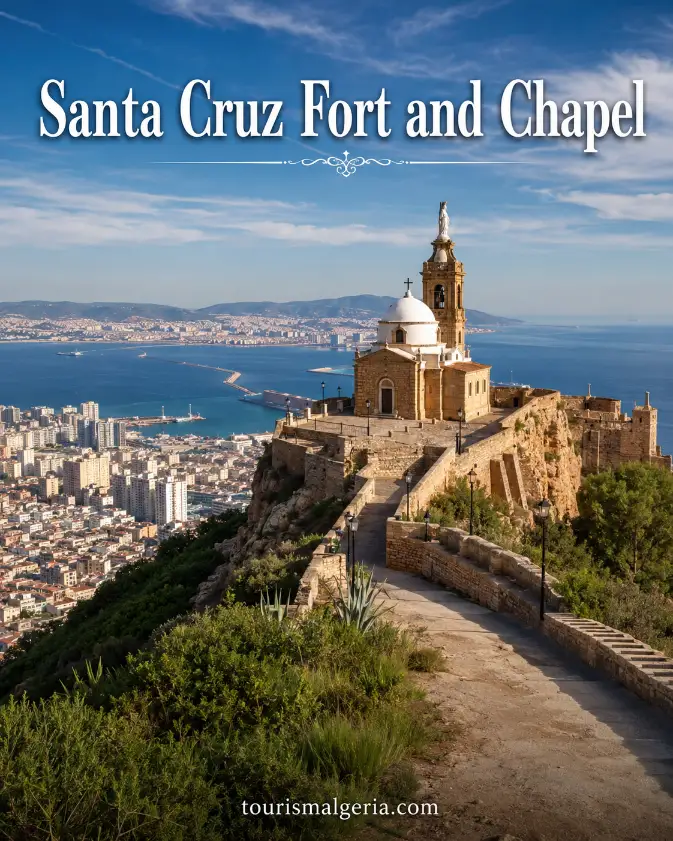
Santa Cruz Fort and Chapel in Oran, Algeria
Santa Cruz Fort and Chapel in Oran form one of Algeria’s most dramatic heritage ensembles, combining a Spanish defensive fortress with the Catholic sanctuary of Notre-Dame de Santa Cruz. Rising above the Mediterranean city, the two monuments unite military history, religious memory, panoramic scenery, and protected cultural heritage.
Santa Cruz Above the City of Oran
The complex stands high above Oran on Mount Murdjadjo, also known locally as Aïdour. From this elevated position, visitors can look across the city, port, coastline, and Mediterranean Sea. The steep setting explains why the mountain became important both strategically and symbolically throughout Oran’s long history.
Santa Cruz Fort and Chapel in Oran – Practical Visitor Information
Address, opening times, how to reach Santa Cruz by taxi, car or cable car, fort and sanctuary access, admission, history, panoramic views, guided visits, photography and other practical information for visiting Mont Murdjadjo in Oran.
Mount Murdjadjo Dominates the Landscape
Mount Murdjadjo dominates western Oran and reaches more than four hundred metres at its highest points. Its rocky slopes form a natural balcony above the city. The fort occupies the upper ridge, while the sanctuary sits below it, creating the celebrated silhouette visible from numerous neighbourhoods and coastal viewpoints.
A Naturally Strategic Position
The mountain’s strategic value comes from its commanding visibility over Oran and approaches toward Mers El Kébir. Any power controlling these heights could observe movement around the city and bay. This geography helps explain why military fortifications were established here during the long Spanish presence in Oran.
The Spanish Origins of Fort Santa Cruz
Fort Santa Cruz developed as part of Oran’s defensive system during the Spanish period. Its principal purpose was surveillance of the surrounding territory and approaches toward the strategically important harbour of Mers El Kébir, making its elevated location essential to the military protection of the city.
Part of a Larger Defensive Network
Santa Cruz did not function in isolation. Oran developed a wider network of defensive works positioned around strategic hills, approaches, and urban entrances. Algeria’s cultural authorities preserve several military monuments connected with this history, demonstrating how planners relied on interconnected fortifications rather than one single defensive position.
Protected Cultural Heritage in Algeria
Spanish Military Heritage in Oran
Spanish occupation profoundly shaped early modern Oran, particularly its defensive landscape. Fort Santa Cruz represents this military chapter more clearly than many surviving structures because its elevated position still reveals the logic behind controlling the port, roads, surrounding hills, and maritime approaches from a protected observation point.
Military Architecture Adapted to the Mountain
The fortress uses thick masonry walls, enclosed spaces, defensive platforms, and strategically positioned openings suited to a hilltop military installation. Its appearance is relatively austere, emphasizing protection rather than decoration. Walking through the surviving structure helps visitors understand the relationship between military architecture and steep mountain terrain.
Stone Walls Blending with the Mountain
The warm stone colour of the fortress blends closely with the rocks of Mount Murdjadjo. From a distance, its walls appear integrated into the ridge. This visual relationship between architecture and geology gives Santa Cruz a distinctive character, especially when sunlight intensifies the ochre and reddish tones of the mountain.
Watching the Route Toward Mers El Kébir
The fort’s commanding location allowed observation of both Oran and routes toward Mers El Kébir. That defensive function becomes immediately understandable from the summit, where the broad field of vision demonstrates why control of the mountain was valuable for monitoring movement across land and along the Mediterranean coastline.
A Fortress Changed by Successive Periods
Oran later passed through different political periods, and its defensive landscape evolved with changing authorities, weapons, and urban development. Fort Santa Cruz should therefore not be viewed as frozen in one historical moment. Its surviving fabric reflects centuries of strategic importance, adaptation, maintenance, abandonment, and conservation.
Fort Santa Cruz as Protected Heritage
The historic importance of Fort Santa Cruz has received official recognition within Algeria’s cultural heritage system. Protection helps preserve the fortress as an important surviving element of Oran’s military landscape and acknowledges its architectural, historical, and archaeological significance within the wider heritage of western Algeria.
Algerian Ministry of Culture and Arts
Conservation Protects the Fortress
Heritage protection means interventions affecting historic structures and their surroundings must respect conservation requirements. This framework helps safeguard surviving military architecture, walls, archaeological evidence, and the broader landscape that gives Santa Cruz much of its meaning, while allowing the monument to remain accessible to contemporary visitors.
Notre-Dame de Santa Cruz Below the Fort
Below the fortress stands the sanctuary commonly called the Chapel of Santa Cruz, associated with Notre-Dame du Salut, or Our Lady of Salvation. Although the fort and sanctuary share the same mountain setting and popular destination name, they belong to different historical periods and served entirely different purposes.
The Chapel Is Also Historic Heritage
The Chapel of Santa Cruz is recognized as an important historic religious monument in Oran. Its cultural significance extends beyond Catholic worship because the sanctuary has become associated with the city’s collective memory, interreligious encounters, pilgrimage traditions, and the history of Christian communities in modern Algeria.
The Cholera Epidemic and the Sanctuary
The sanctuary’s origins are closely connected with a devastating cholera epidemic that struck Oran in 1849. Catholic tradition associated the end of the epidemic with prayers addressed to the Virgin Mary, encouraging development of a sanctuary dedicated to Notre-Dame du Salut on the mountain overlooking the city.
Our Lady of Salvation
The title Notre-Dame du Salut, meaning Our Lady of Salvation, remains central to Santa Cruz’s religious identity. The Virgin associated with the sanctuary is also linked with Oran’s Catholic traditions. For generations, the site has attracted pilgrims as well as visitors interested in religious history and cultural memory.
The Sanctuary Developed Over Time
The sanctuary developed gradually rather than remaining a small nineteenth-century chapel. Additional structures and religious spaces transformed the site into a larger pilgrimage complex overlooking Oran. Its evolution reflects changing needs of the Catholic community as well as the increasing symbolic importance of Santa Cruz within the city.
Two Very Different Monuments
Today’s sanctuary is visually distinct from the fortress above it. Pale walls, arcades, a dome, bell tower, and Marian statue contrast with the heavier defensive masonry of Fort Santa Cruz. Seen together, the monuments create an unusual architectural composition where military history and religious devotion occupy the same mountainside.
An Active Catholic Sanctuary
The sanctuary continues to belong to the Catholic Diocese of Oran and remains an active place of prayer, pilgrimage, encounter, and cultural memory. Visitors should therefore understand that it is not simply a historical attraction. Religious services and community activities can influence access to particular spaces.
Architecture Designed Around the View
Architecturally, the sanctuary is organized around a church, arcaded spaces, terraces, and a prominent tower visible from the city below. Its location makes the surrounding open areas almost as important as the building itself because courtyards and terraces frame extensive Mediterranean and urban panoramas.
The Bell Tower and Marian Statue
The bell tower and Marian statue are among Santa Cruz’s most recognizable visual elements. Their vertical forms stand prominently against the sky and can be identified from parts of Oran below. Together with the sanctuary terraces, they contribute strongly to the visual identity of Mount Murdjadjo.
The Restoration of Notre-Dame de Santa Cruz
A major restoration programme renewed the sanctuary during the twenty-first century. Work addressed structural repair, architectural surfaces, the tower, colours, and interior and exterior spaces. The restoration sought to preserve the sanctuary’s historic character while improving the condition of a monument exposed to demanding mountain and coastal weather.
Preparing the Sanctuary for a New Era
The restoration helped prepare Notre-Dame de Santa Cruz for renewed religious, cultural, and visitor activity. The improved complex subsequently hosted important ceremonies and gatherings, reinforcing the sanctuary’s role as both a local landmark and a place associated with memory, dialogue, pilgrimage, and encounters between different communities.
The Beatification of the Martyrs of Algeria
On 8 December 2018, Notre-Dame de Santa Cruz hosted the beatification of nineteen Catholic martyrs of Algeria killed during the 1990s. The group included Bishop Pierre Claverie of Oran and the Trappist monks of Tibhirine, giving the sanctuary an important place in contemporary Catholic history.
Pierre Claverie and Mohamed Bouchikhi
Pierre Claverie, Bishop of Oran, was killed in 1996 together with Mohamed Bouchikhi, his young Algerian driver. Claverie’s life became associated with dialogue and friendship across religious boundaries. The beatification ceremony at Santa Cruz reinforced Oran’s place within the modern history of Algeria’s Catholic community.
A Place of Christian-Muslim Encounter
Santa Cruz has increasingly become associated with dialogue between Christians and Muslims. Catholic accounts describe Muslim visitors, shared events, and interreligious encounters at the sanctuary. This dimension is particularly meaningful in Oran, where the site’s contemporary identity emphasizes hospitality, memory, peace, and respectful coexistence.
The Sanctuary Remains Active Today
The sanctuary remains an active religious and cultural location under the Diocese of Oran. Visitors may encounter prayer, pilgrimage groups, religious celebrations, cultural meetings, and ordinary tourists during the same visit. Respecting the sanctuary’s spiritual function is essential even when visiting primarily for architecture or panoramic views.
Panoramic Views Over Oran
For many travellers, the panorama is one of the strongest reasons to visit Santa Cruz. From the mountain, Oran spreads below in a broad urban amphitheatre bordered by the Mediterranean. The harbour, coastline, city centre, surrounding hills, and distant sea become especially impressive under clear weather conditions.
Photographing Santa Cruz and Oran
Photography is particularly rewarding from terraces and elevated roads around Santa Cruz. Morning light can reveal details of the city and bay, while late afternoon gives warmer tones to the fortress and mountain. Visitors should remain behind barriers and avoid unstable edges when searching for panoramic compositions.
Reaching Santa Cruz by Road
Santa Cruz can be approached by road from Oran, with the final ascent following the slopes of Mount Murdjadjo. Conditions, parking arrangements, and access restrictions may change, so travellers should verify current local information. The steep terrain makes comfortable footwear useful even when arriving mainly by vehicle.
Walking Up Mount Murdjadjo
Visitors interested in walking should remember that the elevation and gradients can make the climb demanding, especially during warm weather. Carrying water, sun protection, and suitable footwear is sensible. A vehicle or taxi can make the visit easier for travellers who prefer a less strenuous ascent.
Combine Santa Cruz with Sidi El Houari
Santa Cruz provides an excellent introduction to Sidi El Houari, Oran’s historic district. Algeria protects the old city as an important heritage area containing historic streets, religious buildings, fortifications, and urban layers reflecting successive periods of Oran’s development and its strategic Mediterranean importance.
Understanding the Link with Mers El Kébir
A broader historical itinerary can connect Santa Cruz conceptually with Mers El Kébir, whose harbour was strategically linked to the fort’s surveillance role. Viewing the coastline from the mountain helps visitors understand why control of Oran and its neighbouring harbour mattered to successive Mediterranean military powers.
Visit the Ahmed Zabana National Museum
Back in central Oran, the Ahmed Zabana National Museum provides additional historical context through archaeological, ethnographic, artistic, and historical collections. Combining the museum with Santa Cruz allows travellers to move from panoramic military geography to exhibits explaining the much longer human and cultural history of western Algeria.
Choosing the Best Season
Spring and autumn are often comfortable periods for visiting because walking temperatures are generally milder than during the strongest summer heat. Clear winter days can also provide excellent visibility. Regardless of season, conditions on the exposed mountain may feel windier and cooler than streets near sea level.
Staying Safe Around the Fortress
Visitors should take particular care around fort walls, stairs, terraces, and exposed viewpoints. Historic masonry can be uneven, while wind and strong sun may add discomfort. Children should be supervised closely, and everyone should respect barriers or closed sections introduced for maintenance, conservation, or public safety.
Respecting the Sanctuary
At Notre-Dame de Santa Cruz, respectful behaviour is essential because the building remains a Christian sanctuary. Visitors should dress appropriately, speak quietly during worship, avoid interrupting ceremonies, and follow guidance concerning photography. People of different faiths can appreciate the site while respecting its active religious character.
Why Santa Cruz Is Worth Visiting
Santa Cruz is worth visiting because few places in Oran combine such different experiences within one mountain setting. The fortress explains the city’s military geography, the sanctuary reveals religious and social history, and the panoramic viewpoints provide one of the clearest visual introductions to Oran and its Mediterranean setting.
Author and Update
This guide was written and updated on 29 August 2026 by Nabil Frik for TourismAlgeria.com. Before visiting Santa Cruz Fort and the Notre-Dame de Santa Cruz sanctuary, travellers should verify current opening conditions, road access, religious services, and conservation restrictions through official Algerian and diocesan sources.