


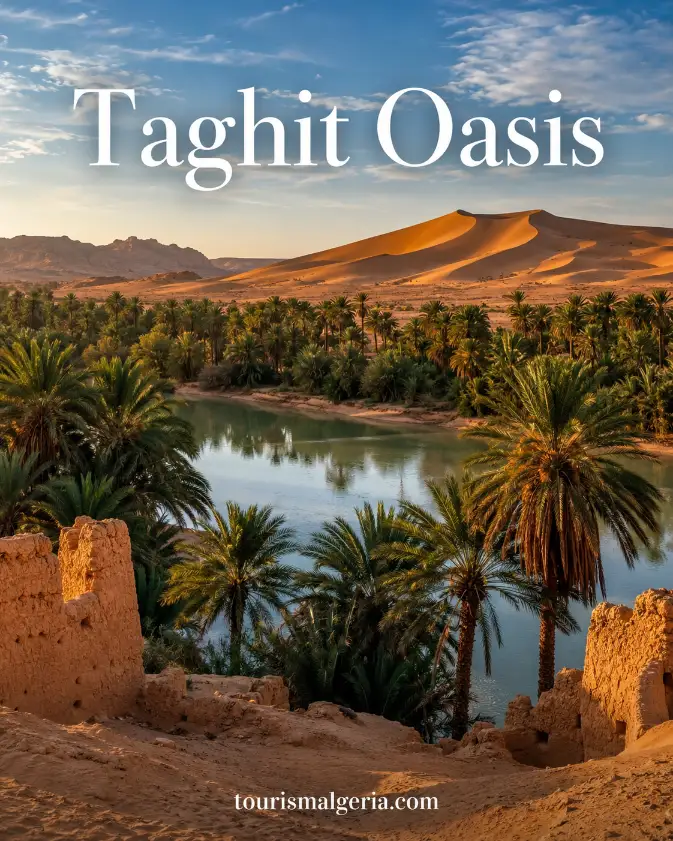
Taghit Oasis in Algeria
Taghit Oasis is a historic Saharan settlement in southwestern Algeria, known for its palm grove, medieval ksar, immense golden dunes, prehistoric rock engravings, and desert scenery. Located in Béchar Province near the Grand Erg Occidental, it combines natural beauty, traditional architecture, archaeology, and living oasis culture.
A Gateway to the Southwestern Sahara
Taghit lies in southwestern Algeria, about ninety-five kilometres from Béchar according to provincial tourism information. The settlement occupies a narrow oasis corridor where cultivated palms, rocky slopes, earthen buildings, and towering dunes meet, creating one of the most recognizable landscapes of the Algerian Sahara.
Taghit Oasis in Algeria – Practical Visitor Information
Location, how to get there from Béchar, opening and visiting times, the historic Ksar of Taghit, palm grove, giant dunes, prehistoric rock engravings, desert excursions, local guides, climate and useful official contacts.
The Grand Erg Occidental
The Grand Erg Occidental forms the spectacular sandy background to Taghit. Its immense dune fields stretch across western Algeria, producing ridges constantly reshaped by wind. Around Taghit, dunes rise immediately behind the settlement, making the transition between inhabited oasis, cultivated palm grove, and open desert especially dramatic.
The Famous Palm Grove of Taghit
Taghit’s palm grove is one of the features most strongly associated with the oasis. Date palms provide shade, agricultural value, and a green corridor contrasting sharply with surrounding rock and sand. Beneath their canopy, traditional oasis cultivation demonstrates how local communities transformed scarce water into productive agricultural land.
The Historic Ksar of Taghit
The old Ksar of Taghit is the historic architectural heart of the oasis. Algeria’s Ministry of Culture recognizes it as protected heritage. Its tightly grouped earthen houses, narrow passages, defensive character, and elevated position illustrate traditional Saharan settlement principles carefully adapted to climate, security, and limited resources.
A Nationally Protected Monument
The Ksar of Taghit received national heritage protection within Algeria’s cultural-property system. This recognition reflects the site’s historical and architectural importance and places conservation of its traditional urban fabric within an official legal framework intended to protect significant monuments, settlements, and archaeological heritage across the country.
Architecture Adapted to Desert Heat
Traditional ksar architecture responds directly to desert conditions. Thick earthen walls help moderate temperature changes, narrow streets provide shade, and compact construction reduces exposure to intense sun and wind. Locally available materials also give buildings colours that blend naturally with surrounding soil, rock, and desert landscapes.
Inside the Old Ksar
Walking through the old ksar reveals a dense network of passages rather than a modern street plan. Houses stand close together, turns are frequent, and shaded spaces appear unexpectedly. This arrangement encouraged privacy, climatic protection, social cohesion, and defence while preserving valuable cultivated land around the oasis.
Preserving Taghit’s Saharan Architecture
The ksar is not merely picturesque scenery but fragile architectural heritage requiring continuous conservation. Restoration must balance structural safety, traditional materials, historical authenticity, local memory, and the needs of contemporary residents. Research on Taghit also emphasizes the importance of preserving Saharan architectural heritage.
A Remarkable Oasis and Dune Panorama
The contrast between the old ksar and the giant dunes behind it creates Taghit’s most famous panorama. From elevated viewpoints, visitors can see earthen architecture, green palms, modern settlement areas, and uninterrupted sand within one frame, explaining why Taghit attracts photographers, filmmakers, and travellers seeking Saharan landscapes.
Walking on the Dunes
The dunes around Taghit are accessible for walking and guided desert excursions, but they deserve respect. Sand can become extremely hot, distances are deceptive, and orientation becomes difficult away from recognizable landmarks. Travellers should carry sufficient water and avoid remote dune exploration without reliable local knowledge or guidance.
Sunset Over Taghit
Sunset is one of the classic experiences in Taghit because low light intensifies the colours of dunes, palms, rocks, and the ksar. As the sun drops, dune ridges become sharply defined and shadows lengthen across the sand, creating changing compositions for photographers and memorable views for visitors.
Sunrise Across the Oasis
Sunrise provides a quieter alternative to sunset and often produces softer colours across the oasis. Cooler temperatures can make early walking more comfortable, while the first light reveals textures in palm groves, rock formations, and dune crests. Early hours may also offer calmer viewpoints and fewer visitors.
Prehistoric Heritage Around Taghit
Taghit is also important for prehistoric archaeology. Rock engravings and worked stone discovered around the region provide evidence of ancient human occupation. These remains demonstrate that today’s arid Saharan environment preserves traces of communities that lived during periods when local climate, vegetation, and animal life were different.
The El Hadjra Archaeological Site
El Hadjra is a documented archaeological location south of Taghit containing rock surfaces with prehistoric engravings. Algeria’s cultural heritage authorities record the site within the regional heritage inventory. Because desert archaeological locations can be difficult to identify and protect, visiting with informed local guidance is particularly sensible.
Protecting Ancient Rock Engravings
Ancient engravings should be observed without touching, tracing, wetting, chalking, or marking the rock surfaces. Prehistoric carvings are vulnerable to erosion and accidental damage, and seemingly harmless actions can alter them permanently. Visitors should follow heritage guidance and leave every archaeological object exactly where it is found.
Rock Art and Ancient Saharan Life
The wider Taghit region contains rock-art stations reflecting long periods of Saharan occupation. Motifs include animals and human figures associated with environments very different from the modern desert. Such imagery contributes evidence about changing ecosystems, hunting, pastoral activity, movement, and human relationships with the prehistoric Sahara.
Protecting Taghit’s Archaeological Landscape
Algerian heritage authorities continue to document and protect rock engraving sites around Taghit and the wider Béchar region. Radio Algérienne has reported on protection efforts. Responsible tourism requires visitors to avoid graffiti, collecting objects, off-road damage, and uncontrolled contact with archaeological surfaces.
Oasis Agriculture Beneath the Palms
The palm grove represents another form of heritage because it records generations of adaptation to limited water and extreme heat. Oasis agriculture depends on irrigation, shade, soil management, and crop selection. Date palms create an upper protective layer beneath which additional useful plants can grow more effectively.
Water Makes the Oasis Possible
Water determines the survival of every Saharan oasis. Taghit’s settlement, gardens, and palm grove developed because communities learned to manage scarce supplies efficiently. Wells, channels, shared practices, and agricultural knowledge transformed an arid environment into cultivated land capable of supporting permanent settlement over many generations.
Taghit as a Living Community
The modern town and historic oasis should be understood together rather than as separate worlds. Taghit remains a living community where residents work, study, farm, trade, and receive visitors. Tourism is most respectful when travellers recognize ordinary local life instead of treating the settlement as an open-air museum.
Traditional Crafts in Taghit
Traditional craftsmanship forms part of Taghit’s cultural and tourism identity. Regional artisans produce objects reflecting Saharan skills, materials, decorative traditions, and practical knowledge. Buying directly from legitimate local craftspeople can help tourism income remain within the community while supporting transmission of cultural practices to younger generations.
Saharan Food and Hospitality
Desert cuisine and hospitality can become an important part of a Taghit visit, especially when travellers stay in locally managed accommodation or join guided excursions. Meals may reflect southwestern Algerian traditions and available oasis products. Visitors should ask hosts about local dishes rather than expecting standardized tourist menus.
Sandboarding on the Dunes
Taghit attracts visitors interested in sandboarding and other dune-based recreation. These activities can add variety to a desert stay when practiced in suitable areas. Travellers should pay attention to heat, equipment, physical ability, environmental impact, and instructions provided by experienced local operators or guides.
Cultural Events and Celebrations
Taghit hosts cultural and seasonal events that can make particular periods livelier than ordinary weeks. Local celebrations may include music, crafts, traditional performances, and desert activities. Travellers planning around festivals should confirm exact dates, accommodation availability, and transport beforehand because programmes and schedules can change.
Stargazing in the Sahara
Nightfall changes Taghit completely. Away from intense urban lighting, the desert sky can become exceptionally clear when weather and atmospheric conditions cooperate. Stargazing from safe areas near the oasis offers a memorable complement to daytime exploration, particularly during cooler months and nights with limited moonlight.
Visiting Taghit in Winter
Winter is generally a popular period for Saharan travel because daytime temperatures are often more comfortable for walking and excursions. Nights, however, can become cold. Visitors should carry layers, a warm outer garment, and suitable footwear rather than assuming that every part of the Sahara stays hot after sunset.
Spring, Autumn, and Summer Conditions
Spring and autumn can also provide pleasant conditions, although temperatures vary considerably. Summer heat may become severe, especially on exposed dunes around midday. Travellers visiting during warmer periods should reduce strenuous activity, prioritize shade, carry sufficient drinking water, and follow local advice concerning heat and sun exposure.
Getting to Taghit from Béchar
Béchar is the principal regional gateway for reaching Taghit. Provincial tourism information places the oasis about ninety-five kilometres away. Travellers generally continue by road using private vehicles, taxis, or organized transfers, while current road conditions, transport availability, and departure times should be checked shortly before travel.
Exploring with a Local Guide
A local guide adds value beyond navigation. Guides can explain the ksar, palm grove, rock art, desert ecology, community history, and safe routes through surrounding terrain. For archaeological locations or off-road excursions, local knowledge is especially useful because sites can be difficult to locate responsibly without assistance.
How Long to Stay in Taghit
Taghit rewards a stay of several days rather than a brief photographic stop. Extra time allows visitors to explore the ksar, walk through the palm grove, visit archaeological sites, experience sunrise and sunset, enjoy local hospitality, and observe how settlement, agriculture, rock, and desert interact.
Building a Taghit Itinerary
A useful first day can focus on the old ksar and palm grove before ending on a nearby dune at sunset. Another day can be devoted to rock engravings with a guide. Additional time allows photography, desert walks, crafts, nearby settlements, or simply enjoying the oasis without rushing.
Photographing People and Heritage
Photography in Taghit benefits from respecting both people and heritage. Ask permission before taking close portraits, avoid entering private homes, and never rearrange objects for pictures. Around archaeological engravings, do not apply water or chalk to improve contrast because such practices can permanently damage ancient surfaces.
Respecting the Old Ksar
The ksar requires careful visitor behaviour because earthen walls and old structural elements can be fragile, especially after weathering or restoration work. Visitors should avoid climbing walls, entering closed buildings, or removing fragments. Following marked routes and local instructions helps reduce pressure on this protected monument.
Exploring Southwestern Algeria
Taghit can be combined with other destinations in southwestern Algeria, particularly Béchar, Kenadsa, and Béni Abbès, depending on current routes and travel plans. Each offers a different combination of oasis heritage, ksour, religious history, desert landscapes, or regional culture, creating a broader journey through the Saoura.
Combining Taghit with Béni Abbès
Béni Abbès is especially complementary because it offers another major oasis environment farther south. Its historic settlement and palm grove allow travellers to compare different Saharan landscapes and understand how communities across the region adapted architecture, agriculture, water management, and social organization to demanding environmental conditions.
Visiting Historic Kenadsa
Kenadsa provides another useful cultural extension from Béchar. Its historic urban heritage is connected with religious, architectural, and regional history. Travellers can compare its traditional built environment with Taghit while considering how different settlements responded to geography, water availability, trade, religious life, and community organization.
Responsible Tourism in Taghit
Responsible tourism matters in Taghit because desert environments and archaeological sites recover slowly from disturbance. Visitors should remove waste, avoid unnecessary driving across vegetation, respect water resources, and use established routes whenever possible. Supporting local guides, accommodation providers, artisans, and food businesses also benefits residents.
Why Taghit Oasis Is Worth Visiting
Taghit stands out because its attractions are interconnected rather than isolated. The ksar, dunes, palm grove, water, archaeology, crafts, and living community together form a distinctive cultural landscape. Understanding those relationships gives visitors a deeper experience than simply climbing a dune or photographing the old settlement.
Author and Update
This guide was written and updated on 29 August 2026 by Nabil Frik for TourismAlgeria.com. Before travelling to Taghit, visitors should verify current transport, accommodation, weather, archaeological access, and local guidance through official Algerian tourism and cultural authorities, particularly when planning remote desert excursions.