


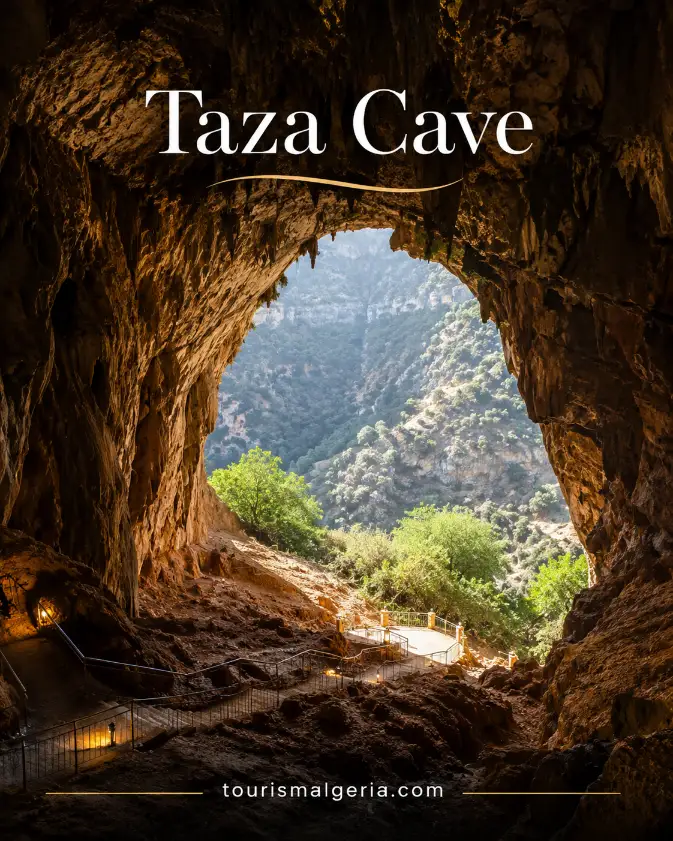
Taza Caves in Jijel, Algeria
The Taza Caves in Jijel are spectacular limestone caverns on Algeria’s eastern Mediterranean coast, famous for stalactites, stalagmites, mineral curtains, columns, and illuminated chambers. Often associated with the Grottes Merveilleuses near Ziama Mansouriah, they form one of the most memorable natural attractions around Taza National Park.
A Different Side of Coastal Algeria
Jijel is widely known for beaches, forested mountains, rocky coves, and clear Mediterranean water, yet the region also hides remarkable underground landscapes. The Taza caves reveal another dimension of this coastline, where water has slowly dissolved limestone and created chambers filled with delicate mineral formations.
Taza Caves in Jijel – Practical Visitor Information
Location, current opening status, how to reach the caves from Jijel, Ghar El Baz, the Grottes Merveilleuses, protected prehistoric caves, Taza National Park, cave temperature, accessibility, visitor rules and official tourism contacts.
Where the Taza Caves Are Located
The caves lie west of Jijel city in the direction of Ziama Mansouriah and Béjaïa, within the mountainous coastal environment associated with Taza National Park. Their position makes them easy to combine with a road journey through forests, cliffs, beaches, tunnels, and panoramic Mediterranean viewpoints.
The Grottes Merveilleuses
The best-known tourist cave is commonly called the Grottes Merveilleuses, meaning the Marvelous Caves. The name reflects the extraordinary shapes visible inside, where limestone deposits resemble curtains, columns, candles, frozen waterfalls, animals, and other imaginative forms created entirely through natural geological processes.
A Cave Discovered During Road Building
Local histories commonly connect the discovery of the tourist caves with early twentieth-century road construction along the difficult Jijel coastline. Cutting through limestone exposed underground cavities that had remained hidden from ordinary view, eventually transforming a construction discovery into one of the region’s most recognizable visitor attractions.
How the Caves Were Formed
The caves developed through karst processes acting on soluble limestone. Rainwater absorbed carbon dioxide from air and soil, becoming slightly acidic before entering fractures in the rock. Over very long periods, this water enlarged cracks into passages, cavities, and chambers beneath the surrounding mountains.
Stalactites Hanging from the Ceiling
Stalactites form when mineral-rich water drips from a cave ceiling and leaves tiny deposits of calcium carbonate behind. Layer after layer gradually builds downward. Some formations remain thin and delicate, while others become thick, elongated structures that dominate the ceiling and create a dramatic underground appearance.
Stalagmites Rising from the Floor
Stalagmites develop where droplets fall onto the cave floor and deposit additional minerals. They grow upward, often directly beneath stalactites. When formations from ceiling and floor eventually meet, they can create continuous limestone columns that appear structural even though they were produced slowly by dripping water.
Curtains and Flowstone
Not every formation grows vertically. Water moving across sloping rock can deposit thin sheets called curtains, draperies, or flowstone. Their folded surfaces often resemble fabric, frozen cascades, or organ pipes, adding visual variety to the chambers and demonstrating how small differences in water movement shape limestone.
Why the Formations Have Different Colours
Cave formations are not always pure white. Minerals and impurities carried by water can introduce cream, yellow, orange, brown, or reddish tones. Artificial lighting can make these colours appear stronger, so visitors should remember that the cave’s natural appearance changes considerably depending on illumination and moisture.
Walking Through the Tourist Cave
The accessible cave has been adapted for visitors with a defined route, lighting, steps, and protective barriers in key areas. The experience remains different from an ordinary museum because surfaces can be wet, spaces may narrow suddenly, and temperature and humidity change noticeably after entering underground.
A Naturally Cool Interior
The cave interior generally feels cooler than the summer air outside, which can be especially refreshing during hot coastal weather. Visitors should nevertheless avoid assuming it will feel cold everywhere, because humidity, crowding, airflow, and seasonal conditions influence comfort throughout the underground route.
Lighting Reveals the Limestone Forms
Installed lighting highlights stalactites, stalagmites, columns, and textured walls that would otherwise remain difficult to appreciate. Good cave lighting can reveal depth and shape without requiring visitors to carry powerful lamps, although dark corners still remind travellers that they are inside a natural subterranean environment.
Use the Railings and Steps Carefully
Cave floors and steps can become slippery because of constant humidity and dripping water. Visitors should use railings where available, avoid rushing, and wear shoes with reliable grip. Children need close supervision, especially on stairs, narrow passages, and areas where other visitors may be moving in both directions.
Taza National Park Around the Caves
The caves belong to a broader natural region shaped by Taza National Park, where forested mountains descend toward the Mediterranean. This protected landscape combines cliffs, beaches, woodland, gorges, karst formations, and wildlife, making the cave visit only one part of a much richer coastal nature experience.
Forests Above the Limestone
Dense Mediterranean forests cover much of the surrounding mountain terrain, creating a striking contrast with the mineral world underground. Oaks and other native vegetation help stabilize slopes, support wildlife, and capture moisture, while shaded roads and trails give the park a greener character than many visitors expect in Algeria.
Mountains Meeting the Mediterranean
One of the most impressive features of western Jijel is the abrupt meeting of rugged mountains and sea. Roads curve around cliffs and forested slopes before opening onto coves and beaches. This dramatic geography makes journeys toward Taza and Ziama Mansouriah scenic even before visitors reach the caves.
A Landscape Shaped by Water
Water has influenced nearly every part of the Taza landscape. Rain shaped underground caves, streams cut valleys, waves eroded the coast, and springs supported vegetation. Seeing the caverns together with nearby cliffs and forests helps visitors understand how geological and hydrological processes created the region’s exceptional diversity.
Wildlife in the Taza Region
Taza National Park protects important Mediterranean habitats and a range of wildlife adapted to forests, cliffs, caves, and coastal ecosystems. Sightings are never guaranteed, but the protected status of the landscape gives nature enthusiasts opportunities to observe birds, small mammals, reptiles, and other species responsibly.
The Barbary Macaque
The wider Jijel and northeastern Algerian mountain region is associated with the Barbary macaque, one of North Africa’s most distinctive mammals. Visitors who encounter monkeys should keep their distance, avoid feeding them, secure food, and remember that wild animals should never be encouraged to approach people or vehicles.
Birdlife Along Forests and Cliffs
Forested slopes and coastal cliffs support varied birdlife, especially where habitat remains relatively undisturbed. Travellers interested in birds should carry binoculars and observe quietly from established paths. Early morning often provides better opportunities than busy midday periods when traffic and visitor activity are greater.
Beaches Near the Taza Caves
The coast around Taza offers several attractive beaches and rocky coves, allowing visitors to combine underground exploration with time beside the Mediterranean. Conditions differ considerably from one beach to another, and swimming safety depends on currents, waves, weather, lifeguard presence, and whether the beach is officially supervised.
The Beach of the Marvelous Caves
The coastal area associated with the Grottes Merveilleuses includes a beach known locally by the same attraction name. Its setting between mountains and sea gives travellers an appealing combination of swimming scenery and geological interest, although current access and bathing conditions should always be checked locally.
Ziama Mansouriah as a Nearby Base
Ziama Mansouriah is the nearest significant coastal town for many visitors exploring the western side of Taza National Park. It can serve as a practical base for beaches, coastal drives, local restaurants, and excursions toward caves and forest landscapes while remaining connected with Jijel and Béjaïa by road.
Travelling from Jijel City
Visitors based in Jijel can reach the cave area by travelling west along the coastal road toward Ziama Mansouriah. The journey itself is part of the attraction, passing mountainous scenery, Mediterranean viewpoints, forest sections, tunnels, beaches, and small settlements distributed along this spectacular stretch of eastern Algeria.
Allow Time for the Coastal Road
Driving distances can appear modest on a map, but mountain roads may require more time than expected. Curves, seasonal traffic, roadworks, scenic stops, and busy summer conditions can slow travel. Visitors should leave generous time rather than planning the cave as a rushed stop between distant destinations.
Best Time to Visit the Caves
The caves can provide an interesting visit during different seasons, but the surrounding coastal experience changes throughout the year. Summer brings beach activity and heavier visitor numbers, while spring and autumn often provide milder conditions for walking, driving, photography, and exploring forested landscapes around the park.
Summer Visits
Summer is popular because travellers combine the caves with Jijel’s beaches, yet this also means heavier traffic and larger crowds. Visiting earlier in the day may improve comfort. The cave interior offers relief from outdoor heat, but waiting areas and nearby exposed spaces can still become very warm.
Spring and Autumn
Spring and autumn are attractive for travellers interested in scenery rather than beach holidays alone. Forests can feel fresher, daytime temperatures may be more comfortable, and roads can be less congested outside major holiday periods. Rain remains possible, so footwear and driving plans should match current weather.
Photography Inside the Caves
Cave photography can be challenging because light levels are low and reflective formations create strong contrasts. Visitors should respect any restrictions on flash, tripods, or professional equipment. Holding a camera steadily and using existing illumination often produces more natural results than aggressively brightening every underground surface.
Do Not Touch the Formations
Stalactites and stalagmites may look solid, but their surfaces can be sensitive to oils, dirt, and physical contact. Touching also encourages others to do the same. Visitors should stay behind barriers and allow mineral formations to continue developing without interference from hands, climbing, scratching, or collecting.
Protect the Cave Environment
Caves are enclosed ecosystems where damage can persist for very long periods. Visitors should remove all litter, avoid disturbing animals, remain on designated paths, and follow staff instructions. Responsible tourism protects not only visible formations but also water quality, microorganisms, and other less obvious components of subterranean ecology.
Exploring Jijel Beyond Taza
A cave visit fits naturally into a wider exploration of Jijel Province. Travellers can combine Taza with beaches, forest viewpoints, Jijel city, coastal villages, and mountain landscapes, creating an itinerary that alternates between underground geology, Mediterranean scenery, local food, and relaxed time along the shoreline.
Jijel City as the Main Gateway
Jijel city offers the broadest selection of accommodation, restaurants, transport, shops, and visitor services in the province. Staying there gives travellers flexibility to explore both eastern and western coastal areas while returning each evening to a larger urban base with convenient access to essential facilities.
Combine Nature and Seaside Tourism
The strongest Jijel itineraries often combine several environments rather than focusing exclusively on one attraction. A morning cave visit can be followed by a coastal viewpoint, forest stop, or beach. This variety makes the region particularly suitable for travellers interested in both nature and Mediterranean leisure.
Respecting a Protected Landscape
Taza’s caves, forests, cliffs, and coastline should be treated as connected parts of one protected environment. Visitors can reduce their impact by using established routes, avoiding litter, limiting unnecessary noise, respecting barriers, and supporting local services that depend on maintaining the region’s natural attractiveness.
Travelling with Children
Families can enjoy the tourist cave when children are comfortable with enclosed spaces, steps, darkness, and slippery surfaces. Adults should keep younger visitors close, explain why formations cannot be touched, and avoid forcing anxious children deeper underground if they become uncomfortable with the cave environment.
What to Bring
Comfortable non-slip shoes are more useful than sandals for the cave itself. Visitors may also appreciate a light outer layer, drinking water for the outdoor portion of the visit, sun protection, and a small bag that keeps hands free when using steps and railings inside.
Why the Taza Caves Are Worth Visiting
The Taza caves are worth visiting because they reveal a hidden geological world beneath one of Algeria’s most beautiful coastal landscapes. Their mineral formations, cool chambers, forested surroundings, nearby beaches, and dramatic mountain roads create an experience that combines geology, nature, photography, and Mediterranean travel.
Author and Update
This guide was written and updated on 29 August 2026 by Nabil Frik for TourismAlgeria.com. Travellers planning to visit the Taza caves should verify current opening conditions, road access, admission arrangements, and any temporary restrictions locally before departure, especially during busy summer periods or after severe weather.