
Origin of the Word Casbah
The word Casbah, also written Kasbah or Qasbah, comes from the Arabic word qaṣabah, meaning a fortified quarter, citadel or old urban stronghold, and in Algiers it became associated with the historic upper town, defensive structures and old medina identity.
Why the Casbah of Algiers Is Important
The Casbah of Algiers is important because it represents centuries of urban life, trade, religion, resistance and Mediterranean exchange, while holding UNESCO World Heritage value for its distinctive architecture, traditional city organisation, historic continuity and symbolic place in Algerian memory and identity.
The History of the Casbah of Algiers
The history of the Casbah of Algiers reflects medieval foundations, Ottoman rule, religious scholarship, commercial life and the colonial period, creating a layered urban space where houses, streets, mosques and palaces preserve traces of Algeria’s political, social and cultural evolution.
The Architecture of the Casbah of Algiers
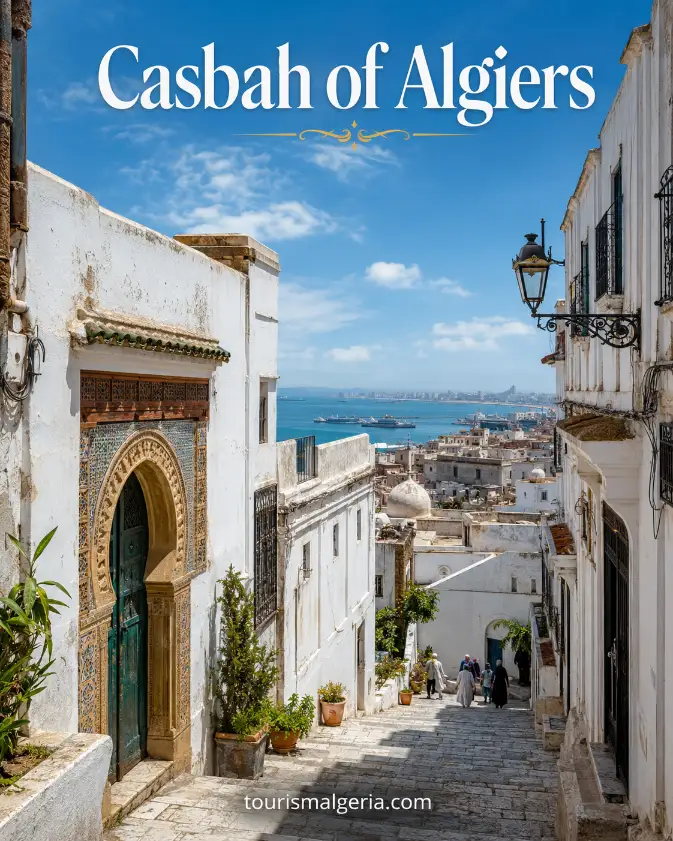
The architecture of the Casbah of Algiers is defined by white façades, inner courtyards, steep stairways, tight lanes, traditional houses, decorative doors, small squares and Ottoman structures, all adapted to hillside terrain, climate, privacy and Mediterranean urban life.
What Visitors Can See in the Casbah
Visitors to the Casbah of Algiers can discover historic mosques, old houses, Ottoman palaces, local markets, hidden passages, elevated viewpoints and residential quarters, where the district’s charm comes from monuments, street life and the atmosphere of a living heritage space.
Why a Guided Visit Is Often Better
A guided visit is often the best way to explore the Casbah of Algiers because the area is complex, many streets look similar, and the deeper meaning of buildings is not always visible without historical, architectural and local explanation.
Best Time to Visit the Casbah of Algiers
The best time to visit the Casbah of Algiers is usually spring, autumn or mild winter days, when walking conditions are more comfortable, light is better for photography and visitors can explore slowly without the stronger summer heat affecting sightseeing.
Safety and Respect Inside the Casbah
Visitors should treat the Casbah of Algiers with respect because it is not only a monument but also a residential neighbourhood, meaning calm behaviour, careful photography, modest clothing and sensitivity toward residents are essential for a positive visit.
Nearby Attractions to Combine With the Casbah
The Casbah of Algiers can be combined with nearby attractions such as the seafront, central Algiers, museums, Martyrs’ Memorial, Notre Dame d’Afrique and colonial-era boulevards, creating a fuller itinerary mixing old heritage, modern city life and panoramic viewpoints.
Why the Casbah Appeals to Different Travellers
The Casbah of Algiers appeals to history lovers, photographers, architecture enthusiasts, cultural travellers, students and first-time visitors because it offers visual depth, layered heritage, human atmosphere and strong sense of place beyond a simple sightseeing stop.
How to Plan a Visit to the Casbah
To plan a visit well, travellers should wear comfortable shoes, carry water, allow enough time, choose a clear meeting point when using a guide and understand that the district is best experienced as a slow cultural exploration.
Common Mistakes to Avoid
Common mistakes include arriving without preparation, rushing the district, treating it only as a photo backdrop, ignoring its residential character, wearing unsuitable shoes or expecting a museum-style visit instead of an authentic historic neighbourhood with real local rhythms and limits.
Service Providers and Organisations Related to the Casbah of Algiers
- UNESCO World Heritage Centre — official heritage reference for the Casbah of Algiers: https://whc.unesco.org/en/list/565/
- Ministry of Culture and Arts of Algeria — useful for cultural heritage context and institutional information.
- Licensed local guides in Algiers — useful for walking tours, historical explanations and safe navigation.
- Algerian tour agencies — useful for combining the Casbah with wider Algiers sightseeing programmes.
- Hotel concierges in Algiers — useful for arranging short guided visits and transport coordination.
- Local heritage associations — useful for cultural interpretation and preservation-oriented visits.
- Tourism information services in Algiers — useful for practical visitor orientation and city planning.
Final Travel Advice
The Casbah of Algiers should be approached as one of Algeria’s most valuable heritage experiences, where the quality of the visit depends on time, respect, walking comfort, local interpretation and cultural curiosity, allowing travellers to understand Algiers through its oldest symbolic urban heart.
Reading the Street Plan of the Casbah of Algiers
The Casbah of Algiers is built on a steep slope, so the lanes behave more like staircases than streets. Many passages are covered by vaulted bridges that link houses across the lane, a feature known locally as a sabbat, and these shaded tunnels explain why the old city feels cool, intimate and slightly labyrinthine. Walking downhill toward the sea is usually easier than climbing back, which is worth remembering when planning a route. Because the Casbah of Algiers has few straight lines, a guide or a clear map of the main axes saves time, and it is wise to note one or two landmarks near the lower entrances so that the way back is easy to find.
Rooftops and Daily Life in the Casbah
Flat terraces are part of the character of the Casbah of Algiers, offering views over neighbouring roofs and the bay. They are also private family spaces, so a viewpoint should be visited only with the host’s clear invitation or a guide’s arrangement. From above, the white cubic houses of the Casbah of Algiers appear to descend like steps toward the harbour, an image that explains why the old city has inspired so many painters, photographers and writers.
Conservation Questions for the Casbah of Algiers
Age, steep terrain and dense housing mean that many buildings in the Casbah need careful maintenance, and restoration has been a long-running subject of public discussion. Visitors can support respectful heritage tourism by staying on open lanes, avoiding fragile doorways and asking a local guide which houses are inhabited and which are being repaired.
Questions to Ask a Guide in the Casbah
- Which lanes are comfortable for walking and which are especially steep?
- Which buildings are open to visitors on the day?
- Where may photographs be taken and where should cameras stay down?
- How long does a relaxed walk through the Casbah of Algiers take at a comfortable pace?
Good answers to these questions turn a visit to the Casbah of Algiers into a calm, well-paced exploration of a place where heritage and daily life still share the same lanes.