
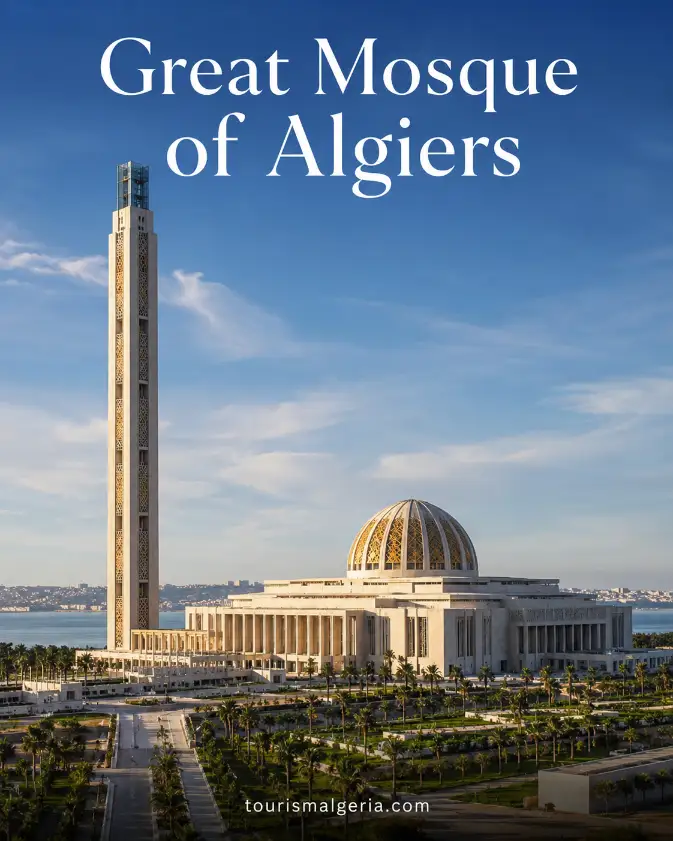
Visiting Times for the Great Mosque of Algiers
The latest public visitor schedule found indicates that the mosque opens to visitors daily from 10:00 a.m. and remains accessible until around 30 minutes after the Isha prayer, although times may change according to prayers, Ramadan, Fridays or official events.
Are Men and Women Separated?
For prayer, men and women are separated. The mosque has a dedicated women’s prayer balcony on the upper floor, overlooking the main prayer hall from behind wooden mashrabiya screens, with its own access route and capacity for thousands of female worshippers.
Can Men and Women Visit Together?
Men and women can generally visit the mosque complex together as visitors, but inside the prayer space they should respect mosque rules, modest dress, quiet behaviour and gender-separated prayer arrangements if they are entering for worship.
Best Time to Visit
The best time to visit is usually mid-morning or late afternoon, outside the busiest prayer periods, because visitors can better appreciate the architecture, prayer hall atmosphere, courtyards, minaret views and the scale of the mosque complex.
Practical Advice Before Going
Visitors should dress modestly, remove shoes before entering prayer areas, avoid disturbing worshippers, check same-day access conditions, respect photography rules and avoid planning a casual tourist visit exactly during Friday prayer or major religious events.
Why Visit Djamaâ El-Djazaïr
The mosque is worth visiting because it represents modern Algerian Islamic architecture on a monumental scale, combining religious function, national symbolism, Andalusian-Maghrebi inspiration, contemporary engineering and a strong visual presence on Algiers Bay.
Main Visitor Points
- Prayer hall
The main prayer hall is the spiritual centre of the mosque and should be visited respectfully, especially around prayer times. - Women’s prayer balcony
The official mosque design includes a separate upper women’s prayer area, confirming gender separation during worship. - Minaret
The minaret is one of the most recognisable architectural features of the mosque and a key visual symbol of modern Algiers. - Courtyards and exterior architecture
The outside spaces help visitors appreciate the scale, symmetry, stonework and monumental design of the mosque complex. - Cultural and spiritual visit
Djamaâ El-Djazaïr is not only a monument, but an active place of worship, so the best visit combines architecture, respect, silence and awareness of Islamic practice.
Simple Visitor Summary
Visit after 10:00 a.m., avoid prayer peaks, dress modestly, expect men and women to pray separately, and verify the same-day timetable locally because mosque access can change with prayer schedules and religious events.
Great Mosque of Algiers and the Bay of Algiers
The Great Mosque of Algiers stands directly on the waterfront in Mohammadia, on the eastern side of the bay, and its position is as important as its size. Unlike the older mosques hidden in the lanes of the Casbah, this building is meant to be seen from a distance, from the coastal road, from ships and from the hills across the bay. The minaret is often described as the tallest in the world, which makes it a natural orientation point: on a clear day visitors can locate it from many parts of the capital and use it to understand how the city is laid out along the sea.
The open ground around the building gives space to walk slowly, to look back at the façade and to understand how the architects handled a very large mass beside the water. Sea air, wind and strong sunlight shape the experience, so a hat and light layers are more useful here than at an indoor monument.
Great Mosque of Algiers Compared With the Historic Mosques of the Casbah
A rewarding way to understand the Great Mosque of Algiers is to compare it with Djamaa el Kebir, Djamaa el Djedid and Ketchaoua, the older mosques of the historic centre. Those buildings grew within a dense medina, with modest exteriors, fitted into the street pattern, and interiors discovered only after entering. The new mosque does the opposite: it is open, symmetrical and monumental, built for large congregations on a scale that earlier builders did not need. Seen together, they show how Algerian religious architecture has moved from intimate urban forms to national symbols, while still drawing on the same Maghrebi vocabulary of arches, geometry, calligraphy and carved wood.
Great Mosque of Algiers: Architecture to Look For
The design draws on Maghrebi and Andalusian traditions, so details are worth noticing rather than simply photographing from afar.
- Geometric patterns that repeat on screens, doors and surfaces
- Calligraphy panels with verses and decorative script
- Horseshoe and pointed arches that frame views across the prayer space
- Carved wood and mashrabiya-style lattice work
- The relationship between daylight and the interior, which changes during the day
Reading these elements slowly turns a quick look at the Great Mosque of Algiers into an introduction to the visual language of Islamic art in North Africa.
A Wider Cultural Complex Beyond the Prayer Hall
The Great Mosque of Algiers is generally presented as a complex rather than a single hall, with educational and cultural functions such as a library and spaces for Quranic learning alongside worship. Which of these areas are open to the public can change, so it is sensible to ask on arrival instead of assuming. Visitors with a particular interest in Islamic art, calligraphy or architecture should say so to a guide, because staff and local hosts can often point to the most interesting areas that casual visitors miss.
Great Mosque of Algiers for Families, Groups and Photographers
Families should expect long walking distances across open ground and plan breaks, especially in summer. Children are welcome in the spirit of a place of worship but should be reminded to speak softly. Groups benefit from a single guide who can explain what is visible and keep the group out of the way of worshippers. Photographers will find the best exterior images in softer morning or late afternoon light, with the bay as background, while photographs of people at prayer should be avoided without permission.
Common Mistakes at the Great Mosque of Algiers
- Treating the mosque as a stop of a few minutes, instead of allowing time to walk the grounds
- Assuming that every area shown in photographs is open to visitors
- Arriving in clothing that is too revealing or too light for a place of worship
- Ignoring the weather, especially strong sun and wind beside the sea
- Overlooking the older mosques of the Casbah, which explain the tradition this building builds on
A calm, curious and well-prepared visit to the Great Mosque of Algiers rewards travellers who want to see how modern Algeria expresses faith, identity and ambition in stone.