
Visiting Times for the Great Mosque of Tlemcen
Published visitor information indicates that tourist visits are usually possible in the morning from 8:00 to 11:00, with Friday closure and a guide required, although the mosque remains an active place of worship and access can change according to prayer times.
Are Men and Women Separated?
For prayer, men and women are normally separated, as expected in a traditional congregational mosque. For non-prayer cultural visits, men and women can generally visit the mosque complex together, provided they respect modest dress, quiet behaviour and mosque rules.
Why the Great Mosque of Tlemcen Is Important
The mosque is important because it is one of the major surviving monuments of Almoravid architecture in Algeria, combining religious function, Maghrebi design, Andalusian artistic influence and later Zayyanid additions in the historic heart of Tlemcen.
The Full Story of the Mosque
The story begins in the Almoravid period, when Yusuf ibn Tashfin’s power expanded across the western Maghreb and the city of Tagrart, today’s Tlemcen, became a strategic urban centre where a major congregational mosque was established.
Almoravid Foundation
The mosque was first founded in the late 11th century, commonly dated to 1082, under the Almoravid ruler Yusuf ibn Tashfin, then substantially rebuilt and enlarged under his son Ali ibn Yusuf, with an inscription dating the reconstruction to 1136.
Zayyanid Expansion and the Minaret
The mosque did not remain frozen in its first Almoravid form. During the Zayyanid period, Tlemcen became a major royal capital, and the mosque was modified, with the minaret commonly linked to Sultan Yaghmurasen Ibn Zyan in the 13th century.
Architecture and Layout
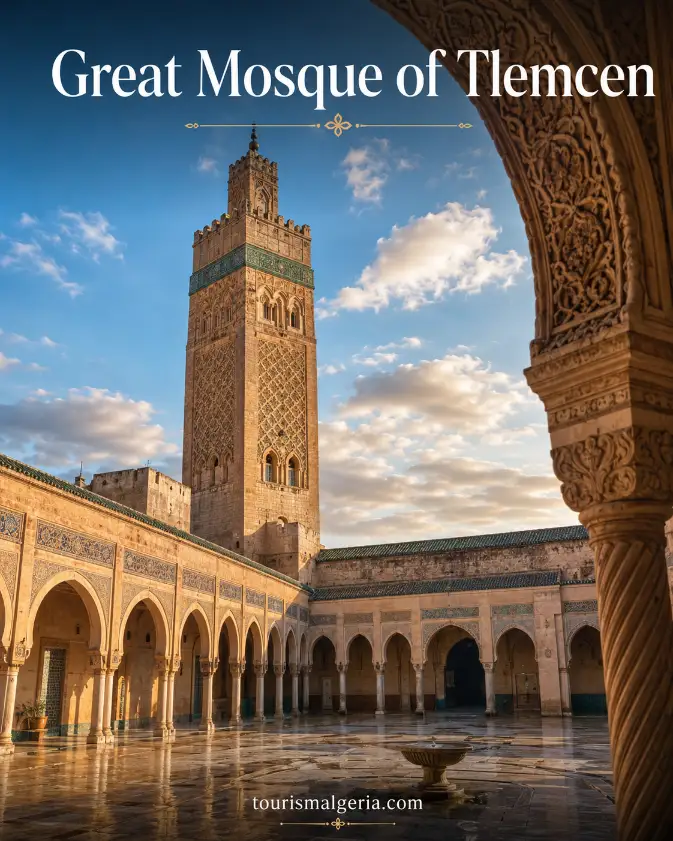
The Great Mosque of Tlemcen follows a major Maghrebi mosque plan, with a rectangular courtyard, galleries, naves perpendicular to the qibla wall and a prayer hall organised by arcades, creating a sober but powerful religious space.
The Mihrab and Decorated Dome
The most beautiful artistic feature is the area around the mihrab, where the dome above the prayer niche uses slender ribs, geometric composition and delicate ornamentation, creating one of the finest medieval Islamic interiors in Algeria.
Almoravid Refinement
The mosque shows how Almoravid architecture could combine austerity and elegance: the building is not overloaded, but the sacred focal points, especially the mihrab and dome, receive rich decorative attention through arches, stucco and geometric rhythm.
Tlemcen as a Spiritual and Cultural Capital
The mosque also reflects the wider identity of Tlemcen, a city long associated with Islamic scholarship, royal courts, Andalusian-Maghrebi culture, Sufi memory, craft traditions and historic monuments such as El Mechouar, Mansourah and Sidi Boumediene.
What Visitors Can See
Visitors can admire the courtyard, arcades, minaret, prayer hall, horseshoe arches, mihrab zone, carved decoration and the calm atmosphere of a historic mosque that is still linked to living religious practice rather than being only a museum monument.
Best Time to Visit
The best time to visit is usually in the morning, outside prayer times, especially if the commonly cited 8:00 to 11:00 visitor window is applied locally. Avoid Friday prayer, major religious holidays and busy worship periods.
Practical Dress and Behaviour
Visitors should dress modestly, remove shoes where required, avoid loud conversation, ask before taking photographs, respect worshippers, avoid crossing in front of people praying and follow local guidance if some spaces are closed to tourists.
Main Highlights of the Great Mosque of Tlemcen
- Almoravid foundation
The mosque is one of Algeria’s key Almoravid religious monuments, with origins in the late 11th century and major 12th-century development. - Mihrab and dome
The mihrab area and its decorated dome are the artistic heart of the mosque, showing refined Maghrebi-Islamic design. - Zayyanid minaret
The minaret reflects the later importance of Tlemcen under the Zayyanid dynasty and gives the mosque its strong vertical landmark. - Historic courtyard
The courtyard offers a calm architectural space framed by arches and linked to the daily rhythm of an active mosque. - Horseshoe arches
The arches connect the mosque visually to wider Maghrebi and Andalusian architectural traditions. - Prayer hall
The prayer hall preserves the religious function of the building and shows how architecture directs attention toward the qibla and mihrab. - Central Tlemcen location
Its position in the city centre makes it easy to combine with the medina, markets, El Mechouar and other historic sites. - Living monument
The mosque is not only a tourist attraction; it is still a functioning place of worship, so respectful behaviour is essential. - Tlemcen heritage route
The visit works well with Mansourah, Sidi Boumediene, El Mechouar Palace and other monuments connected to Tlemcen’s medieval importance. - Symbol of Algerian Islamic architecture
The mosque is one of the best places to understand Algeria’s medieval Islamic heritage beyond Roman ruins and coastal monuments.
How to Use This Page Before Visiting
Travellers should use this guide to confirm local visiting hours, plan a morning visit, avoid Friday prayer, dress modestly, understand gender separation during worship and appreciate the mosque as both a masterpiece of architecture and an active sacred place.
Great Mosque of Tlemcen Within the Old Town of Tlemcen
The Great Mosque of Tlemcen sits among the streets of an old city that rises toward the hills of north-western Algeria, so the walk to the mosque is part of the visit. Approaching on foot lets travellers see how the building fits into the fabric of shops, houses and squares, and how its minaret stands out from the surrounding roofs.
What to Look For in the Great Mosque of Tlemcen
Because access is usually limited and guided, it helps to arrive with a short list of details: the rhythm of the arches, the carved decoration, the light falling into the courtyard and the contrast between the plain areas and the richly ornamented mihrab zone. A guide can explain the inscriptions and the different building phases, which are hard to read without help.
Questions for a Guide at the Great Mosque of Tlemcen
- Which parts belong to the earliest phase and which to later changes?
- Where may visitors stand without disturbing worshippers?
- Are photographs allowed in the courtyard and in the prayer hall?
A quiet, patient approach is the best way to appreciate the Great Mosque of Tlemcen as a place of worship and a monument of Maghrebi craft.
Great Mosque of Tlemcen and the Craft Traditions of the Region
The Great Mosque of Tlemcen belongs to a wider world of Maghrebi craftsmanship in wood, stone, plaster and metal. Visitors who look closely may notice geometric patterns, floral motifs and calligraphy, each following rules that master craftsmen learned over generations. Seeing these details in the Great Mosque of Tlemcen makes it easier to appreciate other workshops and monuments in the old town, where traditional skills are still admired.
Great Mosque of Tlemcen and Photography With Respect
Photographing a living place of worship calls for sensitivity. Ask permission before raising a camera, avoid including worshippers without their consent and never use flash near people who are praying. Exterior views of the minaret and the surrounding streets are often easier to capture, and early or late light adds warmth to the stone. Patience usually brings better pictures than haste.
Great Mosque of Tlemcen Combined With Other Sites in the City
A morning at the Great Mosque of Tlemcen pairs well with a slow walk through nearby streets, markets and tea houses. Tlemcen has a long history as a centre of learning and art, so travellers can plan a day that mixes monuments with museums and viewpoints. Allow time between visits for rest and conversation, since the city rewards unhurried exploration.
Great Mosque of Tlemcen: Common Mistakes to Avoid
- Arriving during prayer times without checking access.
- Wearing revealing or casual clothing instead of modest dress.
- Speaking loudly or treating the building as a simple backdrop.
- Rushing through in minutes instead of taking time to observe.
Careful preparation turns a short stop into a lasting memory of the Great Mosque of Tlemcen.