


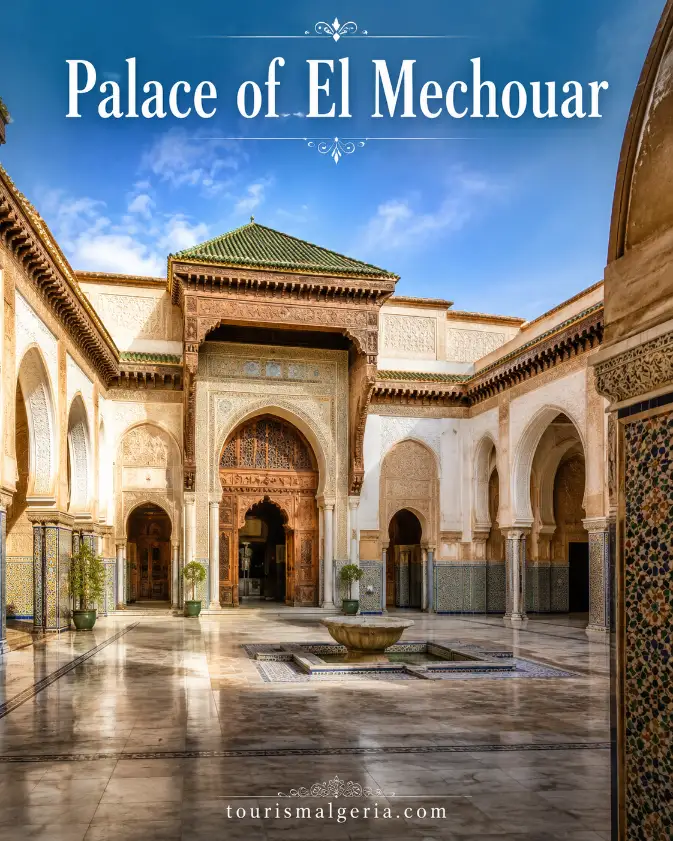
Palace of El Mechouar in Tlemcen, Algeria
The Palace of El Mechouar in Tlemcen is a historic royal complex associated with the Zayyanid dynasty, which ruled the Kingdom of Tlemcen during the medieval period. Located inside a fortified citadel, it combines palace remains, reconstructed court architecture, defensive walls, a historic mosque, and cultural exhibition spaces.
A Royal Citadel in Central Tlemcen
El Mechouar stands in the centre of Tlemcen, close to the old city’s principal monuments and museums. Its fortified enclosure once formed a political heart of the Zayyanid capital, concentrating royal residence, administration, ceremony, defence, religious activity, and court life within a strongly protected urban compound.
El Mechouar Palace in Tlemcen – Practical Visitor Information
Address, opening arrangements, how to get there, entrance information, palace architecture, traditional costume centre, history, photography, recommended visit duration and official tourism contacts.
The Zayyanid Dynasty and Tlemcen
The Zayyanids, also called the Abd al-Wadids, made Tlemcen the capital of an important Maghrebi kingdom. The city became a major political and cultural centre of the central Maghreb, particularly between the thirteenth and sixteenth centuries, when trade, scholarship, architecture, and courtly culture developed strongly. UNESCO
Yaghmurasen Ibn Zyan Founded the Royal Seat
Algerian heritage records attribute the thirteenth-century citadel to Yaghmurasen Ibn Zyan, the first Zayyanid ruler, who reigned from 1236 to 1283. He established a palace and official seat of royal authority there, while later rulers expanded and embellished the complex over successive generations. Algerian Cultural Heritage Map
A Palace That Grew Over Generations
El Mechouar was not created as one finished building. Successive Zayyanid rulers added residences, gardens, service areas, ceremonial spaces and decorative features as political needs evolved. Archaeological research indicates that the palatial enclosure contained several structures rather than the single reconstructed courtyard residence most visitors encounter today.
Understanding the Name El Mechouar
The word Mechouar is commonly associated with consultation, council, audience, or a place where sovereign authority was exercised. In Tlemcen, the name became attached to the fortified royal precinct itself, reflecting its function as a setting for government, ceremony, political decisions, and dynastic representation.
High Walls Protected the Royal Compound
One of El Mechouar’s most immediately visible features is its fortified enclosure. Official heritage descriptions emphasize the defensive character of the citadel, whose surviving high walls still define a large urban block. Their scale recalls a place that functioned simultaneously as residence, administrative centre, and protected stronghold.
The Palace Was Part of a Larger Complex
The reconstructed palace should not be mistaken for the entire historic Mechouar. Medieval sources and archaeological studies describe a larger royal compound containing several residences and supporting facilities. The citadel also included a mosque, service spaces, gardens, water installations, and areas required by a functioning court.
Royal Life Revolved Around Courtyards
Courtyards were central to elite domestic architecture in medieval Tlemcen. The reconstructed royal residence is arranged around an open courtyard bordered by arcades, rooms, planted areas and water. This inward-looking design created privacy while bringing controlled light, ventilation, greenery, and cooling moisture into the heart of the residence.
The Palace Courtyard Today
The palace courtyard is the most photographed part of El Mechouar. Slender columns support decorated arches around a rectangular garden and water basin, producing a balanced composition of architecture, vegetation and reflection. Visitors can appreciate the building most clearly by walking slowly around the surrounding covered galleries.
Zellij Decoration and Geometric Design
Colourful zellij is among the palace’s most distinctive decorative elements. Archaeological excavations uncovered historic fragments of geometric tilework, while the reconstructed interiors employ patterned ceramic compositions extensively. UNESCO cultural heritage documentation also illustrates the importance of traditional zellij craftsmanship throughout Algeria and the wider Maghreb.
Carved Stucco Across the Arcades
Carved plaster decoration covers arches, wall panels and architectural transitions throughout the reconstructed residence. Repeating vegetal forms, geometry and calligraphic bands create visual richness without figurative imagery. The contrast between pale stucco surfaces and darker ceramic tilework gives the courtyard much of its distinctive visual character.
Calligraphy as Architectural Ornament
Arabic calligraphy forms part of the decorative language associated with Zayyanid architecture in Tlemcen. At El Mechouar, inscriptions and ornamental bands contribute rhythm and meaning to architectural surfaces. Nearby museums devoted to Islamic calligraphy make it possible to explore this artistic tradition beyond the palace itself.
Water Was Both Practical and Decorative
Basins and fountains played practical and aesthetic roles in palace architecture. Archaeological work at El Mechouar identified gardens, water basins and interior fountains among the excavated remains. In the reconstructed courtyard, water again creates reflections, movement and a cooling impression beneath surrounding arcades and decorated walls.
Archaeology Revealed the Medieval Palace
Modern understanding of the royal residence depends heavily on archaeological excavation. Research undertaken before reconstruction exposed substantial foundations and decorative remains, including architectural blocks, pottery, ceramics, carved plaster, marble and zellij. These discoveries provided evidence about palace layout and craftsmanship that had long remained hidden beneath later occupation.
Excavations Before the Reconstruction
A major excavation campaign in 2010 examined the palace before reconstruction. Researchers identified remains of adjacent palatial structures, residential facilities, gardens, basins and fountains. The project became one of the important heritage interventions undertaken as Tlemcen prepared to serve as Capital of Islamic Culture in 2011.
The Present Palace Is Largely Reconstructed
Visitors should understand that much of the palace visible today is a modern reconstruction erected above archaeological remains, not an entirely preserved medieval residence. Academic research emphasizes the distinction between original discoveries, surviving fragments, interpreted architectural evidence, and reconstructed twenty-first-century fabric presented to visitors today. Academic study
Why This Distinction Matters
Knowing what is original and what has been reconstructed makes the visit more meaningful. El Mechouar presents both archaeology and modern heritage interpretation. Rather than reducing its value, this layered history encourages visitors to consider how damaged monuments are researched, protected, presented, and sometimes rebuilt for contemporary audiences.
Tlemcen as Capital of Islamic Culture
The palace reconstruction formed part of a wider period of heritage investment connected with Tlemcen’s role as Capital of Islamic Culture in 2011. Restoration and rehabilitation projects across the city renewed attention to monuments reflecting Almoravid, Almohad, Zayyanid, Marinid, Ottoman, and later periods of Tlemcen’s history.
The Mosque of El Mechouar
Inside the citadel stands the historic El Mechouar Mosque, an essential element of the royal precinct. Algerian cultural heritage records attribute its construction to Sultan Abu Hammu Musa in 1317, when it served princes, state officials, and notables associated with the Zayyanid court. Algerian Cultural Heritage Map
The Mosque Served the Royal Court
The mosque was closely connected with palace life rather than functioning only as an ordinary neighbourhood sanctuary. Official heritage information describes it as a private mosque used by rulers, officials and leading figures for daily and Friday prayers, demonstrating how political authority and religious practice coexisted inside the fortified complex.
A Minaret Rich in Zellij
The mosque’s minaret preserves particularly important decorative features. Algerian heritage information highlights its zellij ornament, including geometric and calligraphic compositions associated with Andalusian traditions. Even visitors primarily interested in the palace should examine the minaret carefully because it represents a significant surviving medieval element.
Ottoman Rule Changed El Mechouar
After the decline of the Zayyanid kingdom, the citadel passed into the Ottoman political system during the sixteenth century. Official heritage records describe El Mechouar as becoming an Ottoman dependency. Buildings were adapted over time, illustrating how strategic monuments often continued serving successive authorities rather than disappearing after dynastic change.
Emir Abdelkader and the Citadel
El Mechouar later became associated with Emir Abdelkader, one of the central figures of nineteenth-century Algerian resistance to French expansion. Algeria’s official cultural heritage map states that the citadel served as his residence from 1837 until 1841, adding another important historical layer to the site.
French Military Occupation
French forces occupied El Mechouar in the nineteenth century, and the citadel was subsequently adapted for military purposes. These interventions caused major changes to the older royal complex. Archaeological research and historical plans have therefore been essential for separating medieval remains from structures introduced during later occupation.
The Mosque Was Converted During Colonial Rule
The El Mechouar Mosque also experienced substantial changes. Official heritage information records Ottoman rebuilding and later conversion under French rule to Christian use. Its minaret nevertheless retained important older decoration, making the building an especially visible example of how religious architecture can accumulate several historical phases.
El Mechouar After Algerian Independence
After independence, control of the Mechouar passed to Algerian authorities. The site gradually became valued not simply as a former military compound but as a major element of national cultural heritage. Conservation, archaeological research and public interpretation have since reshaped how residents and travellers encounter the historic royal citadel.
A Protected Cultural Heritage Site
El Mechouar appears in Algeria’s official inventory of protected cultural properties for Tlemcen. The Ministry of Culture records the medieval Mechouar within the national heritage system, while the historic mosque also has protected status. These designations recognize the complex as an important monument requiring conservation and oversight.
Traditional Costume Interpretation Inside the Citadel
The official Algerian cultural heritage map states that El Mechouar currently accommodates a centre devoted to interpreting traditional costume, alongside public administrative functions. This adds an ethnographic dimension to the visit, connecting monumental architecture with clothing traditions, craftsmanship, ceremonial identity, and cultural heritage from Tlemcen and Algeria.
A Strong Starting Point for Exploring Tlemcen
El Mechouar’s central location makes it an excellent starting point for discovering historic Tlemcen. Several museums, mosques and old-city landmarks lie within a short walking distance. Visitors can therefore combine the palace with other monuments rather than treating it as an isolated attraction requiring a separate excursion.
The Great Mosque of Tlemcen Nearby
The Great Mosque stands only a short distance from El Mechouar and provides an important comparison with the royal citadel. Algerian heritage records trace its Almoravid origins to the late eleventh century, while later Zayyanid rulers added to and supported the complex during Tlemcen’s medieval flowering. Algerian Cultural Heritage Map
Visit the Museum of Art and History
The National Public Museum of Art and History of the City of Tlemcen is also located close to the palace. Combining both sites helps visitors place court architecture within the broader urban story, while museum collections provide additional context on the artistic and cultural development of Tlemcen.
Discover the Islamic Calligraphy Museum
Tlemcen’s National Public Museum of Islamic Calligraphy stands within walking distance of El Mechouar. It offers a useful complement to the inscriptions and ornamental writing visible in medieval architecture. Visitors interested in calligraphic design can therefore connect palace decoration with a wider artistic and scholarly tradition.
Photography at El Mechouar
El Mechouar is particularly rewarding for architectural photography. The courtyard offers reflections, repeating arches, zellij patterns, carved plaster and symmetrical perspectives, while the exterior walls communicate the citadel’s defensive scale. Morning and late-afternoon light can reveal surface texture more gently than stronger midday sunshine.
Look Closely Rather Than Only Taking Wide Views
Wide photographs capture the overall courtyard, but many of the palace’s most interesting details require close observation. Visitors should look at geometric tiles, carved stucco, painted ceilings, wooden elements, column capitals and water channels. These details reveal the craftsmanship behind the broader impression of symmetry and refinement.
Respect the Monument While Visiting
As with any protected historic site, visitors should avoid touching fragile decorative surfaces, climbing architectural elements or entering restricted areas. Photography rules may differ between spaces or during cultural activities. Following instructions from staff helps protect both archaeological remains and reconstructed decorative work from unnecessary damage.
Allow Time for the Entire Citadel
A visit should include more than the reconstructed courtyard palace. Walking around the enclosure, examining the mosque and minaret, observing defensive walls and understanding surrounding urban relationships provide a fuller experience. Travellers interested in architecture or history should allow enough time to explore without rushing.
Check Current Opening Arrangements
Opening hours, admission conditions and access to particular rooms can change because of cultural events, restoration, official functions or administrative decisions. Travellers should verify current arrangements locally before making a dedicated journey, especially if seeing the palace interior is essential to their planned visit to Tlemcen.
Why El Mechouar Is Worth Visiting
El Mechouar is worth visiting because it brings together royal history, medieval archaeology, Zayyanid artistic traditions and the complex afterlife of a political monument. The surviving walls, historic mosque, excavated evidence and reconstructed palace collectively reveal why Tlemcen became one of medieval Algeria’s most important cultural capitals.
Author and Update
This guide was written and updated on 29 August 2026 by Nabil Frik for TourismAlgeria.com. Before visiting El Mechouar, travellers should verify current access and opening arrangements through Algerian cultural authorities while remembering that the visible palace combines authentic archaeological remains with substantial modern reconstruction.