


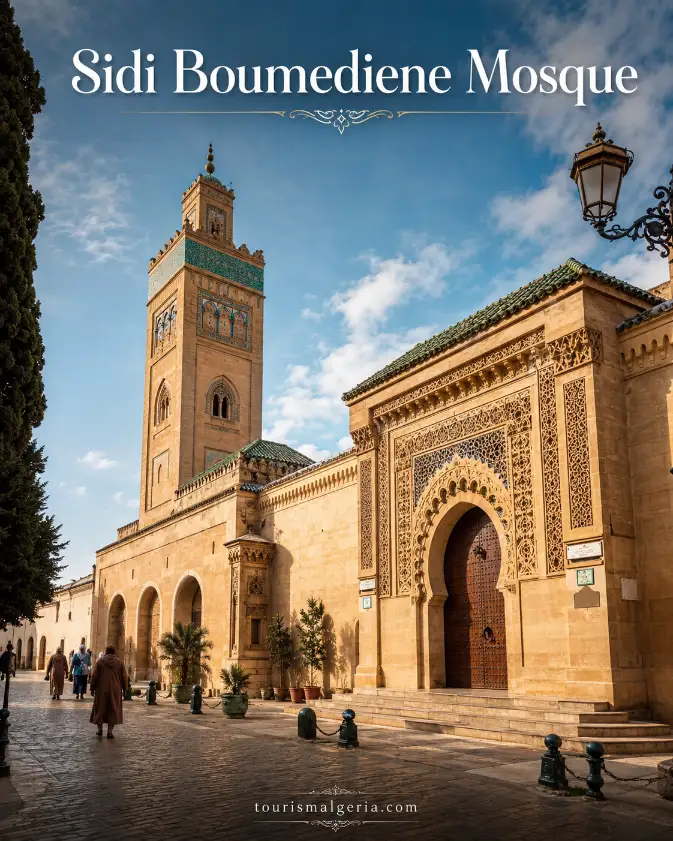
Sidi Boumediene Mosque in Tlemcen, Algeria
Sidi Boumediene Mosque in Tlemcen is a historic Marinid religious monument built in the fourteenth century beside the tomb of the celebrated Sufi scholar Abu Madyan. Located in El Eubbad, it forms part of a larger spiritual and educational complex protected as Algerian cultural heritage.
A Sacred Monument in El Eubbad
The mosque stands in El Eubbad, on the heights overlooking Tlemcen, where religious buildings, tombs, gardens and old residential structures create a distinctive historic landscape. Its elevated setting separates it from the denser city centre while keeping it closely connected to Tlemcen’s medieval cultural identity.
Sidi Boumediene Mosque in Tlemcen – Practical Visitor Information
Address, opening and visiting times, how to get there from central Tlemcen, mosque and mausoleum access, the historic madrasa, entrance information, architecture, dress code, photography and useful official contacts.
Who Was Sidi Boumediene?
Abu Madyan, known locally as Sidi Boumediene, was one of the most influential Sufi figures of the western Islamic world. Born in al-Andalus during the twelfth century, he travelled and studied extensively before becoming closely associated with North Africa and eventually with Tlemcen after his death.
The Saint’s Burial at Tlemcen
Historical sources generally place Abu Madyan’s death in 1198. He was buried at El Eubbad near Tlemcen, and his tomb quickly became an important pilgrimage destination. The later mosque, madrasa and related buildings developed around this sacred focus, creating a major religious complex.
Marinid Foundation of the Mosque
Algeria’s official cultural heritage map states that the mosque was built in 1339 by the Marinid sultan Abu al-Hasan Ali. It was constructed as an annex to the tomb of Sidi Boumediene, strengthening the religious prestige of an already important pilgrimage and scholarly site.
Official Algerian Cultural Heritage Map – Sidi Boumediene Mosque
A Larger Religious Complex
The Sidi Boumediene complex is larger than the mosque alone. Official Algerian heritage information identifies a madrasa dated to 1347, a small palace known as Dar es Sultan, a zawiya, a hammam, public latrines and buildings associated with pilgrims and religious administration.
Marinid Architecture in Tlemcen
The mosque represents Marinid architecture at one of its most refined moments in Tlemcen. Its layout combines an elaborate ceremonial entrance, a square courtyard, arcades, an ablution basin, a decorated prayer hall and a square minaret, creating a carefully ordered sequence from exterior approach to sacred interior.
The Monumental Entrance
The main portal is among the monument’s most impressive features. Visitors pass through a richly ornamented entrance framed by carved stucco, geometric decoration and tilework. The portal introduces the decorative vocabulary of the complex while clearly marking the transition from public street to religious space.
A Decorated Vestibule
Behind the monumental entrance lies a vestibule decorated with carved plaster and a muqarnas ceiling. This transitional space slows movement before the courtyard and demonstrates the sophistication of Marinid craftsmanship. Decorative surfaces combine geometry, vegetal motifs and calligraphy without overwhelming the architectural structure itself.
Cedarwood and Bronze Doors
Historic descriptions of the entrance mention cedarwood doors covered with engraved and chiselled bronze. Such doors were both functional and ceremonial, expressing status through material and workmanship. They also demonstrate the close relationship between carpentry, metalwork and architecture in medieval religious monuments of the Maghreb.
The Courtyard at the Heart of the Mosque
The square courtyard forms the spatial heart of the mosque. Arcades frame the open area, while a basin at the centre serves ablution and reinforces the visual balance of the composition. Sunlight, white surfaces, tiled roofs and patterned paving create a calm transition toward the prayer hall.
Water and Ablution
Water plays an important role within the courtyard. The central basin supports ritual purification while also introducing reflection and movement into the architectural composition. In a warm climate, open courtyards and water help create a more comfortable environment before worshippers enter the deeper shade of the prayer hall.
Inside the Prayer Hall
The prayer hall faces the main entrance across the courtyard and is organized by horseshoe arches supported by columns and piers. Its relatively intimate scale contrasts with the ceremonial entrance, directing attention toward the qibla wall, mihrab and intricate stucco decoration around the sacred focal area.
The Decorated Mihrab
The mihrab is one of the mosque’s most important artistic elements. Carved plaster, geometric forms, vegetal motifs and inscriptions frame the niche marking the direction of Mecca. The decoration demonstrates the close artistic connections linking medieval Tlemcen with Marinid Morocco and the wider western Islamic world.
Muqarnas and Architectural Detail
Muqarnas, the three-dimensional decorative system resembling clustered niches or stalactites, appears prominently within the mosque. It creates transitions between architectural surfaces while producing rich effects of light and shadow. At Sidi Boumediene, muqarnas contributes to the visual refinement of portals, ceilings and sacred interior spaces.
Calligraphy as Decoration
Arabic calligraphy is integrated into the mosque’s decorative programme rather than added as separate ornament. Inscriptions accompany geometric and vegetal designs, reinforcing the religious character of the building. Visitors interested in Islamic calligraphy can compare these architectural inscriptions with collections preserved in Tlemcen’s specialized museums.
The Square Minaret
The square minaret rises above the complex and provides one of its most recognizable external features. Archnet records a height of about twenty-seven and a half metres. Its brick construction, decorative panels and ceramic tilework connect it stylistically with other medieval minarets across the Maghreb.
Archnet – Complex of Sidi Boumediene
Geometric Brickwork and Tilework
The minaret’s geometric decoration demonstrates how relatively simple materials can produce elaborate visual effects. Brick patterns and ceramic accents animate the shaft, while the upper sections create a strong silhouette against the sky. From surrounding streets, the minaret identifies the religious complex from considerable distance.
The Tomb of Sidi Boumediene
The mosque is inseparable from the tomb of Sidi Boumediene nearby. The mausoleum predates the Marinid mosque and became the spiritual centre around which later buildings developed. Pilgrims came to honour the saint, making El Eubbad one of Tlemcen’s most significant devotional landscapes for centuries.
An Almohad Layer of History
Algerian heritage documentation states that the tomb was established around 1200 under the Almohad ruler Muhammad al-Nasir. It later underwent restoration, including twentieth-century work. The mausoleum therefore represents an earlier historical layer than the Marinid mosque that visitors see as the complex’s principal architectural monument.
A Living Place of Devotion
The tomb remains a place of religious significance rather than merely a historic exhibit. Visitors should therefore behave respectfully, particularly around people praying or making private devotions. Photography should never interfere with worship, and local instructions regarding access to the mausoleum should always be followed.
The Madrasa of Sidi Boumediene
The madrasa associated with Sidi Boumediene was built in 1347, according to Algeria’s official cultural heritage inventory. It formed part of a broader educational environment surrounding the sanctuary, where religious scholarship, teaching and accommodation supported the intellectual life that made medieval Tlemcen famous.
Scholarship and Ibn Khaldun
The complex is traditionally associated with major scholars, including Ibn Khaldun, whose name remains closely connected with Tlemcen’s intellectual history. Official Algerian heritage material links the madrasa with important scholars, illustrating how El Eubbad combined pilgrimage, worship, teaching and scholarly exchange within one religious landscape.
Dar es Sultan
Dar es Sultan, the small palace within the wider complex, reflects the relationship between political authority and religious patronage. Marinid rulers invested heavily in religious and educational architecture at Tlemcen, using monuments such as Sidi Boumediene to demonstrate piety, legitimacy and cultural influence beyond their own political territory.
The Zawiya
A zawiya also formed part of the complex, supporting devotional, educational and communal functions. Such institutions were important within North African religious life, especially around respected scholars and saints. At Sidi Boumediene, the zawiya strengthened the site’s role as a living centre rather than an isolated tomb.
Hammam and Pilgrim Services
The presence of a hammam, latrines and service buildings demonstrates how carefully the complex accommodated visitors. Pilgrimage required practical infrastructure as well as sacred architecture. Washing facilities, lodging arrangements and spaces for daily needs enabled worshippers and students to remain near the sanctuary for extended periods.
Protected Algerian Cultural Heritage
Algeria protects the Sidi Boumediene Mosque and its dependencies as national cultural heritage. The official inventory specifically includes the mosque, madrasas, mausoleum, public latrines, baths and buildings used by the guardian and pilgrims, recognizing the value of the entire ensemble rather than only one structure.
Algerian Ministry of Culture – Protected Cultural Heritage
Early Classification and Continuing Protection
The complex was historically classified among protected monuments under early heritage regulations, with its status later maintained within Algeria’s national legal framework. This protection reflects the architectural, religious and historical importance of El Eubbad and establishes controls intended to preserve its buildings and surrounding cultural landscape.
Several Periods in One Complex
Sidi Boumediene is particularly valuable because it preserves several historical periods in close proximity. The saint’s Almohad-era mausoleum, Marinid mosque and madrasa, later restorations and continuing religious use allow visitors to experience Tlemcen’s history as a sequence of connected layers rather than isolated dates.
Exploring El Eubbad
El Eubbad itself deserves attention beyond the main monument. The neighbourhood contains cemeteries, shrines and traditional buildings linked with Tlemcen’s religious history. Walking through the area helps visitors understand why Sidi Boumediene developed as part of a sacred landscape rather than as a standalone mosque.
Views over Tlemcen
The elevated position of El Eubbad provides broad views toward Tlemcen and surrounding countryside. The approach to the mosque therefore combines architecture with landscape, especially in morning or late-afternoon light. Visitors should allow time to explore nearby streets and viewpoints rather than arriving only for the prayer hall.
Photographing the Mosque
Photography is rewarding because the complex offers richly varied subjects, including the portal, courtyard, minaret, carved plaster, tilework and surrounding landscape. Soft light can reveal relief and texture particularly well, while strong midday sun produces dramatic contrasts beneath the arcades and around the monumental entrance.
Respecting an Active Place of Worship
Visitors should remember that Sidi Boumediene remains a functioning religious site. Modest clothing, quiet behaviour and respect for prayer times are appropriate. Shoes may need to be removed before entering prayer areas, and access to certain spaces can be restricted during services or special religious occasions.
Guidance for Non-Muslim Visitors
Non-Muslim visitors should follow current local guidance concerning interior access. Policies can vary according to the part of the complex, religious activities and local arrangements. Even when certain sacred spaces are unavailable, the exterior architecture, entrance, neighbourhood and broader El Eubbad heritage landscape remain rewarding to explore.
Combining Sidi Boumediene with Tlemcen
Sidi Boumediene can be combined with the historic centre of Tlemcen in a broader cultural itinerary. The Great Mosque, El Mechouar citadel, museums and other medieval religious monuments reveal different phases of Almoravid, Zayyanid and Marinid architecture within a relatively compact and historically rich city.
The Great Mosque of Tlemcen
The Great Mosque of Tlemcen provides an especially useful architectural comparison. Its Almoravid origins predate the Sidi Boumediene complex, allowing visitors to observe changes in religious architecture across several centuries. Together, the two monuments demonstrate Tlemcen’s exceptional importance within the artistic history of the western Maghreb.
El Mechouar and Royal Tlemcen
El Mechouar offers another complementary experience because it represents royal and political life rather than pilgrimage alone. Combining the palace complex with Sidi Boumediene helps explain how rulers, scholars, religious institutions and urban communities interacted during the periods when Tlemcen served as a major Maghrebi capital.
Best Season to Visit
Spring and autumn are generally comfortable seasons for exploring Tlemcen on foot, although conditions vary from year to year. El Eubbad involves slopes and steps, so supportive footwear is useful. Visitors should also carry water and sun protection when combining the sanctuary with a longer walking itinerary.
Check Current Access
Opening conditions can change because Sidi Boumediene is both a protected monument and an active religious complex. Travellers should verify current access locally before making a dedicated journey, especially if entering the prayer hall, mausoleum or madrasa is essential to their planned visit to Tlemcen.
Author and Update
This guide was written and updated on 29 August 2026 by Nabil Frik for TourismAlgeria.com. Before visiting Sidi Boumediene Mosque, travellers should verify current access, prayer arrangements and conservation conditions while respecting the complex as both an outstanding medieval monument and an active place of religious memory.