

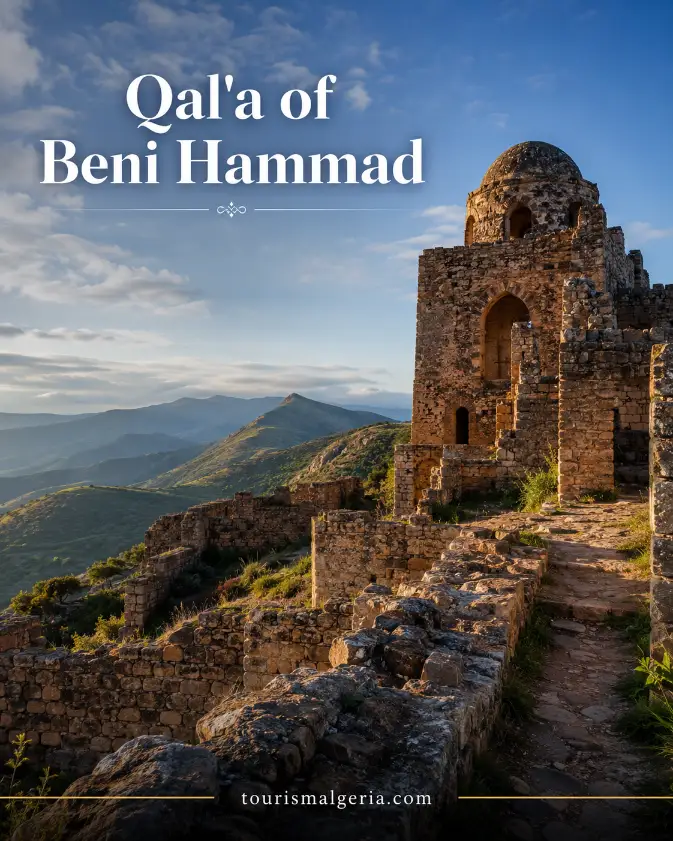
Visit Qal’a of Beni Hammad Ruins in Algeria
The Qal’a of Beni Hammad ruins in Algeria are the remains of a fortified medieval Islamic city, built in the mountains near Maadid in M’Sila Province, and recognised by UNESCO as the first capital of the Hammadid emirs.
Why Visit Qal’a of Beni Hammad
A visit to Qal’a of Beni Hammad is useful for travellers who want to discover Algeria beyond Roman ruins, because the site represents medieval Islamic architecture, Hammadid political power, mountain fortification and the early urban history of central North Africa.
Where Qal’a of Beni Hammad Is Located
The site is located about 36 kilometres north-east of M’Sila, at around 1,000 metres altitude, on the southern flank of Djebel Maâdid, in a mountainous setting that gives the ruins a strong visual and strategic character.
A Former Hammadid Capital
Qal’a of Beni Hammad was founded at the beginning of the 11th century by Hammad, son of Bologhine, and became the first capital of the Hammadid dynasty before being abandoned under the threat of Hilalian incursions.
Islamic Ruins Instead of Roman Ruins
Unlike Timgad, Djemila, Tipaza or Lambaesis, Qal’a of Beni Hammad is not mainly a Roman site, but a medieval Muslim fortified city, making it essential for understanding Algeria’s Islamic architectural and political heritage.
The UNESCO Importance of the Site
UNESCO describes Qal’a of Beni Hammad as an authentic picture of a fortified Muslim city, with important remains including its mosque, palaces and mountain setting, giving the site outstanding value within Algerian heritage.
Source: UNESCO World Heritage Centre.
What Visitors Can See at Qal’a of Beni Hammad
Visitors can see the remains of defensive walls, palace areas, the great mosque, the standing minaret, stone foundations, scattered architectural fragments and wide mountain views that help explain why the site was chosen as a fortified capital.
The Great Mosque and Minaret
The mosque is one of the most important remains at Qal’a of Beni Hammad, and UNESCO notes that its prayer hall had 13 aisles with eight bays, making it one of the largest mosque structures in Algeria.
Palaces and Fortified Urban Remains
The ruins include traces of palatial and urban structures that show how the Hammadid rulers created a political centre combining defence, residence, administration, religious life and prestige architecture in a difficult mountain environment.
Mountain Landscape and Defensive Position
The mountain setting is part of the experience, because the ruins are not isolated stones on flat land but the remains of a fortified city placed in a strategic highland landscape overlooking routes, valleys and natural barriers.
Qal’a of Beni Hammad as a Visit from M’Sila
Qal’a of Beni Hammad can be visited from M’Sila as a cultural excursion, and it fits well into an itinerary focused on medieval Algeria, Islamic architecture, mountain landscapes and lesser-known UNESCO World Heritage sites.
Best Time to Visit Qal’a of Beni Hammad
The best time to visit is usually spring or autumn, when temperatures are more comfortable for walking through open ruins, and the surrounding mountain landscape can be more pleasant for photography and slow exploration.
How Long to Spend at the Site
A focused visit can take one to two hours, but travellers interested in Islamic history, photography, ruins, mosque architecture and mountain scenery should allow more time to understand the layout and visual power of the site.
Practical Travel Tips
Visitors should wear comfortable walking shoes, bring water, avoid the hottest hours, check access conditions locally, consider a guide or knowledgeable driver, and remember that the site is historically rich but may require context to interpret well.
Main Highlights of Qal’a of Beni Hammad Ruins
- First Hammadid Capital
The site preserves the memory of the first capital of the Hammadid emirs, founded in the early 11th century in a strategic mountain location. - UNESCO World Heritage Site
Qal’a of Beni Hammad is a UNESCO-listed cultural site and one of Algeria’s most important medieval archaeological destinations. - Great Mosque Remains
The mosque remains are central to the visit because they show the religious and urban importance of the fortified city. - Standing Minaret
The minaret is the most recognisable visual landmark of the site and one of the strongest surviving symbols of Qal’a Beni Hammad. - Fortified City Walls
The defensive remains help visitors understand why the site was chosen as a protected political and military centre. - Palace Traces
Palace foundations reveal the prestige and organisation of Hammadid rule in central Algeria. - Mountain Setting of Djebel Maâdid
The landscape gives the ruins dramatic power and shows how architecture, defence and geography worked together. - Islamic Architecture in Algeria
The site is essential for travellers who want to discover Algeria’s Islamic-medieval heritage rather than only Roman antiquity. - Excursion from M’Sila
Its location near M’Sila makes it suitable for a heritage day trip for travellers exploring central Algeria. - Quiet Historical Experience
Qal’a of Beni Hammad is ideal for visitors seeking a less crowded but deeply important archaeological site with strong historical identity.
How to Use This Page Before Visiting Qal’a of Beni Hammad
Travellers should use this guide to plan transport from M’Sila or nearby towns, prepare for mountain conditions, prioritise the mosque, minaret, walls and palace traces, and understand why Qal’a of Beni Hammad is one of Algeria’s most important Islamic heritage sites.
Algeria trip planer 3 days, 5 days, 7 days
Hotels Comparator in Algeria
Algiers-Kasbah english speaking guide
Algeria Ferries
Algerie Car Rental
Sahara Desert Hotels in Algeria
Algeria Visa Application
Casbah of Algiers
Algiers Church of Notre-Dame d’Afrique
Makam El Chahid
Timgad
Djemila
Tipaza Roman Ruins
Royal Mausoleum of Mauritania
Tiddis
Hippo Regius (Annaba) ruins
Lambaesis
Qal’a of Beni Hammad